Chapter 3 Mechanical Adjustments Page 3-8
Table 3-1: Labeler Connector Panel Functions
Connector Function
Output Provides output signals (stop relay uses pins 1 and 2). Requires Connector
(614125), contacts (614108), and cable clamp (614126).
Product Connection for Photocue sensor (Reflective, Through-Beam, or Diffuse).
Jam Connection for Jam switch
Inhibit Used for future designs
Comm Used for future designs
Power Incoming Power (115 VAC)
Encoder Connection for Encoder sensor
Photo F/B Used on the BK730 base (for front and back Through-Beam sensors)
Tab Connection for Tab Sensor in the Peel Point
Keypad Connection for the Labeler Keypad
Controller I/O Connection for Labelers mounted on a BK7IB
Note: The Product and Photo F/B cables cannot be connected simultaneously. One of
these inputs is used in order to trigger the presence of materials on the transport
base whether it is a BK730A-2 or third party equipment.
3.3 Wide Labeler Guidelines (BK731-2WL & UBK-731-WL)
This section provides guidelines for applying labels with backer materials up to 5” (127
mm) onto mail substrates such as envelopes and magazines. These tips apply for all Wide
Label Systems including normal BK731-2 labeling heads that have been upgraded in the
field via the UBK-731-WL field upgrade kit.
3.3.1 Importance of the Right & Left Side Guides
One of the critical requirements for Wide Label Tabber applications is to ensure that the
mail piece or magazine being labeled does not skew in any direction before the label is
applied. If the substrate does approach the Wide Label Peel Point Assembly (p/n
9103815A) at an angle, the applied label will also have a skew angle and its edges will not
be parallel to that of the substrate. Furthermore, if each piece is transported with slightly
different angles, there will be a significant piece-to-piece drift for the applied label
position. This is due to the fact that the signal that determines when the label application
process should begin is based on lead edge detection of mail pieces. Different angles with
respect to the Right and Left Side Guides (p/n 212430 and 212431) for transported mail
pieces can delay or accelerate detection of the physical mail piece resulting in inconsistent
label positioning.
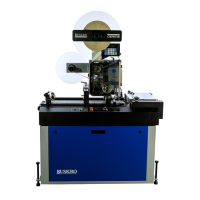
Buskro Ltd. BK730-2 Tabber


 To Next Page