Product Description 17
Characteristics
Following are the important characteristics of 60 GHz cnWave products:
l High throughput capability
With the multi-gigabit channel bandwidth, it is possible to gain multi-gigabit capacity. Based on
802.11ad, it is possible to get a 5 Gbps PHY rate. With 802.11ay, it is possible to get a 10 Gbps PHY
rate. 60 GHz cnWave products are capable of providing 15 Gbps Ethernet rates with channel
bonding enabled. For channel bonding (CB2), MCS13 is supported and this has a PHY rate of 7.7
Gbps.
l Unlicensed and interference free
Typically, the V band is either an unlicensed or lightly licensed band, which is relatively a new
band. This band has limited interference when compared to 2.4 and 5 GHz bands.
l Line of Sight (LoS)
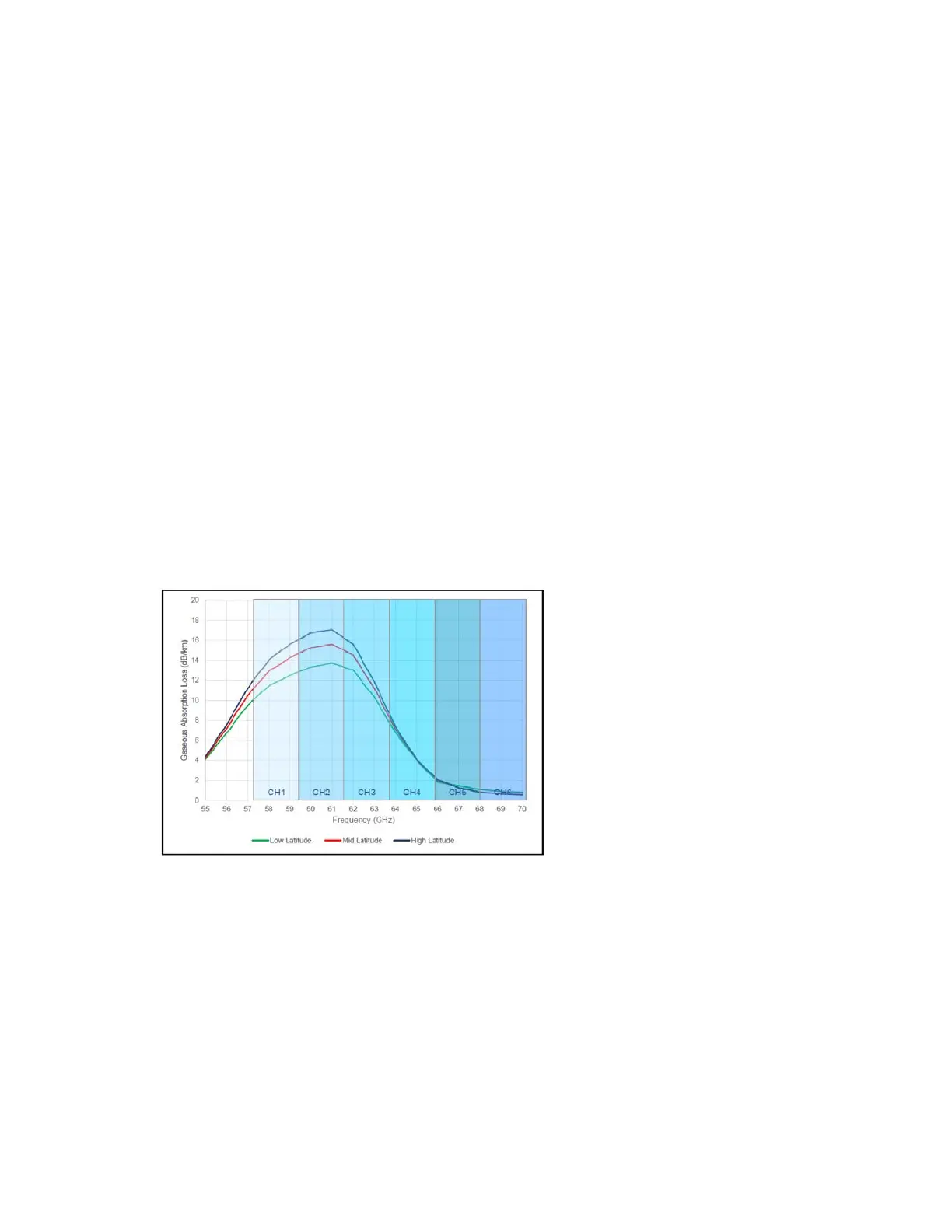
60 GHz is affected by oxygen absorption, it varies throughout the band. The absorption gets
reduced if the frequency gets increased. For example, the absorption is 15 dB/km in 60 GHz
frequency, 5 dB/km in 64 GHz, and 0.5 dB/km in 68 GHz. If the total channel is divided into 6
channels, then the mid-channel that is channels 2 and 3 has more absorption loss. From channel 4,
the absorption level starts to drop. So only Line of Sight links are available and Near LoS or non
LoS links do not work with 60 GHz.
Figure 2:
Line of Sight
l Rain fade
You can view significant rain fade for 60 GHz links, particularly those pushing the longer distances.
Attenuation depends on the rain rate which must be factored in while planning the network. Rain
attenuation depends on the level of the rain. The following table describes the rain level and
absorption loss.



 To Next Page