
 Need help?
Do you have a question about the Cambium Networks cnWave and is the answer not in the manual?
Explains the document's intent for operation, installation, and maintenance personnel.
Describes how references are shown and the document's chapter/section organization.
Instructions on how users can submit feedback on document content and accuracy.
Covers key regulatory details and compliance with country-specific rules.
Instructions for downloading and installing product firmware before deployment.
Details the necessary skills for configuring IP addressing and using the web UI.
Provides guidelines for protecting outdoor installations from lightning strikes.
Outlines the radio engineering skills and training required for installers.
References to end-user license agreements and open-source software notices.
Procedures for reporting problems and details on hardware warranty.
Recommendations for setting security parameters based on industry practices.
Explains the document's conventions for warnings, cautions, and notes.
Information on disposal requirements and environmental regulations in EU/UK and non-EU.
Overview of the 60 GHz cnWave product, its spectrum, and capabilities.
Details on the 60 GHz frequency band division into channels and bandwidths.
Key features including high throughput, unlicensed band, Line of Sight (LoS), and rain fade.
Benefits of the 802.11ay standard, including channel bonding and synchronization.
Introduction to Terragraph as a connectivity solution and its key components.
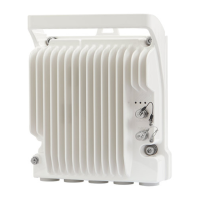
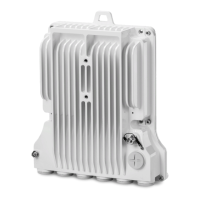
Description of the 60 GHz cnWave family, including Distribution and Client Nodes.
Detailed features for each product variant like V1000, V2000, V3000, and V5000.
Details on supported network topologies: Point-to-Point (PTP), Point-to-Multipoint (PMP), and Mesh.
Tables detailing modulation and coding rates for CB1 and CB2 throughput.
Explanation of how link parameters are adjusted based on signal quality.
How transmit and receive signals are synchronized to prevent self-interference.
Details on the TDD channel access mechanism and MAC layer operation.
Describes optional encryption algorithms for secure data transmission.
Introduction to the management system, including web interface and agents.
Details on using cnMaestro as a central management system for Cambium products.
Information on IPv6 addressing, system logging, and software upgrades.
Information about the hardware components, including wireless nodes.
Selection guide for optimal mounting brackets based on ODU type and mounting choice.
Information on required radio accessories like telescope mounting kits and alignment tubes.
Description of external interfaces for V1000, V2000, V3000, and V5000 units.
Technical specifications including dimensions, weight, temperature, and power consumption.
Explanation of the 60 GHz cnWave system's operation using Terragraph technology.
Details on available PSUs, including part numbers and specifications.
Information on Ethernet/DC cables, cable lengths, and required accessories.
Details on SFP modules for network connectivity and Direct Attach Copper cables.
Factors for planning site, grounding, lightning protection, and ODU location.
Key guidelines for deployment, including alignment, spacing, and interference avoidance.
General wireless specifications and radio spectrum planning details.
Considerations for planning links, including range, obstacles, and path loss.
Planning for 60 GHz cnWave data networks, including topology and routing protocols.
Methods for designing networks that support both IPv4 and IPv6 traffic.
Details on Layer 2 Ethernet bridging using EoGRE for customer traffic.
Supported 802.1Q features per port for VLAN tagging and management.
Critical safety warnings and guidelines for installation personnel.
Procedures for grounding equipment to protect against lightning and surges.
Guidelines for radio placement and selection of appropriate mounting brackets.
Step-by-step installation guides for V1000, V2000, V3000, and V5000 units.
Connecting ODUs to LPUs on poles for lightning protection.
Steps for securely fastening ground cables to the radio unit.
Detailed procedures for mounting ODUs using various bracket options.
Instructions for connecting the PSU port to the radio using Ethernet or PoE.
Guidance on installing different types of PSUs, including DC power injectors.
Procedures for connecting SFP optical or copper modules to the ODU.
Steps for safely removing cables and SFP modules from the ODU.
Automatic node configuration via E2E service and manual PoP node setup.
Procedure to connect the unit to a management PC and power it up.
Steps for logging into the 60 GHz cnWave web interface.
Explanation of dashboard elements like Uptime, Links, Channels, and Throughput.
Steps to enable and configure the internal E2E Controller.
Adding sites, nodes, and links to establish network connections in Topology.
Configuration options for network settings including Basic, Management, Security, Advanced.
Configuration settings for individual nodes, including Radio and Networking tabs.
Enabling DHCP Option 82 for intercepting DHCPv4 packets.
Feature to monitor PoP interface status and manage tunnels.
Configuring external failover for PTP links using device or cnMaestro UI.
Supported 802.1Q features for Data VLANs, including Port Types and Remarking.
Settings for wireless security, RADIUS server, and user passwords.
Steps for upgrading node software and managing software images.
Accessing and utilizing tools for diagnostics like Events, DA Logs, and Engineering Logs.
Viewing statistical data and performance graphs for links, Ethernet, GPS, and Radio.
Assists in optimizing radio alignment for optimal performance.
Retrieves SFP power details using remote commands or CLI.
Information on using the Ping tool for checking network reachability.
A simple tool for quickly creating Point-to-Point links.
Managing onboard controllers via cnMaestro for network management.
Automates IPv6 route management for E2E Controller in single and multi-PoP networks.
Configuration parameter to manage isolated PoPs during network build.
Lists safety specifications for the 60 GHz cnWave platform family.
Details electrical safety compliance specifications for the hardware.
Lists EMC type approvals granted for the 60 GHz cnWave platform family.
Standards applicable to human exposure to RF energy and exposure limits.
Information on applicable FCC power density exposure limits for the 57-66 GHz bands.
Recommended separation distances and compliance margins for safe operation.
How the platform complies with radio regulations in various countries.
System technical regulation compliance and granted type approvals.
Information regarding compliance with Innovation, Science and Economic Development Canada regulations.
Details on FCC compliance and notifications, including interference rules.
Downloading logs to view more information about errors.
Steps to resolve setup issues encountered during IPv4 tunneling.
Troubleshooting steps when a link is not established between nodes.
Resolving issues where PoP nodes are not communicating with E2E or cnMaestro.
Troubleshooting steps when links fail to establish or remain operational.
Addressing problems related to suboptimal throughput performance.
Steps to reset the device configuration to factory default settings.
 General
| Brand | Cambium Networks |
|---|---|
| Model | cnWave |
| Category | Network Hardware |
| Language | English |



 To Next Page