System Planning 80
Avoiding the tight angle deployment
Avoid tight P2MP angles in the deployment for the following reasons:
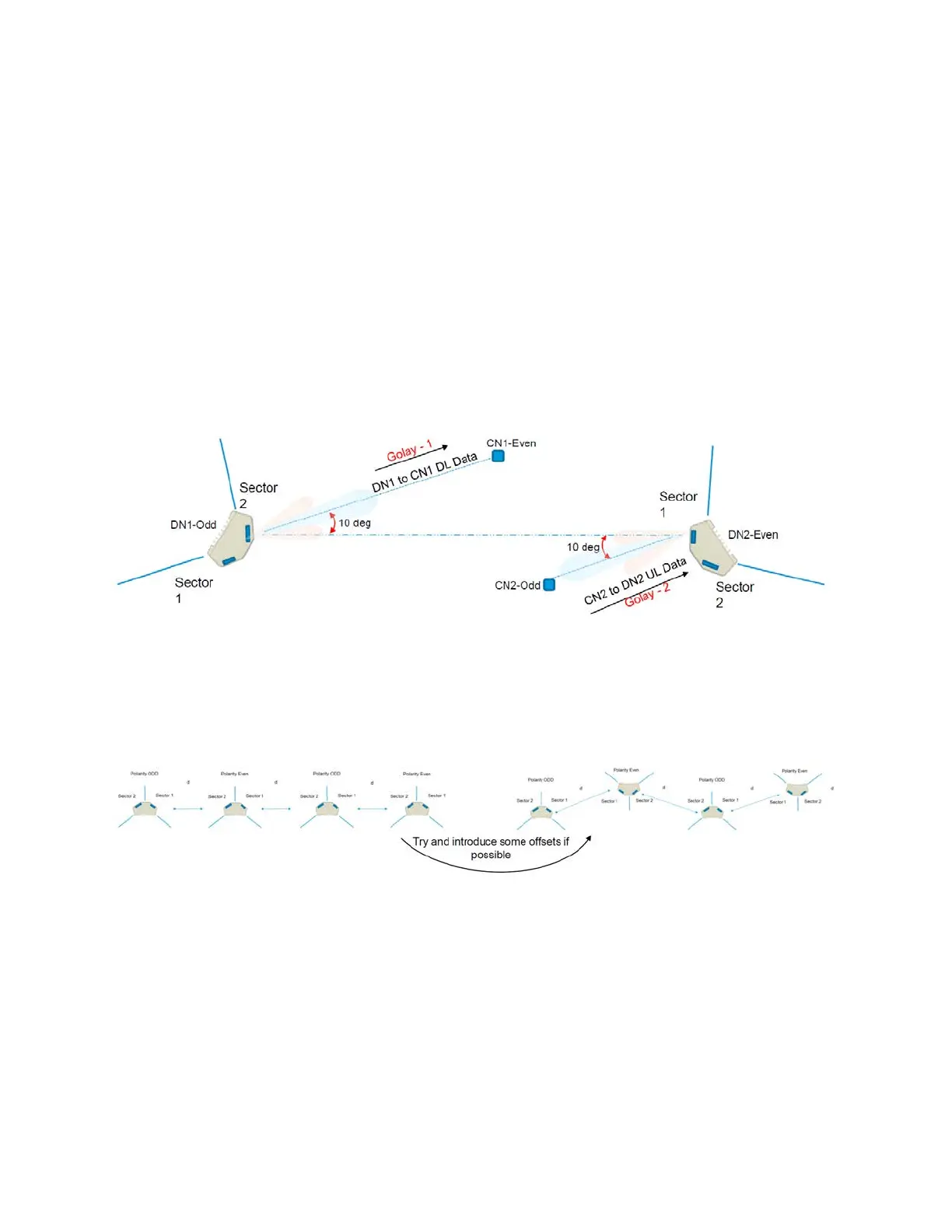
l In Figure 54 (shown as an example), a downlink data transmission from the DN1 to CN1 can
interfere with the uplink data reception at CN2 to DN2. This interference can be both down to main
lobe in very tight angles or sidelobes with up to 20 degrees delta between two CNs.
l The level of interference depends on the link distances between DN1->CN1 versus DN->DN2 versus
CN2->DN2.
l In most cases, the main interference is due to the early weak interference.
l To mitigate this early-weak interference, different Golay code assignment could be used. This
issue only relates to the two links transmitting at the same time in the same physical direction.
Figure 54:
Tight angle deployment
Avoiding the straight line interference
It is recommended to avoid the straight line interference. When the desired link and interference link
angles are the same, there is no assistance from the beamforming interference suppression.
Figure 55:
Representation of straight line interference
It is recommended to assign appropriate Golay codes to mitigate early-weak interference. In Figure 56,
the red and orange arrows show the possible weak interference. The code assignment must be in the
form of 2-2-1-1 or 1-1-2-2 but not in the 1-2-1-2 form.




 To Next Page