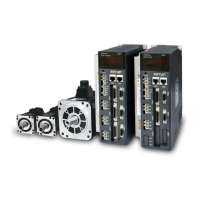
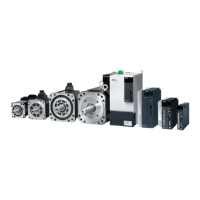
Summa Series Servodrive Product Manual
Document Version: V1.01
(Dec, 2019)
© 2019 ESTUN Automation Co., Ltd. All right reserved.
Statusword (6041h)
Position Actual Value (6064h)
Torque Actual Value (6077h)
Controlword (6040h)
Target Position (607Ah)
Touch Probe Function (60B8h)
Statusword (6041h)
Position Actual Value (6064h)
Torque Actual Value (6077h)
Following Error Actual Value (60F4h)
Touch probe status (60B9h)
Touch probe pos1 pos value (60BAh)
Touch probe pos2 pos value (60BCh)
Physical Inputs (60FDh)
5.3.5 Service Data Object (SDO)
SDO is used to transfer non-cyclic data, such as communication parameter configuration, and Servo
running parameter configuration. The CoE service type includes Emergency Message, SDO request and
SDO response.
5.3.6 Emergency Message
When an alarm occurs in the Drive, the CoE service can trigger an emergency message to inform the user
of the error code.
An emergency message consists of eight bytes of data as shown in the following description.
Emergency Message Structure
Mailbox Header CoE Header Error Code Error Register Data
Data frame header CANopen emergency message
6 bytes 2 bytes 2 bytes 1 bytes 5 bytes
NOTE: Byte4 and Byte5 are the alarm numbers of the Drive, and the alarm number is a hexadecimal value.
5.3.7 Distributed Clock (DC)
The synchronization of EtherCAT communications is based on a mechanism called a distributed clock.
With the distributed clock, all devices are synchronized with each other by sharing the same reference
clock. The slave devices synchronize the internal applications to the Sync0 events that are generated
according to the reference clock.
You can use the following synchronization modes with EtherCAT (CoE). You can change the
synchronization mode in the Sync Control registers (ESC registers 0x980 and 0x981).


 To Next Page
 Loading...