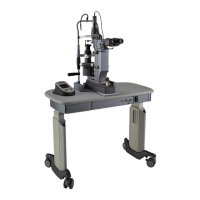
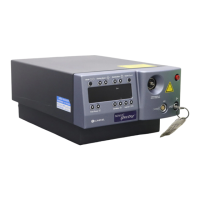
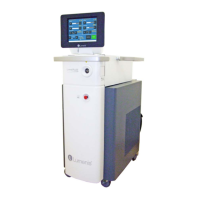
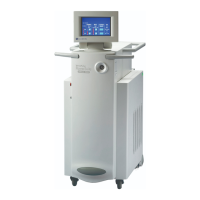
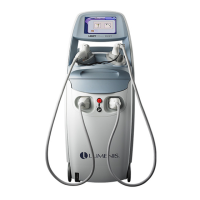
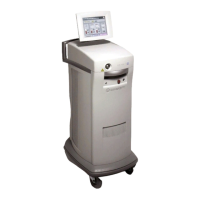
Smart532
™
Clinical Guide
UM-1151440EN, Rev. C, May 2016 A-27
Note
Users should be aware of the general laser warnings, precautions,
and adverse effects out-lined in the General Information section in
this chapter, as well as the warnings, precautions, and
contraindications specific to ophthalmic procedures.
The LIO is used for treatment of retinal lesions in the peripheral fundus,
anterior to the equator. Other uses include extending pan-retinal
photocoagulation further anterior than can conveniently be reached with a
conventional slit lamp laser photocoagulator, retinal photocoagulation in
patients with media opacities where conventional photocoagulation with a
slit lamp is difficult or impossible, and treatment of patients limited to the
supine position.
● Precautions pertaining to laser safety should be carefully observed:
requiring the wear of laser safety goggles by all individuals present in
the room, posting warning signs at all entrances to the area where the
laser is being used, and using only nonflammable drapes and
anesthetics.
● The LIO should be carefully inspected before each use to be sure that
it is not damaged.
● The LIO can be configured at the factory for use with a Lumenis argon
laser, krypton laser, or diode-green (Smart532) laser. Only the filter
material and electrical characteristics differ.
● The LIO consists of an indirect ophthalmoscope that has been
modified with a fixed laser safety filter and a lens system to focus the
laser beam.
● Like an unmodified indirect ophthalmoscope, the LIO is mounted on a
headband. The LIO is connected to the laser by a fiber-optic which is
plugged into the laser in the same way that any Lumenis fiber-optic is
connected to the laser.
● The LIO is designed to conveniently deliver laser energy to the far
periphery of the fundus. With the indirect ophthalmoscope, the doctor
has a clearer view of the areas of the fundus which are anterior to the
equator of the eye than can be obtained using a slit lamp.
● Another advantage is the ability to position the patient to take
advantage of gas bubbles that are injected into the eye during
pneumatic retinopexy to force the retina into the proper position (so
that it is resting against the choroid). If the laser treatment can be
performed when the retina is in this position, the retina can be attached
using the laser and may be less likely to detach again. If the patient can
be positioned so that the retina can be treated without the laser beam
Ophthalmoscope
(LIO)
Use


 To Next Page