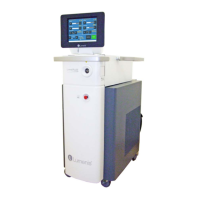
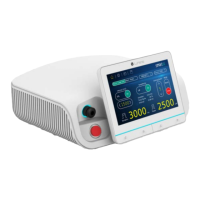
Smart532
™
Clinical Guide
UM-1151440EN, Rev. C, May 2016 A-3
Delivery of laser energy is occasionally associated with pain or
discomfort. During the procedure, pain may be reduced by topical
anesthesia or retrobulbar block. The extent and duration of pain following
laser therapy are usually minimal.
The possibility of infection must be considered and treated accordingly,
especially when laser energy is delivered via endoprobes.
The possibility of postoperative bleeding must be considered, and post-
operative follow-up is advised. Laser irradiation may cause the regression
newly formed vessels, thereby producing vitreous and subhyaloid
hemorrhage. If laser application is applied close to the macula and with
high power setting, there is a risk of disrupting the pigment epithelium and
compromising the Bruch’s membrane, thereby giving rise to foci of
choroidal neovascularization which can bleed
4,5
.
In some cases, extensive photocoagulation may cause a reduction in visual
acuity secondary to macular edema, a reduction in peripheral vision, a
reduction in the power of accommodation, loss of color vision (especially
in the blue spectrum), loss of contrast sensitivity, a scotoma or
photophobia
6,7,8
. Visual function may also be compromised by inadvertent
delivery of laser energy to the fovea and parafoveal areas.
Tissue effect may be controlled by altering the distance between hand-held
fiber-optic delivery devices and the target tissue.
Once the treatment is completed, routine post-operative care is indicated
according to the procedure done.
All recommendations for safe use of your laser system should be followed.
Users should be aware of the recommended practices for the safe use of
4
A. Obana, B. Lorenz, A. Gassler and R. Birngruber, "The therapeutic range of
chorioretinal photocoagulation with diode and argon lasers: an experimental
comparison," Lasers Light Ophthalmol., vol. 4, pp. 147-56, 2009.
5
P. Romero-Aroca, J. Reyes-Torres, M. Baget-Bernaldiz and C. Blasco-Suñe,
"Laser treatment for diabetic macular edema in the 21st century," Curr. Diabetes
Rev., vol. 10, no. 2, pp. 100-12, 2014.
6
H. McDonald and H. Schatz, "Visual loss following panretinal photocoagulation
for proliferative diabetic retinopathy," Ophthalmology, vol. 92, pp. 388-93, 1985.
7
J. Evans, M. Michelessi and G. Virgili, "Laser photocoagulation for proliferative
diabetic retinopathy," Cochrane Database Syst. Rev., 2014doi:10.1002/14651858.
CD011234.pub2.
8
F. P. A. Bandello, M. Del Borrello, N. Zemella and M. Isola, "“Light” versus
“classic” laser treatment for clinically significant diabetic macular oedema.," Br J
Ophthalmol, vol. 89, no. 7, pp. 864-70, 2005.
Free-Beam
Devices


 To Next Page