UM-1151140EN, Rev. C, May 2016
Laser
Safety
and
Regulatory
2.3. Laser Safety
Eyewear
Laser safety eyewear is routinely required with most lasers. When using
the laser system, the Laser Safety Officer should determine the need for
safety eyewear based on the Maximum Permissible Exposure (MPE),
Nominal Hazard Zone (NHZ), the Nominal Ocular Hazard Distance
(NOHD), and the optical density (OD) for each of the available laser
emissions and the configuration of the treatment room (usually within the
controlled area). For additional information, refer to ANSI Z136.1-2014,
ANSI Z136.3-2011, or International Standard IEC 60825-1: 2014.
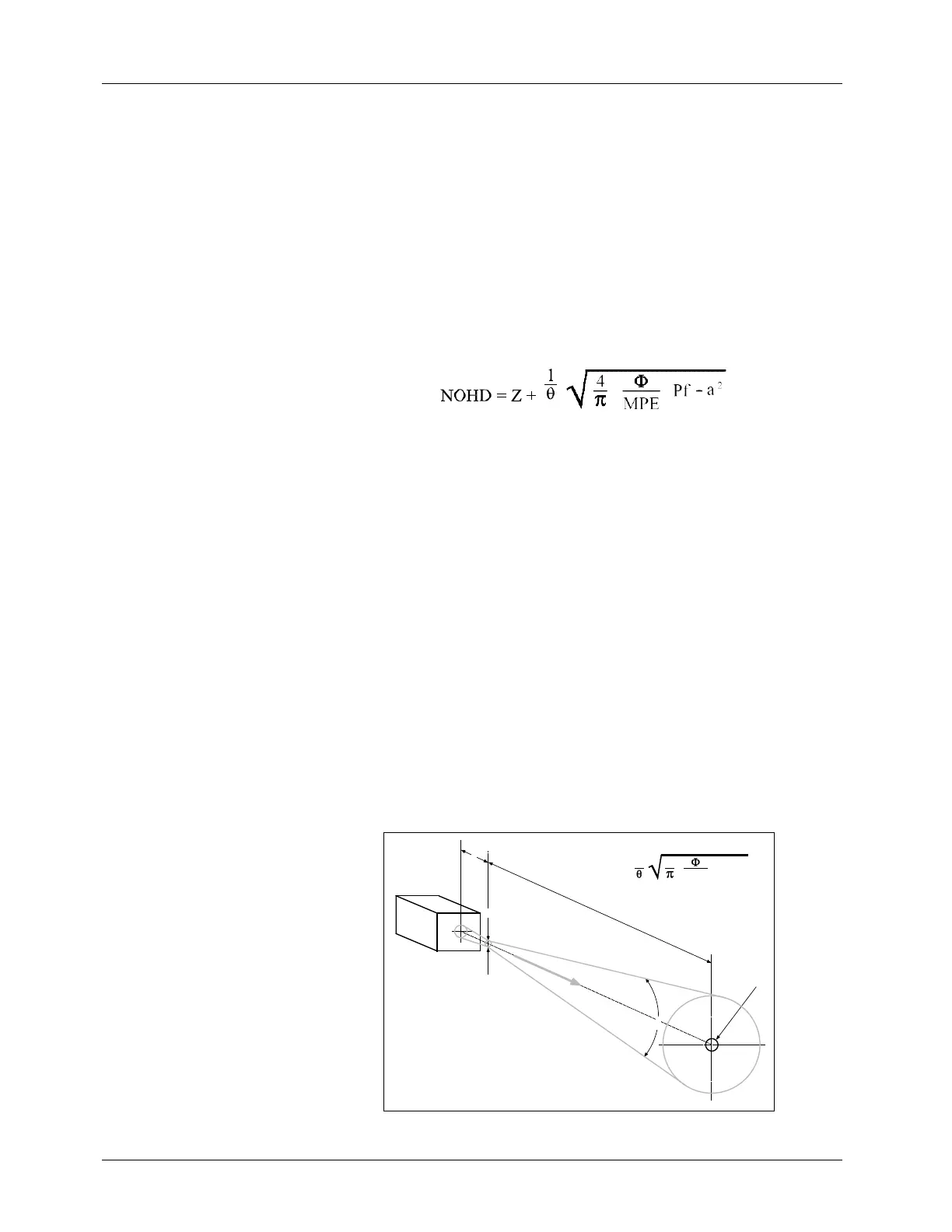
The following formula was used to calculate the worst case NOHD for
Lumenis Smart532 lasers and compatible delivery systems:
Where:
Z = the distance of the beam waist from the laser system;
a = the beam waist diameter (1/e
2
of axial irradiance for Gaussian
beam);
θ = minimum full angle beam divergence (1/e
2
of axial irradiance for
Gaussian beam);
e ≈ 2.7182818285, the base of natural logarithms;
Ф = maximum energy of one laser pulse or maximum CW laser power;
Pf = the profile correction factor (1 for uniform profile or 2 for
Gaussian irradiance);
MPE = Maximum Permissible Exposure, in energy density units (energy
per unit area), or power density units (power per unit area);
NOHD = the Nominal Ocular Hazard Distance (measured from
laser aperture;
= the distance required to reduce the energy density or power
density to the MPE.
Z
a
θ
NOHD = Z + Pf
- a
2
1 4
MPE
Laser System


 To Next Page