HandKey II Installation and Operation Manual
Revision 2.0 Page 129
Glossary
Address, IP – An Internet Protocol address is a unique address assigned to a computer
for communicating over the Internet. It is made up of 4 sets of numbers,
separated by periods (for example, 123.245.78.901).
Address, Reader – A Hand Reader Address is a unique identification number assigned
to a Hand Reader. Each Hand Reader on a network must be assigned a unique
address.
AWG – American Wire Gauge is a U.S. standard set of wire conductor sizes. The
“gauge” refers to the diameter of the wire. The higher the gauge number, the
smaller the diameter, the thinner the wire, and the greater the electrical
resistance. Thicker, smaller gauge wire carries more current because it has less
electrical resistance over a given length. Thicker wire is better for long wire
distances.
Card Reader Emulation Mode – In Card Reader Emulation Mode, the Hand Reader
outputs hand read data in a card reader format, typically to an access control
panel. The data is outputted when user’s hand is successfully read. This mode
is commonly used when a Hand Reader is being added to an existing access
control network. By configuring the Hand Reader in card emulation mode, it
can easily replace an existing access control reader in the network. The Hand
Reader can be configured to output data in a variety of card reader formats –
such as Wiegand, ABA Track-II magnetic stripe, or bar code.
Daisy-Chain – A Daisy-Chain is a method of wiring together Hand Readers on a
network, where the first Hand Reader is connected to the second Hand Reader,
which is connected to the third Hand Reader, and so on until the last Hand
Reader is reached.
End-of-Line (EOL) Termination – EOL Termination is a set of resistors attached to the
data lines at the last Hand Reader physically connected to a network. These
resistors prevent data signal distortion and reflection back across the data lines,
improving the integrity of the network connection.
IP Address – see Address, IP
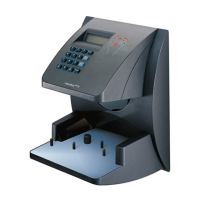
Platen – The Platen is the flat surface at the base of the HandKey, on which a user
places his/her hand for enrollment and verification. The platen has guide pins
to ensure the user’s fingers are consistently positioned correctly.
Reader Address – see Address, Reader
Template – A Template is a set of data generated for a user. It is made up of the user’s
enrollment information and any system configuration parameters that are
assigned to the user. The template is stored at each Hand Reader and can be
stored at a host computer when the HandNet™ for Windows™ software is
used.


 To Next Page