Installation manual
HB-37420-810-01-25F-EN PSC1-C-100 Installation manual - V2.2.docx Page 174 of 201
Version: 38F
12.3 Steps required for designing, realisation and testing
The realisation of parts of systems with a safety-related function requires particular care during
planning, realisation and testing. Guidelines on these issues are also given in the applicable
standards (cf. EN ISO 13849-2 or EN ISO 61508). The effort here depends on the complexity
of the task for parts of the system with a safety-related function.
For the realisation of such functions with the aid of safety-related control and monitoring
functions, the PSC1 series offers efficient support in the form of the system architecture
(architecture cat. 4 according to EN ISO 13849-1) and above all also the programming
language and tested safety functions. Programming is in the form of FUP (function plan-
orientated programming) as recommended in the safety standards. It also corresponds to the
requirements on a limited variability programming language (LVL) for which significant
simplifications in the documentation and test scope apply.
In any case the individual steps require careful planning and analysis of the methods and
systems used. The individual steps are also to be documented so they are clearly traceable.
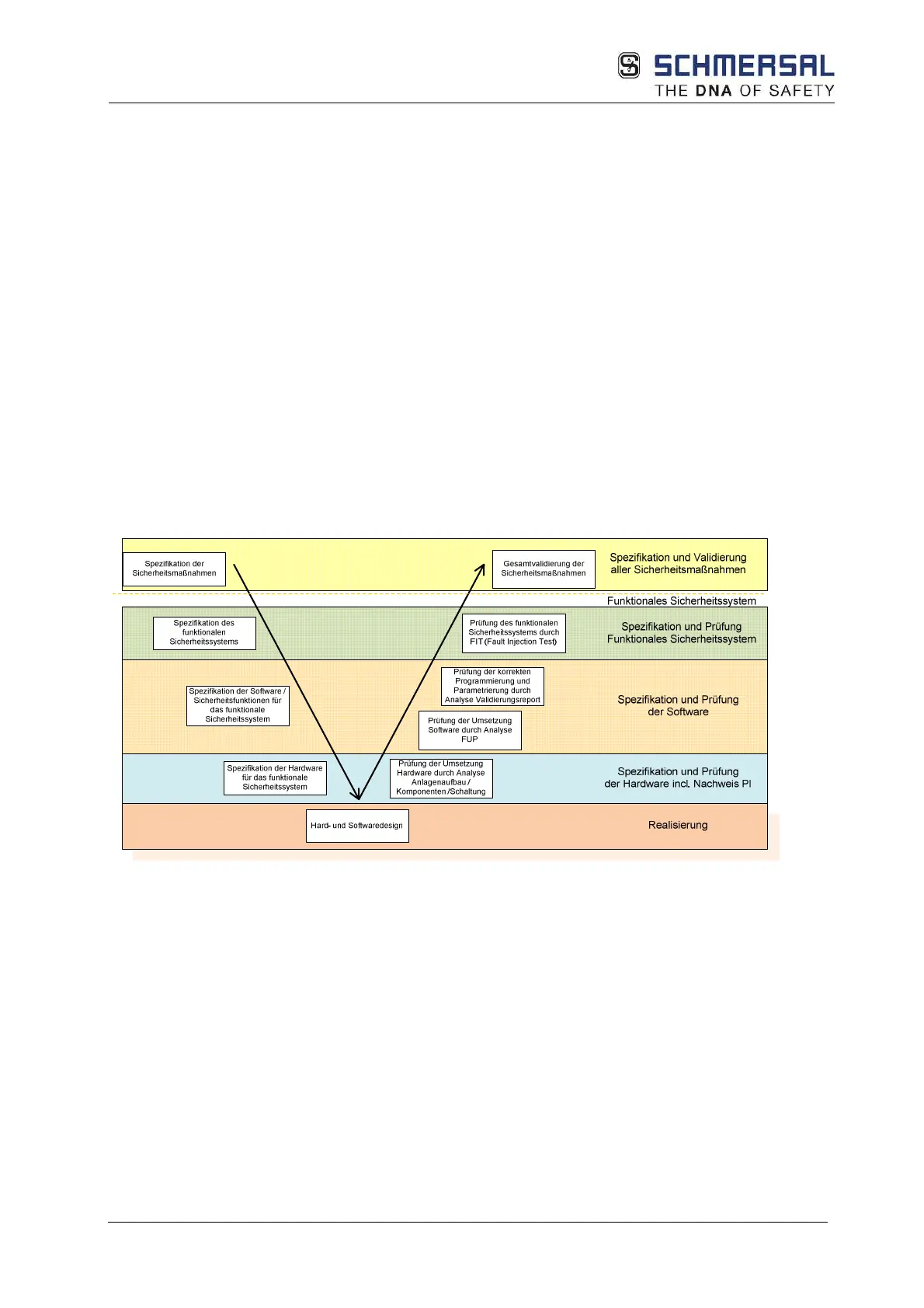
V model (simplified):
The implementation of safety-related functions requires a structured procedure as is shown,
for example, in the V model recommended in applicable standards. In the following as an
example the procedure for applications with modules from the PSC1 series is shown.


 To Next Page