7. PREPARING THE MA T ER I AL
FOR STERILIZATION
34. .
7. PREPARING
MATERIAL FOR
STERILIZATION
Clean and rinse all instruments before loading them into the sterilizer. Disinfectant residues
and solid debris may inhibit sterilization and damage the instruments and the Bravo.
Unwrapped instruments, once exposed to ambient or external conditions, cannot be
maintained in a sterile state. If sterile storage is desired, wrap the instruments to be sterilized
according to the instrument manufacturer’s instructions, select the appropriate wrapped cycle
and allow it to run to completion.
USER SHOULD USE ONLY STERILIZATION WRAPS THAT HAVE BEEN CLEARED FOR THEIR
MARKET. FOR U.S. CUSTOMERS, USE ONLY STERILIZATION WRAPS THAT HAVE BEEN
CLEARED BY FDA FOR THE STERILIZATION PROGRAM CHOSEN.
To promote drying and enable effective sterilization, wrapped or pouched instruments must not
touch each other.
SciCan recommends the final user carefully choose the most appropriate sterilization cycle
according to the recommendations of their leading infection control authorities and local
regulatory guidelines / recommendations.
PLEASE REFER TO THE APPENDIX B - PROGRAMS (Introduction) FOR
THE LIST OF COMPATIBLE MATERIALS WITH THE STERILIZER.
TREATING TEXTILE
MATERIAL
BEFORE
STERILIZATION
With regards to textile material (or porous materials in general), such as smocks, napkins,
caps and other, carefully wash and then dry these before they are treated in the autoclave.
DO NOT USE DETERGENTS WITH A HIGH CONTENT OF CHLORINE AND/OR PHOSPHATES.
DO NOT BLEACH WITH CHLORINE-BASED PRODUCTS. THESE SUBSTANCES CAN D AM AG E
THE TRAY SUPPORTS, T R AYS AN D AN Y ME T AL INSTRUMENTS THAT MAY BE PRESENT IN
THE STERILIZATION CHAM B ER .
ARRANGING THE
LOAD
To ensure proper sterilization and to reduce wear on instruments, follow the instructions
below:
General notes for positioning on trays.
– Arrange instruments made of different metals (stainless steel, tempered steel, aluminum,
etc.) on different trays or keep them well separated from each other.
– For instruments not made of stainless steel, place a paper sterilization napkin or a muslin
cloth between the tray and the tool to avoid direct contact between these two different
materials.
– Always arrange objects with some distance between them and so that they will remain so
for the entire sterilization cycle.
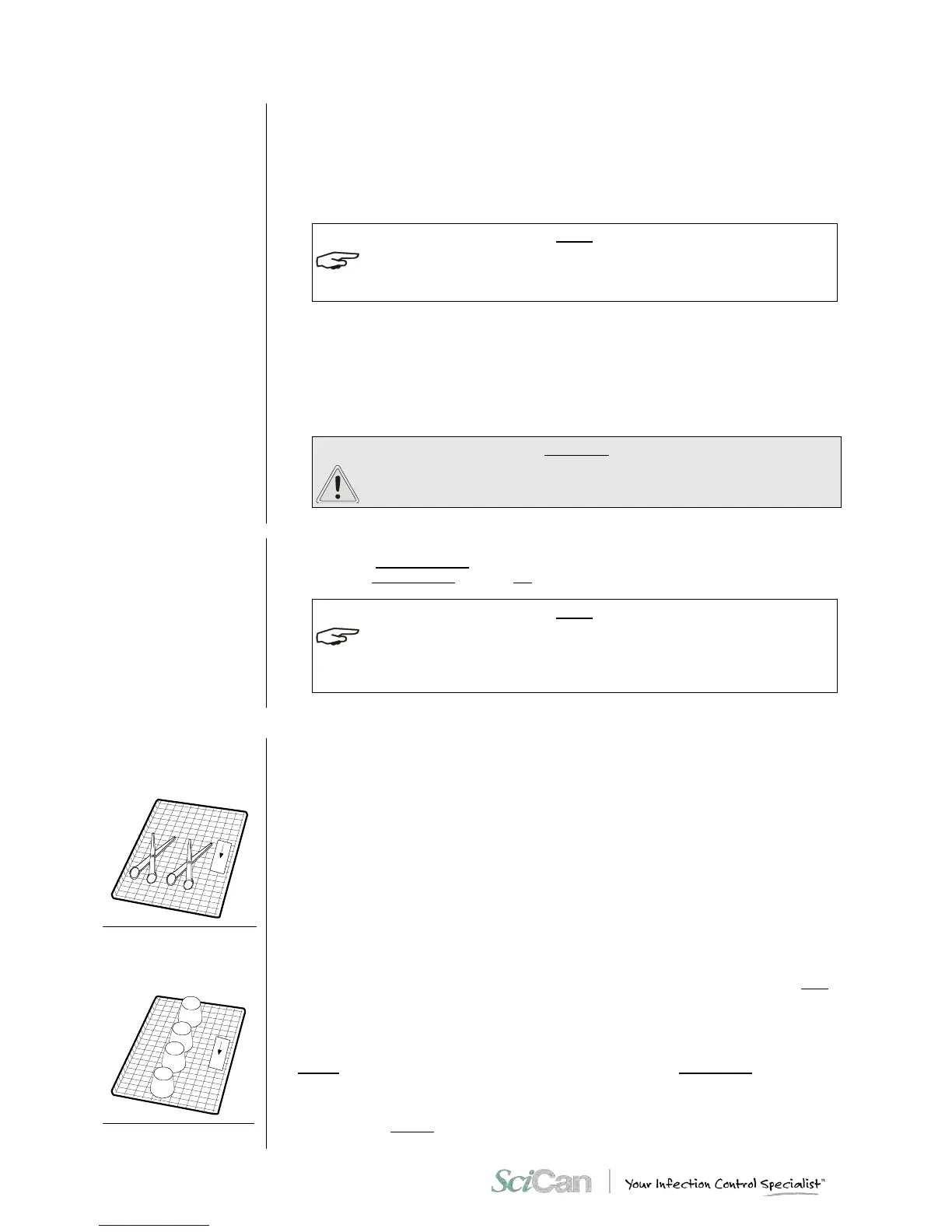
– Make sure that hinged instruments are sterilized in an open position.
– Position cutting instruments, (scissors, scalpels, etc.) such that they do not come into
contact with each other during sterilization; if necessary, use a cotton or gauze cloth to
isolate and protect them.
– Arrange receptacles (glasses, cups, test tubes, etc.) on their sides, or upside down to
avoid pooling water.
– Do not load trays beyond their maximum indicated limit (see Appendix B).
– Do not stack trays or put them in direct contact with the walls of the sterilization chamber.
– A lwa ys use the tray support provided.
– To insert and remove trays from the sterilization chamber, al wa ys use the extractor
provided.


 To Next Page