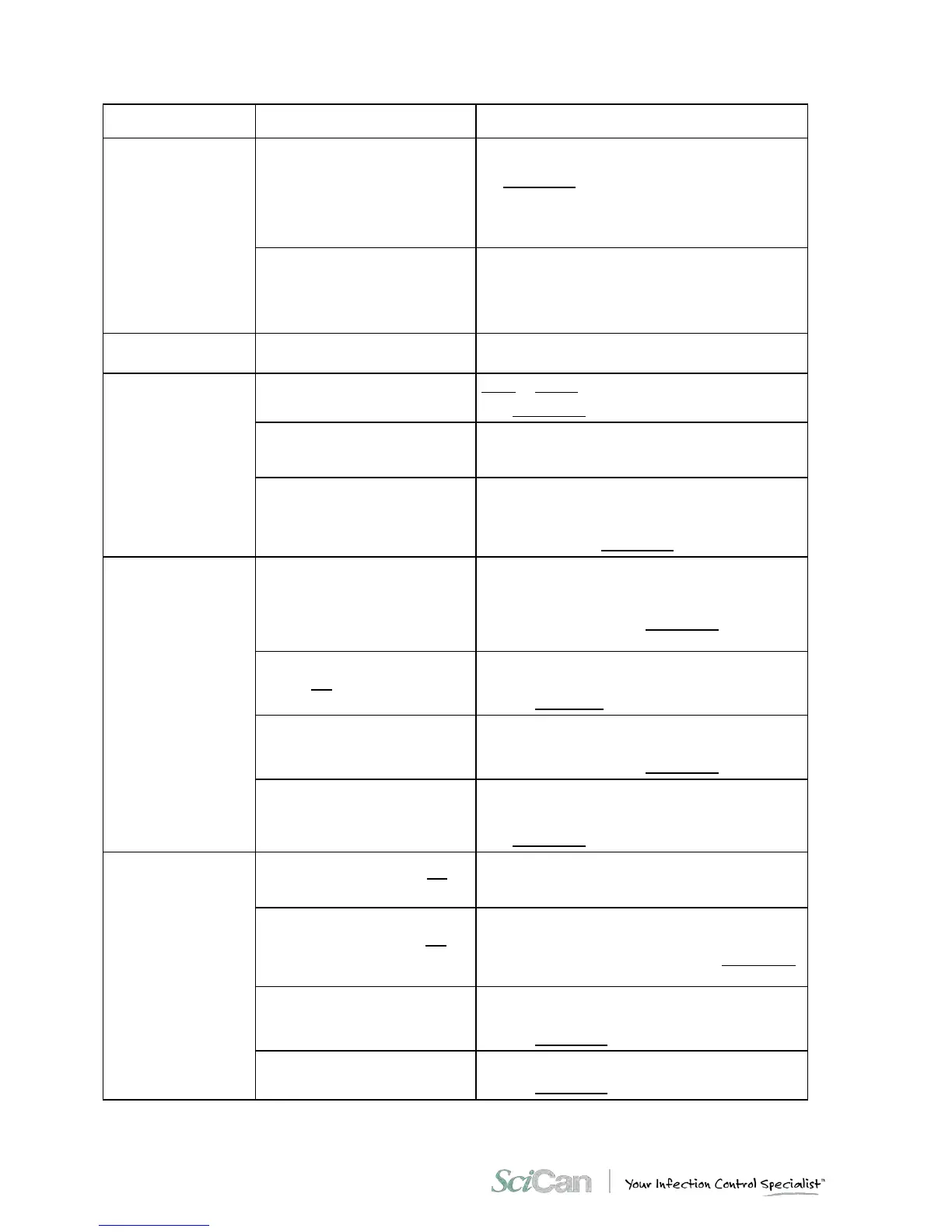
APPENDIX D – TROUBLESHOOTING
70. .
The water supply tube from the
external tank (optional) is not well
connected.
Check the tightness of the connector; if necessary,
reassemble, paying greater attention to sealing (see
the Chapter 4 - “Installation”).
Check that the tube coming from the external tank is
completely pushed onto the connector; make sure that
the plastic tie has been applied.
Steam leaks from the gasket.
At the end of the cycle, clean the gasket and porthole
of the container under pressure. Check if the gasket is
damaged.
Run another cycle and check the situation. If the
gasket still leaks, replace it with a new one.
There is water around
the drain tank.
Drain tubes (optional drain tank) not
correctly connected to the tank.
Check that the tubes connected to the drain tank are
correctly and completely pushed onto the connectors.
The sterilizer has
problems creating a
vacuum in the chamber
(drying problems,
presence of water in the
sterilization chamber at
the end of the cycle,
etc.).
Drain filter of the sterilization
chamber obstructed.
Clean or replace the drain filter.
(See Appendix C “Maintenance”).
Drain circuit obstructed or drain
tubes choked (optional drain tank).
Check that the drain tubes (and the connectors they
are pushed onto) are not obstructed and run freely
from the device to the tank.
The air intake on the frame and/or
the cover is obstructed or the heat
exchanger is not sufficiently
ventilated.
Remove all possible obstructions from the air intake
and heat exchanger.
Check that the device is not in direct contact with walls
or surfaces (see the Chapter 4 - Installation).
Excessive humidity on
the material and/or
instruments at the end
of the program.
There is too much material inside
the sterilization chamber.
Check the quantity of material sterilized and make sure
that it does not exceed the maximum allowed quantity,
depending on the type of load.
(See the Summary Table in Appendix A, Technical
Characteristics).
Material not correctly positioned.
Position the material, and especially wrapped material,
according to the instructions.
(See the Chapter 7 - Preparing the Material).
Wrong sterilization program
selection
Select the appropriate sterilization program for the type
of material to be treated.
(See the Summary Table in Appendix B, Programs).
Drain filter of the sterilization
chamber obstructed.
Clean or replace the drain filter.
Check for kinks in the exhaust tube, if being used.
(See Appendix C Maintenance).
Traces of oxidation or
spots on instruments
Quality of the instruments is not
adequate.
Check the quality of the instruments with the problem,
checking whether the material they are made of can
tolerate steam sterilization.
Quality of the distilled water not
adequate.
Empty the tank and fill it with high-quality distilled
water.
(See the Water Supply Characteristics in Appendix A,
Technical Characteristics).
Organic or inorganic residues on
the instruments.
Carefully clean the material before subjecting it to the
sterilization cycle.
(See the Chapter 7 - Preparing the Material).
Contact between instruments made
of different metals.
Separate instruments made of different metals.
(See the Chapter 7 - Preparing the Material).


 To Next Page