I2773-4.4 en
143
Somat eDAQ
lite
Sum Damage Only When TRUE
Select the sum damage only when TRUE option to filter out input data samples that
are not to be used in the fatigue damage accumulation processing.
Trigger Channel
Specify the trigger channel used in the sum on trigger feature. The trigger channel can
be any logical channel that has the same sample rate as the input channel.
Accumulate Across Test Runs
The accumulate across test runs option is not currently supported.
Damage Model
Select one of three available damage models. The following table defines each model
in terms of a log
10
-log
10
linear relationship.
NOTE
These basic damage models do not provide any corrections for the mean values of the
load ranges affecting the cumulative damage.
Model Description
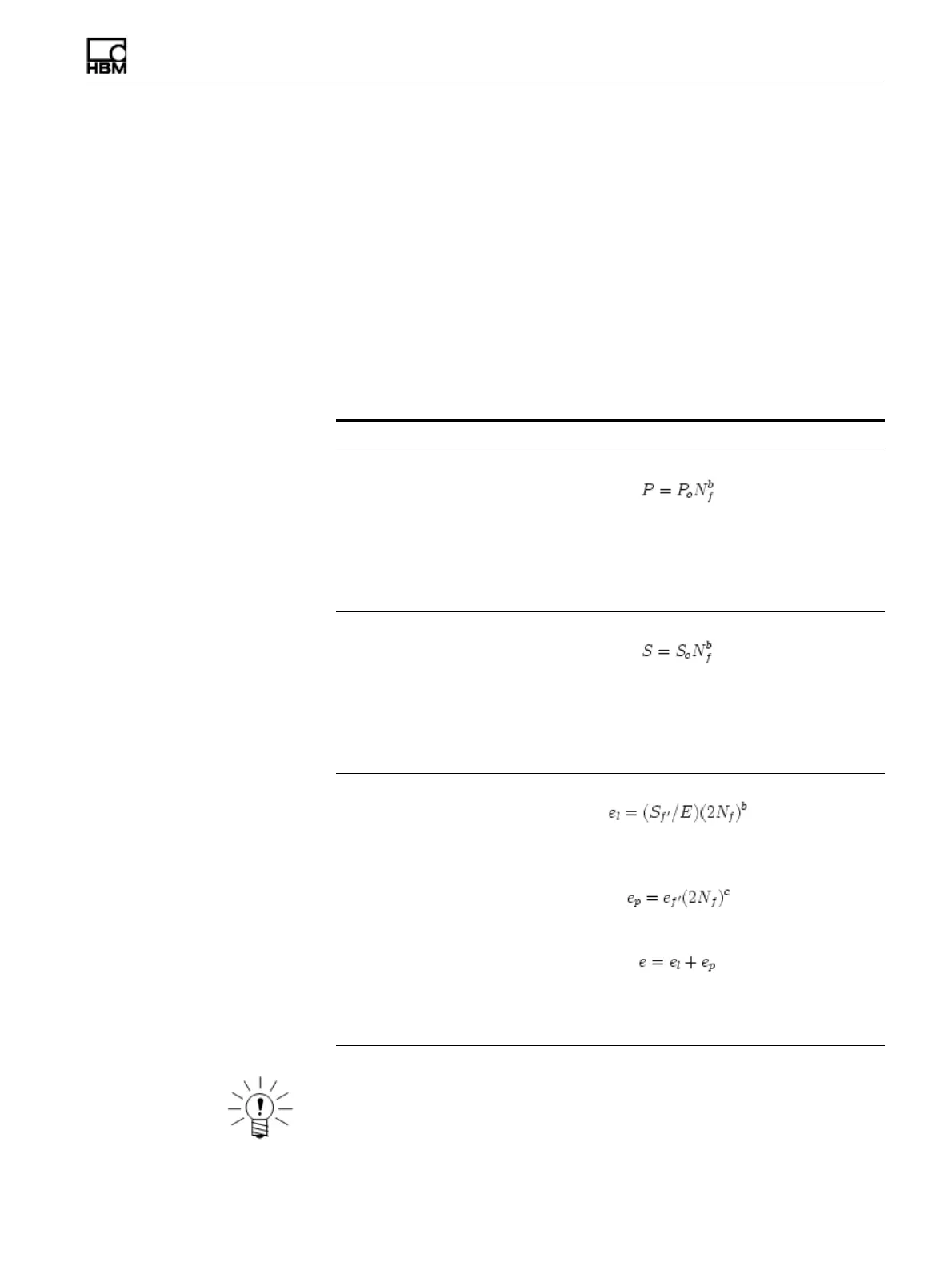
Load-Life The load-life relationship is defined by
where
N
f
is cycles to failure,
P
is the applied load range and
P
o
and
b
are, respectively, the user-defined intercept and slope of the
log
10
-log
10
function.
For each rainflow cycle, the damage, 1/
N
f
, computed from the load
range,
P
, is added to the cumulative damage sum.
Stress-Life The stress-life relationship is defined by
where
N
f
is cycles to failure,
S
is the applied stress range and
S
o
and
b
are, respectively, the user-defined intercept and slope of the
log
10
-log
10
function.
For each rainflow cycle, the damage, 1/
N
f
, computed from the stress
range,
S
, is added to the cumulative damage sum.
Strain-Life The strain-life relationship is defined by
where 2
N
f
is reversals to failure,
e
l
is elastic strain amplitude and
S
f
’
/
E
and
b
are, respectively, the user-defined intercept and slope of
the log
10
-log
10
function;
where
e
p
is plastic strain amplitude and
e
f
’
and
c
are, respectively,
the user-defined intercept and slope of the log
10
-log
10
function; and
where
e
is the total strain amplitude.
For each rainflow cycle, the damage per cycle, 2/2
N
f
, computed from
the stress range, 2
e
, is added to the cumulative damage sum.
HBM: public


 To Next Page