148 Theory of Operation 083730300A DCN8101
Thus, the difference in the peak heights and the resulting M/R ratio is only due to CO and
not to interfering gases. In this case, GFC rejects the effects of interfering gases and so
that the analyzer responds only to the presence of CO.
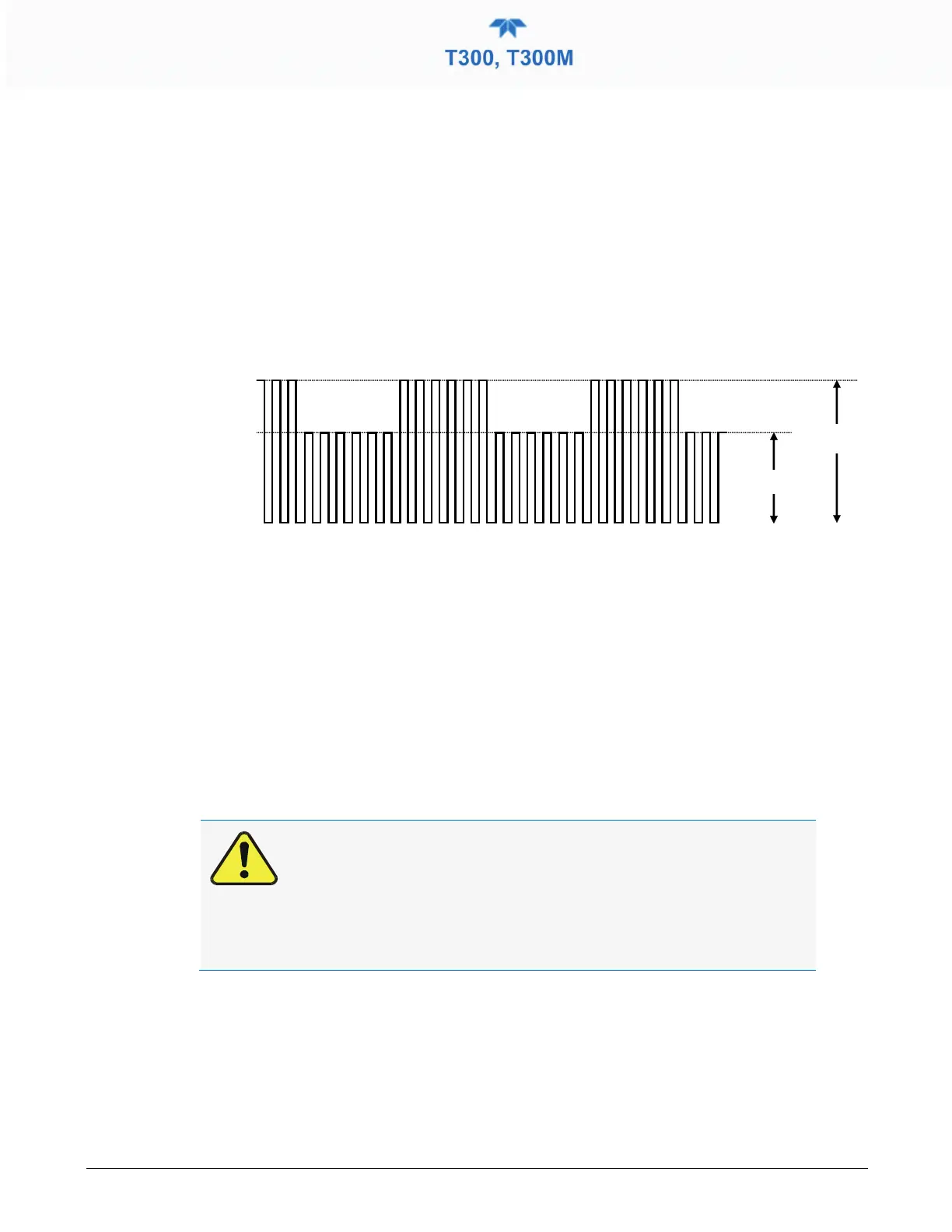
To improve the signal-to-noise performance of the IR photo-detector, the GFC Wheel
also incorporates an optical mask that chops the IR beam into alternating pulses of light
and dark at six times the frequency of the measure/reference signal. This limits the
detection bandwidth helping to reject interfering signals from outside this bandwidth
improving the signal to noise ratio.
The IR Signal as the Photo-
Detector sees it after being
chopped by the GFC Wheel
S
Figure 6-6. Chopped IR Signal
6.1.2.4 SUMMARY INTERFERENCE REJECTION
The basic design of the T300/T300M rejects most of this interference at a 300:1 ratio.
The two primary methods used to accomplish this are:
• The 4.7μm band pass filter just before the IR sensor which allows the instrument to only
react to IR absorption in the wavelength affected by CO.
• Comparison of the measure and reference signals and extraction of the ratio between them.
6.3 PNEUMATIC OPERATION
CAUTION – General Safety Hazard
It is important that the sample airflow system is both leak tight and
not pressurized over ambient pressure.
Regular leak checks should be performed on the analyzer as
described in the maintenance schedule, Table 5-1.
Procedures for correctly performing leak checks can be found in
Section 5.6.3.
An internal pump evacuates the sample chamber creating a small vacuum that draws
sample gas into the analyzer. Normally the analyzer is operated with its inlet near
ambient pressure either because the sample is directly drawn at the inlet or a small vent is
installed at the inlet. There are several advantages to this “pull through” configuration.
• By placing the pump down stream from the sample chamber several problems are avoided.
• First the pumping process heats and compresses the sample air complicating the
measurement process.



 To Next Page