EasyManua.ls Logo

Valleylab Force FX-C - Spark Control Circuit

Valleylab Force FX-C
214 pages
Print Icon
To Next Page IconTo Next Page
To Previous Page IconTo Previous Page
Loading...
Power
Supply/RF
Board
4-24
To
minimize
ringing
on
the
output
voltage
waveform
at
light loads,
transistor Q7 switches
in
the
50
watt,
150
ohm
heat
sink
mounted
resistor
in
series
with
the
transformer
primary
for
part
of
the
RF
switching
cycle.
In
the
Desiccate coag
mode,
K2 is closed
and
K14 is open.
The
T_ON\
signal is a
continuous
pulse
train
with
a
pulse
width
of
2 ]1S
and
a
frequency of 39
kHz.
The
output
resonates
with
a frequency
of
308 kHz.
Output
Relays
In
all
monopolar
modes,
K13
is
closed
and
routes
patient
return
current
through
the
Patient
Return
Electrode receptacle. K15
routes
active
current
through
the
Monopolar
IjCEM
Instrument
receptacle. K16
routes
the
active
current
through
the
Monopolar
2
Instrument
receptacle.
In
bipolar
mode,
the
Patient
Return
Electrode receptacle relay
is
open.
Relays K12
and
K17
route
bipolar
current
to
the
Bipolar
Instrument
receptacle.
All
output
relays
are
open
when
the
generator is
not
being
activated.
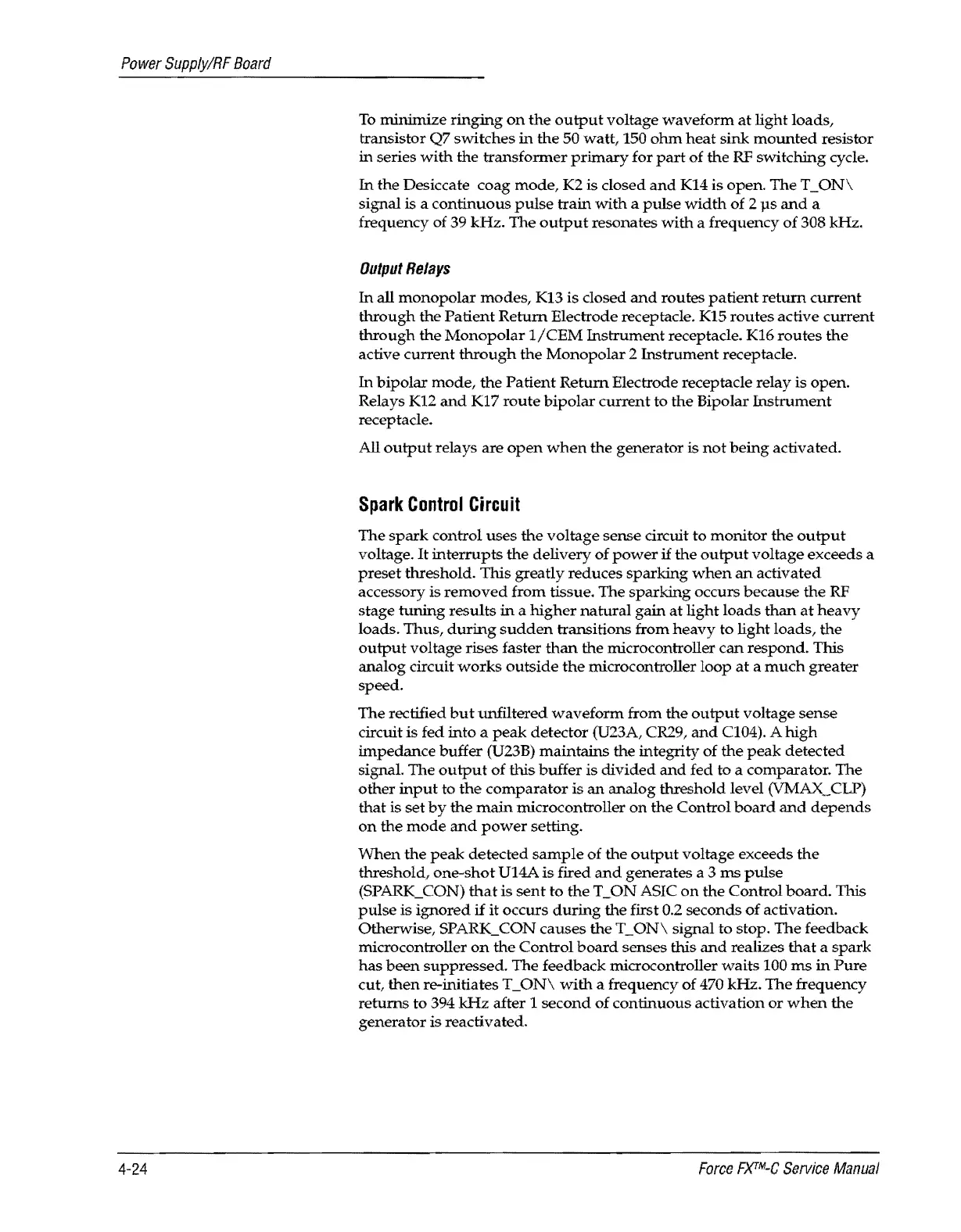
Spark
Control
Circuit
The
spark
control uses
the
voltage
sense circuit to
monitor
the
output
voltage.
It
interrupts
the
delivery
of
power
if
the
output
voltage
exceeds a
preset
threshold.
This
greatly
reduces
sparking
when
an
activated
accessory is
removed
from tissue. The
sparking
occurs because
the
RF
stage
tuning
results
in
a
higher
natural
gain
at
light
loads
than
at
heavy
loads. Thus,
during
sudden
transitions from
heavy
to light loads,
the
output
voltage rises faster
than
the microcontroller
can
respond.
This
analog circuit
works
outside
the
microcontroller loop
at
a
much
greater
speed.
The
rectified
but
unfiltered
waveform
from
the
output
voltage
sense
circuit
is
fed
into
a
peak
detector (U23A, CR29,
and
CI04). A
high
impedance
buffer (U23B)
maintains
the integrity
of
the
peak
detected
signal. The
output
of
this buffer
is
divided
and
fed to a comparator.
The
other
input
to
the
comparator
is
an
analog threshold level (VMAX_CLP)
that
is
set
by
the
main
microcontroller
on
the
Control
board
and
depends
on
the
mode
and
power
setting.
When
the
peak
detected
sample
of
the
output
voltage exceeds
the
threshold,
one-shot
Ul4A
is
fired
and
generates a 3
ms
pulse
(SPARK_CON)
that
is
sent
to
the
T_ON
ASIC
on
the
Control
board.
This
pulse
is
ignored
if
it occurs
during
the
first 0.2 seconds
of
activation.
Otherwise, SPARK_CON
causes
the
T_ON\
signal
to
stop.
The
feedback
micro controller
on
the
Control
board
senses this
and
realizes
that
a
spark
has
been
suppressed.
The feedback microcontroller
waits
100
ms
in
Pure
cut,
then
re-initiates
T_ON\
with
a frequency
of
470
kHz.
The
frequency
returns
to 394
kHz
after 1
second
of
continuous
activation
or
when
the
generator
is
reactivated.
Force
FXTM-C
Service
Manual

Table of Contents

Related product manuals