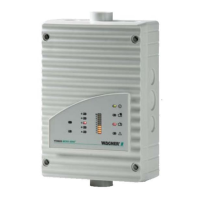
Technical Description
TITANUS
PRO·SENS
®
22
06/13
Function
The aspiration unit in the basic device takes air samples from the protected
area via a pipe system with defined sampling points and carries them to the
sensitive detector module.
Dependent on the response sensitivity of the used detector module (up to
0.5%/m, 0.1 %/m or 0.015 %/m light obscuration) TITANUS
PRO·SENS
®
ac-
tivates the alarm when the corresponding light obscuration is achieved. Four
different alarm thresholds can be set. The alarm is indicated at the device via
the alarm LED and can be transmitted to a connected central fire detection
unit (FAS).
Different delay periods can be set for the alarm thresholds and the fault dis-
play and fault transmission (refer to chapter installation „Settings“).
Alarm indications are stored and have to be reset after eliminating their
cause.
For TITANUS
PRO·SENS
®
2 two detector modules allow to monitor two ar-
eas the way described above. If one area is to be monitored, a two-detector
dependency and additionally through the choice of different response sensi-
tivities an action alarm can be realized.
TITANUS
®
incorporates an intelligent signal processing system with
LOGIC·
SENS
, which can be activated and deactivated with a switch at the
detector module. This fades out interferences and contributes to a safe op-
eration and avoiding false alarms.
Each detector module is checked for soiling, signal faults and detachment. A
fault is shown on the fault indicator of TITANUS
®
and can be transmitted to
the CFDU via a fault contact. Faults caused by short-lived surround fluctua-
tions can be masked out with a time-delayed setting.
An air flow sensor checks the connected pipe system for fractures and
blockages.
The air flow sensor can recognise a blockage of the air sampling points of at
least 50% to total blockage and any pipe fracture, which would result in a
50% loss of air sampling points. Depending on the design of the pipe sys-
tem, blockages of individual air sampling points can also be recognised. The
air flow monitoring system is temperature-compensated and can be set to be
air pressure-dependent.
After a delay period, which can be programmed by switches, the fault is indi-
cated on the air sampling smoke detection system and, if required, the fault
signal is passed to the CDFU via a fault contact. The thresholds of the moni-
3.1.1
Detector module
LOGIC·
SEN
Monitoring the detector mo-
dule
ir flow monitoring



 To Next Page
 Loading...