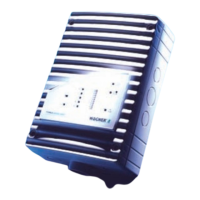
Need help?
Do you have a question about the WAGNER Titanus Micro-Sens and is the answer not in the manual?
Manual's purpose for installers and users new to the system, covering technical knowledge requirements.
Explains warning symbols (WARNING, NOTICE, TIP) used in the manual to ensure safe operation and avoid damage.
Outlines conditions for guarantee claims and liability limitations based on manual observance and intended use.
States WAGNER's copyright and restrictions on manual reproduction, including extracts, without written permission.
Information on protecting the system during transport and environmentally friendly disposal of packaging materials.
Details the system's capabilities, including fire location, sensitivity settings, intelligent signal processing, and airflow monitoring.
Describes suitable applications where point-type alarms are limited, such as high-risk, inaccessible, or aesthetically sensitive areas.
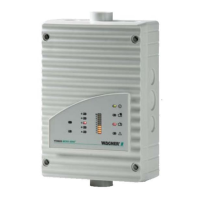
Details the main components: detection unit, device base, and pipe system, including their functions and materials.
Explains the four operational phases of the ROOM·IDENT technology for fire localization and alarm activation.
Provides an overview of the system's components and optional accessories for enhanced functionality and connectivity.
Describes the device base and detection unit components, including connections, sensors, and displays.
Explains the use of external detector boxes for creating dependencies, locating branches, and increasing sensitivity.
Details the use of the DIAG 3 diagnostics tool for device configuration, maintenance, and fault analysis.
Describes network card options for data logging, remote access via SNMP, and integration into risk management systems.
Explains the connection and functionality of remote displays, identical to detection unit displays, up to 1000m distance.
Details the use of up to 5 addressable reaction indicators via an indicator bus for fire location identification.
Provides an overview of the pipe system components, including pipes, fittings, filters, and blow-through devices.
Focuses on aspiration apertures for room monitoring, detailing reduction films and clips for different environmental conditions.
Describes standard LF-AD-x and special SF-x air filters for protecting the system from dust in various environments.
Explains air return systems for pressure compensation and air quality control in areas with differing air pressures.
Details the installation and function of steam traps for collecting condensate in humid environments.
Provides detailed technical specifications including voltage, current consumption, outputs, dimensions, weight, and noise level.
Lists technical data for the detection box, covering power supply, dimensions, protection class, and temperature range.
Details specifications for accessories like parallel displays, reaction indicators, and relay boards.
Outlines pipe system parameters such as maximum length, number of apertures, temperature range, and monitoring area.
Describes project planning for air sampling smoke detection systems according to EN 54-20/ISO 7240-20 standards.
Highlights compliance with national regulations and specific guidelines like VdS and DIN VDE for system planning.
Covers essential aspects of pipe system design for reliable fire detection, including aperture planning and layout.
Details the need for recognizing air flow changes and adjusting sensor sensitivity for reliable monitoring.
Explains fire sensitivity classes (A, B, C) and how detection units achieve them based on aspiration aperture count.
Specifies crucial limit values for pipe length, aperture count, and monitoring surface area for system design.
Provides essential factors for project planning, including system sensitivity, aperture count, and necessary accessories.
Emphasizes selecting accessories like filters and steam traps early in the planning phase due to their impact on pipe dimensioning.
Lists various pipe accessories including air filters, steam traps, sound suppressors, and stop valves with their applications.
Guides project planning for pipelines considering pipe accessories and their impact on system sensitivity.
Provides tables for calculating aperture diameters based on pipe configuration (I-pipe, U-pipe, M-pipe, Double U-pipe).
Addresses project planning for individual aperture monitoring and specific scenarios like blocked apertures.
Details planning parameters for monitoring individual or blocked aspiration apertures across different pipe systems.
Explains simplified pipe design for equipment protection and small areas, focusing on unified aperture diameters.
Covers project planning for sampling points located distantly from the main pipe run using branch pipes.
Provides guidance on designing pipe systems for forced air flow, particularly in ventilation and climatic applications.
Details considerations for using air sampling hoses, including transport time adjustments and length calculations.
Explains project planning with air return systems to manage pressure differences and air quality, including length calculations.
Covers general regulations and considerations for installing the TITANUS MICRO·SENS® system, emphasizing no unauthorized modifications.
Provides guidance on choosing an appropriate installation site, ensuring notices are visible and avoiding spaces with opening doors.
Details the steps for connecting the air sampling pipe to the TITANUS MICRO·SENS® device base unit.
Explains how to prepare electrical connections, install cable entries, and feed cables through for additional modules.
Illustrates the connection of TITANUS MICRO·SENS® to a Fire Alarm System (FAS) including the reset button functionality.
Describes the integration of a reset board, its usage conditions, and calculations for terminating resistors and idling current.
Covers the installation of a reset and isolating button board into an additional housing for system control.
Details the process of fitting relay boards RU-1 and RU-2 into an additional housing for expanded system capabilities.
Provides instructions on installing network modules, emphasizing safety precautions and correct placement of accessories.
Explains how to connect remote displays to the TITANUS MICRO·SENS®, including housing fitting and electrical connections.
Covers the addressing and connection of reaction indicators for fire location, including setting up switch S1 and testing.
Guides the user on safely inserting the detection unit into the device base, noting mechanical coding for protection.
Details the system settings managed via the diagnostic tool, covering sensitivity, delays, and air flow parameters.
Explains how to perform simple device checks using the diagnostic tool and store data for later assessment.
Specifies requirements for pipes, hoses, and fittings, including compression resistance and temperature range.
Provides instructions on cutting pipes, cleaning joints, and ensuring airtight connections for the pipe system.
Details the process for cutting, cleaning, and gluing air sampling hoses to fittings for airtight connections.
Explains how temperature variations affect pipe length and how to calculate expansion using a given formula.
Describes the design and positioning of aspiration apertures using film sheets and marking tape for precise air sampling.
Covers installation of ceiling feed-throughs for false ceilings, including drilling holes and attaching hoses.
Addresses system monitoring in ventilation and climatic applications, focusing on air sampling point positioning.
Details the installation of LF-AD-x and SF-400/650 filters for protecting the system in dusty environments.
Explains how to feed the air return into the pipe connection, ensuring a secure fit and proper fixation.
Guides the installation of the SD-1 noise suppressor to reduce noise emissions from the TITANUS MICRO·SENS®.
Describes the use of a 3-way ball valve for blowing through with compressed or pressed air for maintenance.
Details the installation of steam traps (KA-DN-25 and KA-1) at the lowest pipe system point to collect condensate.
Explains the installation of the test adapter, emphasizing it must be closed during normal operation for air flow integrity.
Covers pre-installation checks for the pipe system and insertion of the detection unit into the device base.
Describes Plug and Play commissioning, where standard settings are maintained and air flow adjustment is automatic.
Explains using the diagnostics tool for commissioning, allowing pre-set changes and air pressure-dependent/independent adjustment.
Provides steps for installing the DIAG 3 diagnostics software on a PC and connecting it to the TITANUS MICRO·SENS®.
Details air flow sensor adjustment, including types of adjustment and conditions for successful initialization.
Guides on testing the detection unit and alarm forwarding to the FAS by triggering the system with test aerosol.
Explains how to test pipe breaks and blockages recognition, and troubleshoot air flow monitoring issues.
Describes how to test fault forwarding by checking displayed faults on the TITANUS MICRO·SENS® and the FAS.
Details testing the air flow sensor analysis function using test pipes and diagnostic tools for complete or limited function checks.
Explains how to commission fire seat location using the ROOM·IDENT screen and determine transport times for fire detection.
Guides on testing reaction indicator address settings during commissioning, ensuring correct lighting and flashing.
Details visual checks for pipe system accessibility, aspiration apertures, connections, and overall device condition.
Recommends checking detector and alarm forwarding as per commissioning procedures and visually inspecting for damage.
Instructs on testing aspiration apertures for blockages, especially in dusty or icy areas, and blow-through procedures.
Provides steps for safely removing and replacing the detection unit, including jumper X4 changes and automatic initialization.
Details the process for exchanging air filter inserts in the device base, including visual checks and filter replacement.
Explains how to clean or change filter inserts in the LF-AD-x air filter, emphasizing careful handling to avoid air flow faults.
Guides on changing the filter element in the SF 400/650 special filter, stressing attention to the flow direction.
Describes the manual blow-through process for the pipe system using compressed air to remove dust and dirt.
Explains how to test air flow sensor values using diagnosis software, checking actual and ideal values for deviations.
Details testing fire seat location and reaction indicators using the ROOM·IDENT screen and determining transport times.
Covers testing air flow monitoring by checking for pipe breaks or blockages displayed on the diagnostics tool.
Explains how to test fault forwarding by checking displayed faults on the TITANUS MICRO·SENS® and the FAS.
Outlines the regular maintenance schedule, including visual checks, detector testing, pipe system checks, and sensor adjustments.
Provides tables for classifying sensitivity and determining permitted pipe lengths based on system configuration.
Lists all available TITANUS MICRO·SENS® devices, detection units, accessories, and spare parts with order numbers.
A template for recording test results during commissioning and maintenance of the aspirating smoke detection system.
Defines key technical terms used throughout the manual, aiding in understanding system functionalities and components.
 General
| Power supply | 24 V DC |
|---|---|
| Housing material | Plastic |
| Relative Humidity | 10% to 95% (non-condensing) |
| Protection Class | IP30 |
| Type | Aspiration smoke detector |
| Detection principle | Laser light scattering |
| Number of sampling points | Up to 5 |
| Alarm levels | Adjustable |
| Operating temperature | -10 °C to +60 °C |
| Operating Temperature Range | -10 °C to +60 °C |
| Alarm Sound Level | N/A (External alarm required) |

 To Next Page