d. Tighten the locknut.
1. Check:
WARNING
EWA13180
● The tire pressure should only be checked
and regulated when the tire temperature
equals the ambient air temperature.
● The tire pressure and the suspension must
be adjusted according to the total weight
(including cargo, rider, passenger and ac-
cessories) and the anticipated riding
speed.
●
Operation of an overloaded vehicle could
cause tire damage, an accident or an injury.
NEVER OVERLOAD THE VEHICLE.
WARNING
EWA13190
It is dangerous to ride with a worn-out tire.
When the tire tread reaches the wear limit,
replace the tire immediately.
2. Check:
●
Tire surfaces
Damage/wear → Replace the tire.
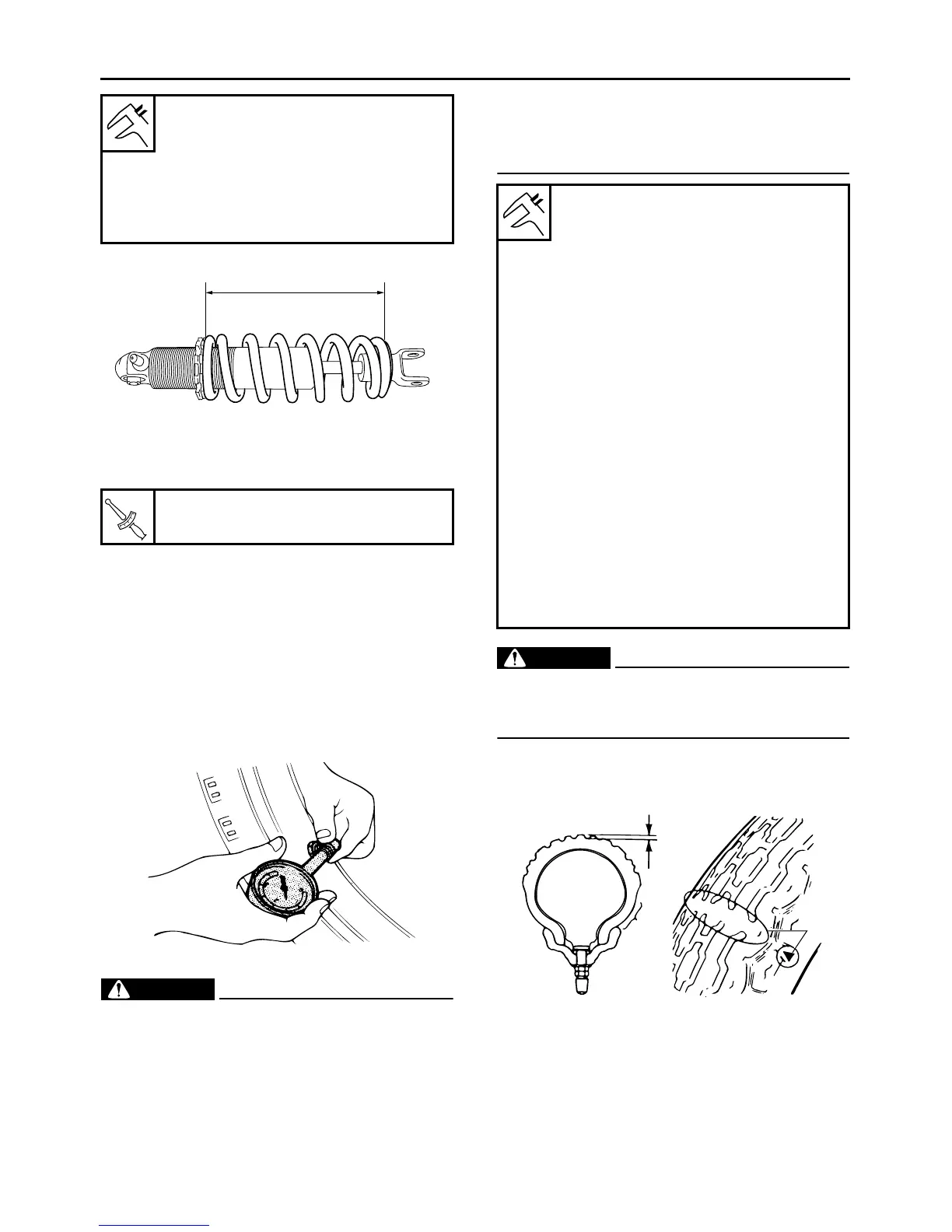
Spring length “c”
Standard
197.0 mm
Minimum (hard)
187.0 mm
Maximum (soft)
207.0 mm
Locknut
10 Nm (1.0 m•kg, 7.2 ft•lb)
c
T
R
.
.
Tire air pressure (measured on
cold tires)
Loading condition
0–90 kg (0–198 lb)
Front
125 kPa (18 psi) (1.25 kgf/cm
2
)
Rear
150 kPa (22 psi) (1.50 kgf/cm
2
)
Loading condition
90 kg–Maximum load
Front
150 kPa (22 psi) (1.50 kgf/cm
2
)
Rear
175 kPa (25 psi) (1.75 kgf/cm
2
)
High-speed riding
Front
150 kPa (1.50 kgf/cm
2
)
Rear
175 kPa (1.75 kgf/cm
2
)
Maximum load
160 kg (353 lb)
* Total weight of rider, passenger, cargo
and accessories
1. Tire tread depth
2. Side wall
3. Wear indicator
1
2
3


 To Next Page