CHAPTER 3: PROGRAMMING FUNCTIONS
LW500A/LW600A PULSED Nd:YAG LASER
990-539 3-15
4. REFERENCE SETTING – Sets the maximum input power to the flashlamp. When the LAMP
INPUT POWER
exceeds the REFERENCE SETTING, a warning message will appear.
The best way to use this feature is to set the REFERENCE SETTING to 95% ~ 98%. Then as the
flashlamp starts to age, it will require more power to maintain a constant output. Eventually the
LAMP INPUT POWER will reach the REFERENCE SETTING value and the Lamp Input Power Limit
screen will appear. Once this alarm condition exists the operator can set the REFERENCE
SETTING
value to 100% and schedule a flashlamp replacement to minimize production down-
time.
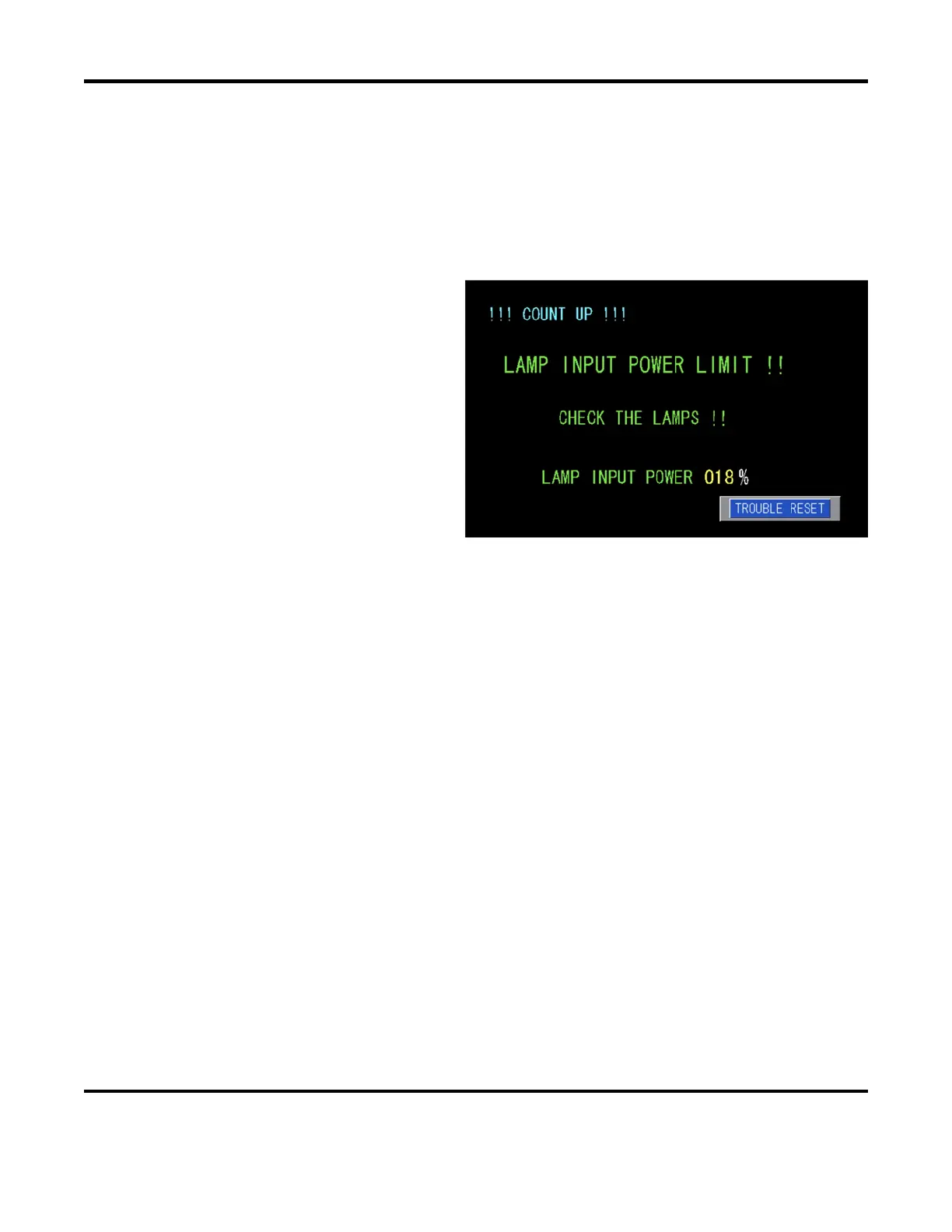
In the example shown on the right, the
REFERENCE SETTING was set to 18%.
Once the LAMP INPUT POWER reached
18%, the following screen appeared.
To clear the message, select the
TROUBLE RESET button. If the
REFERENCE SETTING is below 100%,
re-enter a new REFERENCE SETTING
and continue Laser operations.
5. AVERAGE
– Displays the total mean (average) power in Watts (W) of the laser oscillator
(averaged over one second). Each time the Laser is fired, its output is measured and displayed.
In the case of high-repetition outputs, the energy is displayed at periodic intervals. This is
because the repetitions are faster than the LCD refresh rate. The displayed average power will
differ from the actual delivered power at the work piece. This difference varies based on the
optical configuration of the system.
6. ENERGY
– Displays the measured laser energy in Joules (J) of the laser oscillator. Each time
the Laser is fired, its output is measured and displayed. In the case of high-repetition outputs,
the energy is displayed at periodic intervals. This is because the repetitions are faster than the
LCD refresh rate. The displayed energy will differ from the actual delivered energy at the work
piece. This difference varies based on the optical configuration of the system.


 To Next Page