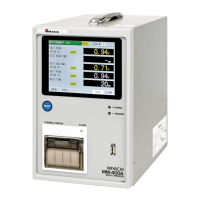
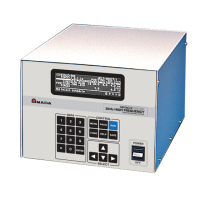
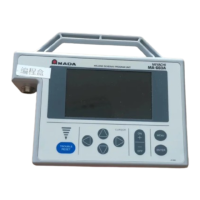
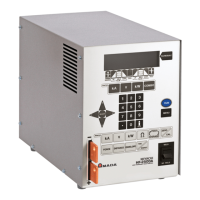
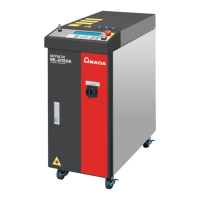
LW500A/LW600A PULSED Nd:YAG LASER
xii 990-539
General Precautions
This Operator's Manual describes the Operation and Maintenance of the LW500A(E) / 600A(E) and
ML-2651B(-CE) / 2650B(-CE) Nd:YAG Laser Welders, and provides instructions relating to its SAFE
use. Procedures described in this manual must be performed as detailed by qualified and trained
personnel.
Before attempting to use the laser, please read this instruction manual and the Laser Safety Manual
(Amada Miyachi America Part Number 990-502) thoroughly for safety reasons and to effectively
take advantage of the full capabilities of the Laser Welder.
After reading this manual, retain it for future reference when any questions arise regarding the
proper and SAFE operation of the Nd:YAG Laser Welder.
Installation Precautions
Install the Laser securely on a firm and level surface.
LW500A/600A and ML-2651B/2650B Models: Connect to an A.C. Service of three-phase,
220/220/240 VAC +10%/-15%, 100A, 50/60 Hz.
NOTE: Depending on the manufacturing date, the 240VAC option may not be available.
LW500AE/600AE and ML-2651B-CE/2650B-CE Extended Voltage Models: Connect to an
A.C. Service of three-phase, 380/400 VAC 10%, 60A, 50/60 Hz (for 400VAC models).
Be sure to apply good grounding to the laser.
This manual does not cover adjustments made prior to start-up, as such adjustments are performed
by our engineers after the Laser is installed. For space requirements and power supplies, see
Appendix A, Technical Specifications.
Use the Laser in a place where the ambient temperature is between 41-95°F (5-35°C) and humidity
is 85% (non-condensing) or less and where there are no sudden temperature fluctuations.
Do not use the Laser in the following places:
Where there is considerable dirt, dust, mist, chemicals, fumes, moisture, or near a high-
frequency noise source.
Where the Laser may be subjected to vibration or impact.
Where moisture may be condensed on the surface of the Laser.
Where there is a high concentration of CO
2
, NOx (nitrogen oxides) or SOx (sulfur oxides).
(Air containing more than 0.1% CO
2
may shorten the life of the ion-exchange resin).
If the outside of the Laser is stained, wipe it with a dry or slightly moistened cloth. If it is badly
stained, use a neutral detergent or alcohol to clean it. Do not use paint thinner, acetone, benzene,
etc. which can discolor or deform the parts.
Do not put screws, coins, etc. in the Laser, since they can cause a malfunction.
Operate the switches and buttons carefully by hand. If they are operated roughly or with the tip of a
screwdriver, a pen, etc. they can cause a malfunction.


 To Next Page