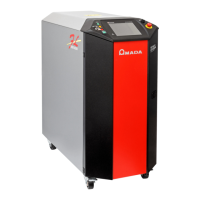
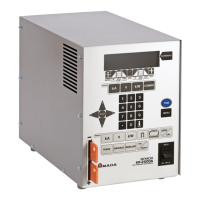
This document describes the YAG Laser Welder models ML-2050A, ML-2051A, and ML-2150A, including their operation, installation, and maintenance.
Function Description
The YAG Laser Welder is designed to generate powerful light by amplifying electromagnetic waves, primarily for industrial welding applications. It utilizes an Nd: YAG laser, which is generated by doping Neodymium with a Yttrium Aluminum Garnet crystal. The laser operates at a wavelength of 1064 nm, emitting near-infrared rays that are invisible to the human eye. Most laser equipment for welding, including this product, falls under Class 4 laser classification, indicating the highest hazard level. Direct or scattered laser beams are highly dangerous and can cause blindness if they enter the eye. To ensure safety, red guide light is typically used to indicate the invisible laser's irradiation point on the workpiece. If a CCD camera is integrated with the output unit, cross lines are displayed on the monitor, with their intersection marking the irradiation point.
The laser system comprises a power supply, cooler, oscillator, optical fiber, and an output unit. The optical fiber allows for remote delivery of laser light, enabling the optical fiber and output unit to be mounted directly in a manufacturing line. The system supports multiple laser light beams from a single laser unit to multiple optical fibers through "powersharing" or "timesharing."
Powersharing: This method splits a single laser light into multiple beams using a beamsplitter, allowing simultaneous welding of multiple workpieces or multiple positions on a single workpiece. If the energy of a single laser beam is 100%, powersharing distributes this energy; for example, with two deliveries, each receives 50%, and with three deliveries, each receives 33%. The system supports up to three deliveries for powersharing, ensuring uniform output for each delivery without energy loss.
Timesharing: This method applies 100% of the laser energy to multiple workpieces by rapidly changing the reflection angle using a mirror in the timesharing unit, without splitting the single laser light. For instance, with three deliveries, laser light is irradiated sequentially from each of the three optical fibers. Up to three deliveries are available for timesharing.
Important Technical Specifications
Oscillator:
- Maximum rated output: ML-2050A: 15 W; ML-2051A: 7 W; ML-2150A: 25 W.
- Max. output energy: ML-2050A: 15 J/P (Pulse width 5ms); ML-2051A: 7 J/P (Pulse width 5ms); ML-2150A: 25 J/P (Pulse width 5ms).
- Max. peak power: ML-2050A: 4 kW; ML-2051A: 2.5 kW; ML-2150A: 6 kW.
- Pulse width: Standard: 0.2 to 10.0 ms (0.1 ms steps); Fine setting: 0.20 to 5.00 ms (0.02 ms steps).
- Pulse repetition rate: 1 to 30 pps.
- Oscillation wavelength: 1.064 μm.
- Positioning guide beam: Built-in visible laser (Red).
- Output stability: ±3%.
Power Supply:
- Power supply: Single-phase 200 V, 220 V, 240 V AC +10%,-15%, 50/60 Hz.
- Max. input current: 7 A.
- Max. apparent power: 1.4 kVA.
- Breaker rated current (to be supplied by customers): Recommended 15 A or more, applicable to harmonics and surges.
- Ground: Class D (ground resistance: 100 Ω max.).
Cooler:
- Heat exchange method: Forced air cooling.
- Heat-exchanging ability: 850 W (731 kcal/h).
Control Panel:
- Schedule setting: Up to 32 schedules can be set by combining laser output waveform, repetition rate, number of repetitions, and upper/lower limit alarm (Energy monitor [J]).
- Monitor: Energy monitor (J) and average power (W).
- Counter: 9-digit total (preset) counter and 9-digit good (preset) counter.
- Alarm indication: Messages displayed on liquid crystal display.
Operating Environment:
- Ambient temperature: 5° to 30°C.
- Ambient humidity: 85%RH or less (non-condensing).
Physical Characteristics:
- Mass: Approx. 70 kg.
- Dimensions: 700 (H) x 310 (W) x 665 (D) mm.
- Noise level (A): Less than 70 dB.
Optical Fiber Minimum Bending Radius:
- φ 0.2, 0.3, 0.4mm: 100mm
- φ 0.6mm: 150mm
- φ 0.8mm: 200mm:
- φ 1.0mm: 250mm
Maximum Incident Laser Energy and Power of the Optical Fiber:
- ML-2050A: SI φ 0.3mm: 15J, 15W; SI φ 0.4, 0.6, 0.8, 1.0mm: 15J, 15W.
- ML-2051A: SI φ 0.2mm: 7J, 7W; SI φ 0.3mm: 7J, 7W; SI φ 0.4, 0.6, 0.8, 1.0mm: 7J, 7W.
- ML-2150A: SI φ 0.4, 0.6, 0.8, 1.0mm: 25J, 25W.
- Note: For ML-2150A, use an optical fiber of φ 0.4 mm core diameter or larger. Only SI optical fiber can be used; GI optical fiber is not compatible.
Usage Features
Control Methods: The laser welder offers three control methods:
- Control Panel (PANEL CONTROL): For independent use or when external control systems are off. Welding schedules are set and laser light is output directly from the control panel.
- External Input/Output Signals (EXTERNAL CONTROL): For integration with PLCs or similar automatic machines. External signals control schedule selection, laser light output, and emergency stops.
- External Communication Control (RS-485 CONTROL): For control via a personal computer or similar device by sending commands. This allows for centralized data management, including welding schedules and monitor values.
Welding Schedule Settings:
- Up to 32 different welding schedules can be set and registered, allowing for waveform control, high-speed, and high-quality welding.
- Schedules can be momentarily switched.
- The ML-2051A model uses a very thin optical fiber, ideal for welding with a small spot diameter.
Laser Light Delivery:
- Supports up to three deliveries of laser output, including powersharing and timesharing (beamsplitter and branch shutter are optional).
- Powersharing ensures uniform outputs for each delivery without energy loss.
- Optical fiber detection is available to check for fiber connection and breakage (requires an optional output unit with a fiber sensor).
User Interface:
- Welding schedules are entered via a liquid crystal display, ensuring easy and accurate operation.
- Monitoring of laser energy (J) and mean power (W) is provided. If the laser energy falls outside a preset range, a trouble signal is output for quality control.
- High-precision optical fiber eliminates the need for optical axis adjustment after removal and reinstallation.
Installation and Space Saving:
- The laser power supply, oscillator, and cooler are integrated into a single unit for easy transport and installation.
- The system does not require external cooling water or piping.
- Requires at least 500 mm of clear space in front, back, right, left, and above for cooling and maintenance access. Airflow must not be interrupted.
Maintenance Features
Routine Handling:
- Periodic Inspection: Regular inspections are recommended, as detailed in the Maintenance Part.
- Cleaning: The exterior of the laser should be wiped with a dry or moistened cloth. For heavy stains, neutral detergent or alcohol can be used, but avoid paint thinner or benzine.
- Optical Fiber Handling: Avoid bending the optical fiber beyond its minimum bending radius or subjecting it to shocks to prevent damage.
Cooler Unit Maintenance:
- Air Filter Cleaning: The air filter on the side of the main unit should be cleaned weekly. It can be washed with tap water and air-dried.
- Cooling Water: Use deionized or purified water (resistivity: 16 MΩ·cm minimum). Tap water, industrial water, ground water, or ultra-pure water can cause corrosion or clogging.
- Draining Water: Water should be drained from the cooling water tank before replacing the ion-exchange resin, replacing cooling water (every 6 months), or when the equipment is stored for a month or longer, or if the temperature falls below 0°C.
- Ion-Exchange Resin: Replace the ion-exchange resin every 6 months and the ion-exchanger cartridge every 3 years. Store new resin in a cool place away from direct sunlight and prevent freezing.
- Water Filter Cleaning: The water filter in the cooling water tank should be cleaned every 6 months and replaced every 3 years.
Laser Oscillator Section Maintenance:
- Flashlamp Replacement: Recommended when the number of laser outputs reaches approximately 1,000,000 shots. The procedure involves removing the oscillator cover, draining water from the laser chamber, and carefully replacing the flashlamp, ensuring correct polarity.
- Incident Beam Adjustment: While high-precision optical fiber generally eliminates the need for frequent adjustments, it is required after laser oscillation adjustments, optical adjustments, replacement of beamsplitters, input units, YAG rods, laser chambers, or φ0.2 mm optical fibers.
- Cleaning Optical Parts: Lenses of the output unit should be cleaned with air blow, ethanol, and lens cleaning paper to remove foreign particles or blur.
- Optical Fiber Cleaning: The optical fiber's end face should be checked for stains or dust using an end face checker and cleaned with air blow or lens cleaning paper.
Power Supply Section Maintenance:
- Lithium Battery Replacement: The lithium battery for backup on the CPU board (main unit) and control board (control panel) should be replaced every 3 years. It is recommended to record output schedule data before replacement as it may be lost. Dispose of lithium batteries according to local environmental regulations.
Troubleshooting:
- The control panel displays error codes and messages when a fault occurs, guiding the operator on necessary measures.
- Troubleshooting steps are provided for issues not displaying fault codes, such as changes in laser output despite normal monitor values, which may indicate resonator optical axis dislocation.

 Need help?
 General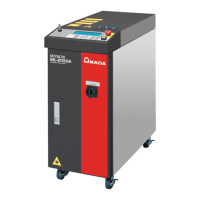

 To Next Page