3. Functions of the ML-2050A/2051A/2150A
19
ML-2050A/2051A/2150A
Introduction Part
Installation and
Preparation Part
Operating Part Maintenance Part Appendixes
3. Functions of the ML-2050A/2051A/2150A
⇒
Laser power feedback control and optional waveform control functions
■
The Laser can handle a wide variety of workpieces. Up to 32 dierent settings
for weld schedules using waveform control are available.
■
The welding schedule can be momentarily switched. This permits high-speed
and high-quality welding.
■
The ML-2051A uses very thin optical ber that makes it suitable for welding
with a small spot diameter.
■
Up to 3 deliveries of laser output, including powersharing and timesharing, are
available. (The beamsplitter and branch shutter are options.)
■
Powersharing permits obtaining uniform outputs for each delivery without
energy loss.
⇒
Simple operations and maintenance
■
For greater convenience, the Laser is designed to allow the operator to work
on the Laser from the front for cumbersome tasks such as wiring and filter
replacement.
■
As welding schedules are entered on the liquid crystal display, the user can
perform operations easily and accurately.
■
A variety of input and output signals allow the Laser to be connected to
automatic machines.
■
Both the laser energy (J) and its mean power (W) are monitored. If the desired
energy range has been preset and the laser energy is out of the range, the
trouble signal is output. This function is provided for quality control purposes.
■
Use of high-precision optical fiber eliminates the optical axis adjustment
usually needed every time the ber is removed and reinstalled.
■
Optical ber detection is available to check ber connection and breakage. (An
optional output unit with ber sensor is required.)
■
Using the external communication function permits managing data such as
welding schedules and monitor values in centralized form.
⇒
The factory environment can be improved by space saving.
■
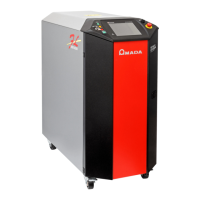
The laser power supply, oscillator, and cooler are integrated into a single piece
for easy transport and installation of the Laser.
■
The Laser does not require external cooling water or piping.
⇒
The Laser conforms to the following standards.
In compliance with IEC Standards IEC60825-1 “Safety of laser products Part1:
Equipment Classications, requirements and use’s guide”
Chapter 1 Overview of the YAG Laser Welder


 To Next Page