4-14
2. Set the patient simulator to 0 pressure for the desired IBP channel.
3. Press the Zero key on the module to make a zero calibration.
4. Set static pressure to 200 mmHg on the patient simulator.
5. Select Main Menu→Maintenance→enter the required password→Module→IBP. In the Cal. IBP Press. menu, set
the calibration value to 200 mmHg.
6. Select the Calibrate button next to the desired IBP channel to start a calibration.
7. If the calibration is completed successfully, the message Calibration Completed! will be displayed. Otherwise, a
corresponding message will be displayed.
Method 2:
Tools required:
Standard sphygmomanometer
Squeeze bulb
Tubing
T-shape connector
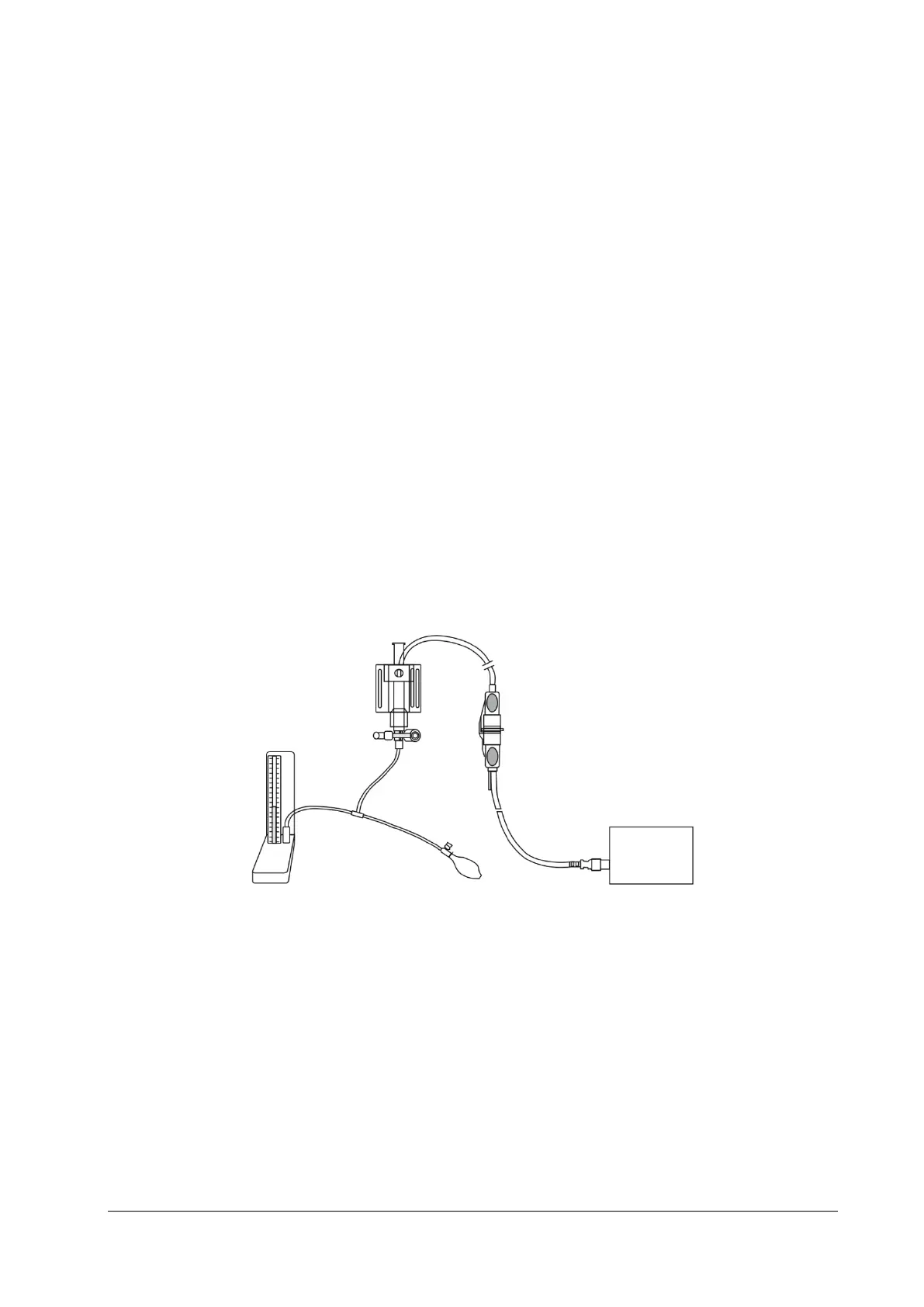
1. Connect the 3-way stopcock, the sphygmomanometer and the squeeze bulb through a T-shape connector, as
shown below.
2. Zero the transducer, and then open the stopcock to the sphygmomanometer.
3. Select Main Menu→Maintenance→enter the required password→Module→IBP. In the displayed interface, set
the target calibration value of the target channel. Value range: 80 to 300 mmHg.
4. Inflate using the squeeze bulb until the reading of sphygmomanometer approximates the preset calibration value.
5. Adjust the calibration value in the Maintain IBP menu until it is equal to the reading of sphygmomanometer
6. Select the Calibrate button next to the desired IBP channel to start a calibration.
If the calibration is completed successfully, the message Calibration Completed! will be displayed. Otherwise, a
corresponding message will be displayed.
4.4.7 C.O. Test
Tools required:
Sphygmomanometer
T-shape connector
Pressure adapter cable
IBP
module
3-way stopcock
Pressure transducer



 To Next Page