- radiation energy and
- decay pattern of the respective nuclide,
but other factors are also relevant, such as:
- detector sensitivity,
- measuring geometry,
- self-absorption in the source.
The calibration factor indicates the value with which the back-
ground-corrected gross counts per second must be multiplied to
obtain data displayed in Bq/cm².
Accordingly, a Bq/cm² measurement is only correct when the
set and measured nuclide match.
When setting the unit Bq/cm² and selecting the respective nu-
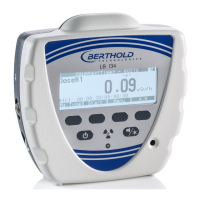
clide, the LB 134 automatically converts the measured cps to
Bq/cm². The software includes a (editable) nuclide library with
about 70 different nuclides and their calibration factors for
measurement of the area activity. Moreover, 9 empty positions
are available to enter the calibration factors for other nuclides.
What to do with unknown nuclides?
In practice, however, we often encounter a nuclide mix contain-
ing unknown or only partially known nuclides; let us, therefore,
consider the following alternatives:
Nuclide mix of unknown composition
If you do not know the composition, select a calibration factor
for alpha or beta sources which is calculated from the average
value of the alpha or beta sources which are most frequently
encountered after an accident in a nuclear power plant.
If you do not know the nuclides, use the setting ß-tot (beta to-
tal).
Nuclide mix of known composition
To measure the activities of several nuclides at the same time,
you can do the averaging yourself (if necessary with weighing)
and enter the calibration factor.
Another alternative is to set a so-called reference nuclide. This
means that you select an isotope with medium energy stored in
the nuclide library of the device which corresponds to the nu-
clide mix to be measured.
For non-contamination probes, there are various types of
measurements, instead of the nuclide table, which can be used
to quickly carry out various measurement tasks.




 To Next Page