Calculated unit of measurement in γ and n doserate
measurements
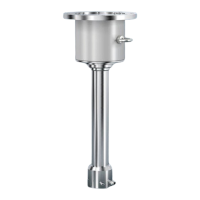
Currently, two probes with different energy-compensated coun-
ter tubes are available for γ or n doserate measurement; they
output the radiation effect as ambient equivalent doserate in
units of μSv/h (micro Sievert/h). The integrated probe LB 1346
is an energy-compensated Geiger-Mueller counter tube for the
range from 0.1 to 20,000 µSv/h and an energy range from 30 -
1300 keV. The external probe LB 1236-H10 is an energy-
compensated proportional counter tube for the measuring range
from 0.05 to 10,000 µSv/h and an energy range from 30 to 1300
keV. With the integration function, the doserate can be integrat-
ed over time to dose, with dose and integration time being dis-
played. The calibration factors, the dead times and the intrinsic
background have been determined by Berthold Technologies
and are already set in the device. The determination of the neu-
tron doserate with the probe LB 6411 or LB 6411-1 is quite
similar to the method described here; a He-3 counter tube is
used to measure the thermal neutrons generated with the help
of a moderator through a nuclear reaction. Without knowing the
neutron spectrum to be measured, we get the correct neutron
doserate and the corresponding dose within a range from
30 nSv/h to 100 mSv/h.
Calculated unit of measurement in activity measurements
The LB 134 is used to measure the activity of samples (alpha,
beta and gamma radiation). One can also choose to display the
count rate (cps) or the decay rate (Bq/pCi/dpm, etc.).
In this function, the alpha-beta proportional counter tube
LB 1238 with end window (about 30 mm diameter) is used as a
detector. In contrast to conventional Geiger-Müller end window
counter tubes, the counter tube LB 1238 can distinguish alpha
and beta activities.
The samples are usually measured in the Counter-Timer
mode to achieve a high accuracy. The statistical accuracy or
the measurement time can be selected as a parameter for the
measuring time. Similar to the contamination measurement, in
this measurement mode you have to enter separate calibration
factors for each nuclide which match your measuring ar-
rangement and the nuclide to be measured. In this measure-
ment mode, the calibration factor is also determined using a
sample with known activity. The ratemeter mode is used in this
function, for example, for the rapid detection of radiation or ra-
dioactive sources, for example, in chromatography, to see if the
radioactively labeled sample already appears in the column.




 To Next Page