KBF P + KBF LQC + KBWF (E6) 11/2016 page 146/189
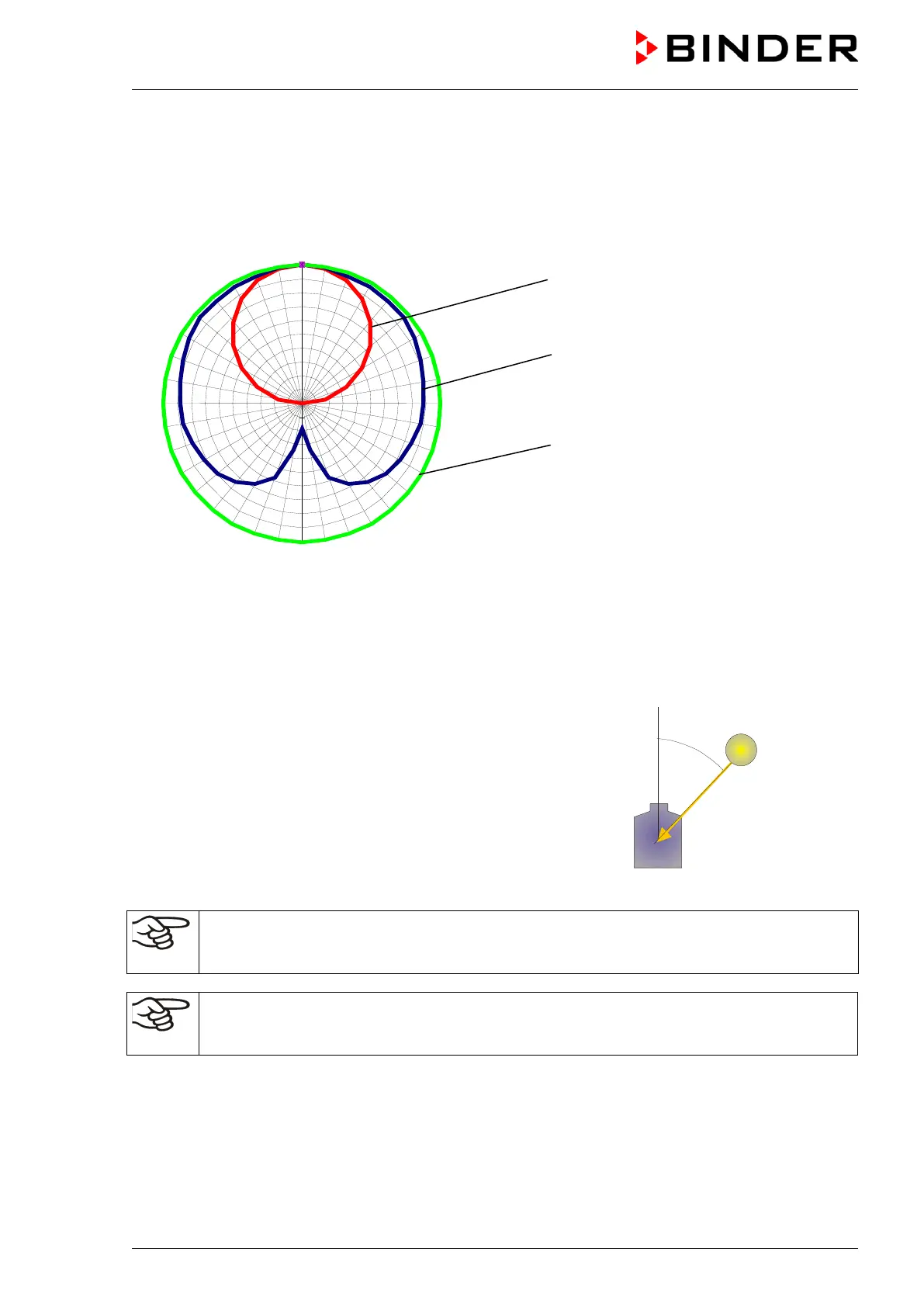
Radiation in a range of +/- 100° around the 90° axis of incidence is weighted almost equally with a factor
between 1.0 and 0.9. Only with greater angles, weighting of the radiation decreases, technically caused by
the sensor foot.
Comparison of different sensor types
Planar sensor
Spherical sensor
(sensor foot at 270°)
Ideal spherical sensitivity characteristics
Figure 32: Comparison of the spatial sensitivity characteristics
of planar and spherical sensors
If a sample is irradiated with light at an angle of incidence of 45°, the
spherical sensor assumes the impinging light quantity as large as the
amount of light that would impinge with vertical irradiation (factor 1).
Since this is true for a sample with spatial extension, the error is zero
in this case.
A planar sensor instead would take into account the cosine of the an-
gle of incidence: cos 45 = 0.71. But due to the spatial extension of the
sample, no correction is necessary. The planar sensor therefore calcu-
lates the amount of light which impinges on the sample by a factor of
0.71 less than the light quantity that would impinge with vertical irradia-
tion. Thus, the light really impinging on the sample surface will be cal-
culated only at 71% of the real value.
Deviation from the vertical: 0°
Light
source
In case of exclusive use of entirely flat samples without spatial extension (e.g. spreaded sam-
ples, film), an overrating of the light which really impinges on the plane surface is possible.
Please contact BINDER INDIVIDUAL customized solutions.
If an independent reference measuring device shall be used to directly compare the light inten-
sities, it must bear the same spatial sensitivity characteristics (spherical) as the sensors of the
BINDER system.


 To Next Page