3-22 2002 Buell S3T: Engine
HOME
INSTALLATION
If only cylinder head work was needed, reinstall cylinder head
following these instructions. If further repair is required, see
3.6 CYLINDER AND PISTON.
1. See Figure 3-9. Coat mating surfaces of cylinder studs
(12) and head screws (1, 2) with parts cleaning solution.
2. Scrape old oil and any carbon deposits from threads by
using a back-and-forth motion, threading each head
screw onto its mating cylinder stud.
3. Remove head screws from studs. Wipe or blow dry
thread surfaces.
4. Apply oil to stud threads and to the underside of the
head screw shoulder.
CAUTION
Only oil film must remain on the head screw surfaces.
Too much oil will pool in the head screw sleeve. Pooled
oil may prevent proper torque application and full thread
engagement.
5. Blow or wipe off excess oil from head screws.
6. Thoroughly clean and dry the gasket surfaces of cylinder
(19) and cylinder head (18).
7. Install a new O-ring (14) on each dowel (15).
NOTE
O-rings (14) help to properly position the head gasket (4). O-
rings must be installed before the head gasket.
8. Install a new head gasket (4) to cylinder.
9. Carefully lower cylinder head over studs and position on
dowels. Use great care so as not to disturb head gasket.
CAUTION
The procedure for tightening the head screws is critical
to proper distribution of pressure over gasket area. It
prevents gasket leaks, stud failure, and head and cylin-
der distortion.
10. See Figure 3-7. For each cylinder head, start with screw
numbered one, as shown. In increasing numerical
sequence (i.e. – 1, 2, 3 and 4):
a. Tighten each screw to 8-10 ft-lbs (11-14 Nm).
b. Tighten each screw to 13-15 ft-lbs (18-20 Nm).
c. Loosen all screws.
11. After screws are loosened from initial torque, tighten
head screws in three stages. Tighten fasteners in
increasing numerical sequence (i.e. – 1, 2, 3 and 4).
a. Tighten each screw to 8-10 ft-lbs (11-14 Nm).
b. Tighten each screw to 13-15 ft-lbs (18-20 Nm).
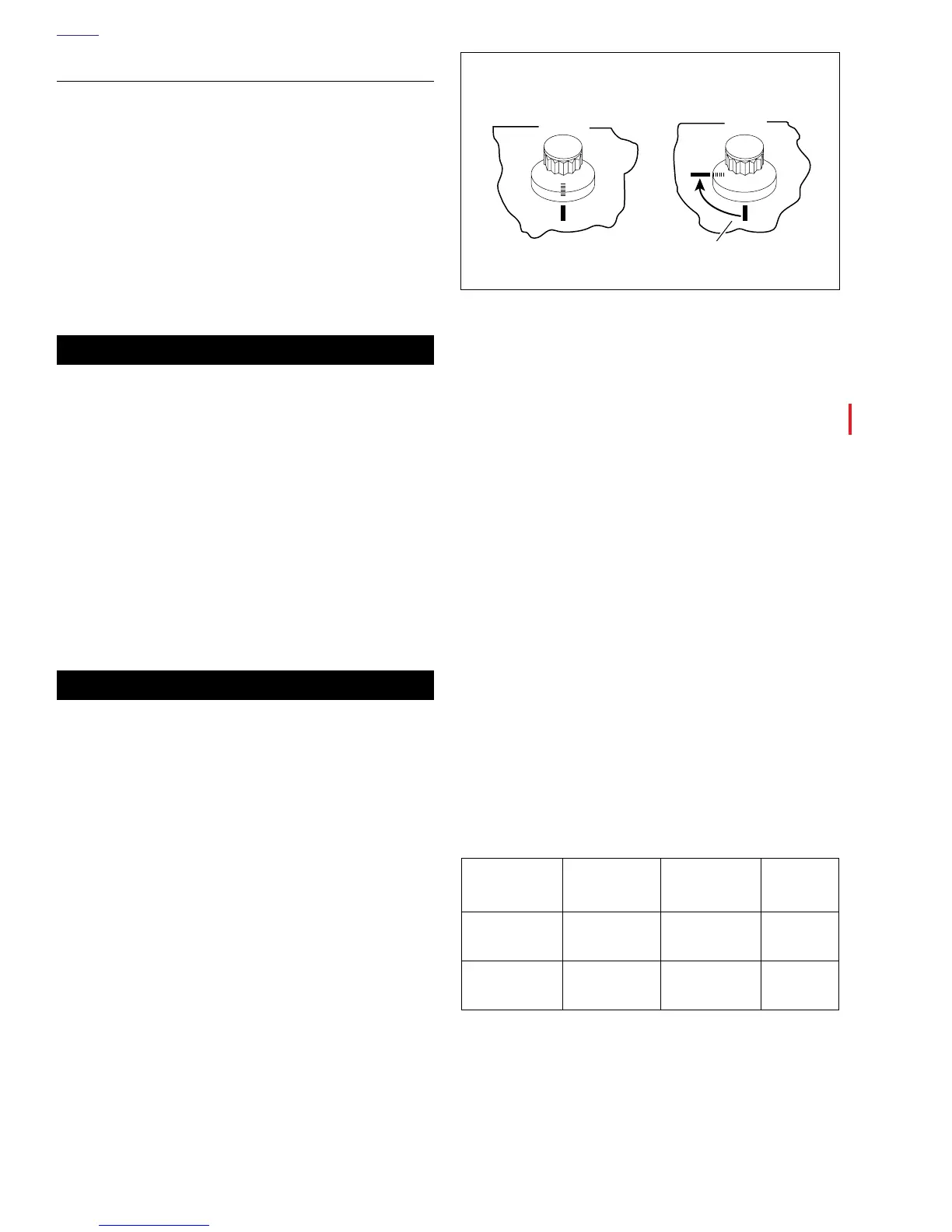
c. See Figure 3-27. Mark cylinder head and head
screw shoulder with a line as shown (View A).
Tighten each screw a 1/4-turn (85°-90°) (View B).
12. See Figure 3-11. Rotate engine so that both lifters (6),
from the cylinder being serviced, will be installed on the
base circle (lowest position) of the cam.
13. Apply a liberal amount of engine oil to lifter assembly
(especially roller needles) for smooth initial operation.
14. Insert lifter (6) into bore in crankcase (1). Rotate lifter so
that flats at upper end of lifter face the front and rear of
the engine. If the lifter is installed incorrectly, pins (2)
cannot be inserted.
15. See Figure 3-11. Insert anti-rotation screws (2). Tighten
to 55-65 in-lbs (6-7 Nm).
16. Install push rod covers.
a. Slide new seal (8) and retainer (9) over top of push
rod cover (7).
b. Position new O-ring (10) at top of push rod cover.
c. Hold cover at an angle and insert top through hole in
cylinder head. Push up on cover while aligning bot-
tom of cover with lifter bore in crankcase.
d. Lower retainer (9) with seal (8) onto crankcase,
aligning locating pin (15) with hole in retainer.
e. Insert screw (11) with washer (13) through hole in
retainer (9). Thread screw (11) into tapped hole in
crankcase. Tighten to 15-18 ft-lbs (20-24 Nm).
NOTE
Intake push rods and valves are located next to the carbure-
tor’s intake manifold; exhaust push rods and valves are next
to the exhaust headers.
17. Identify push rod color coding, length and respective
push rod positions in engine. See Tabl e 3-5. Place intake
and exhaust push rods onto seat at top of lifter.
Figure 3-27. Tightening Head Screws
Table 3-5. Push Rod Selection Table
POSITION
COLOR
CODE
LENGTH
PART
NUMBER
Exhaust
(Front & Rear)
3 Band-Pink
10.800 in.
(274.320 mm)
17904-89
Intake
(Front & Rear)
1 Band-Brown
10.746 in.
(272.948 mm)
17897-89
View
A
View
B
b0094x3x
Tighten head screws 1/4-turn in
the third stage of installation















 To Next Page