Cellwatch Frontier System Installation & User Manual
Section I – Installation Guide-56
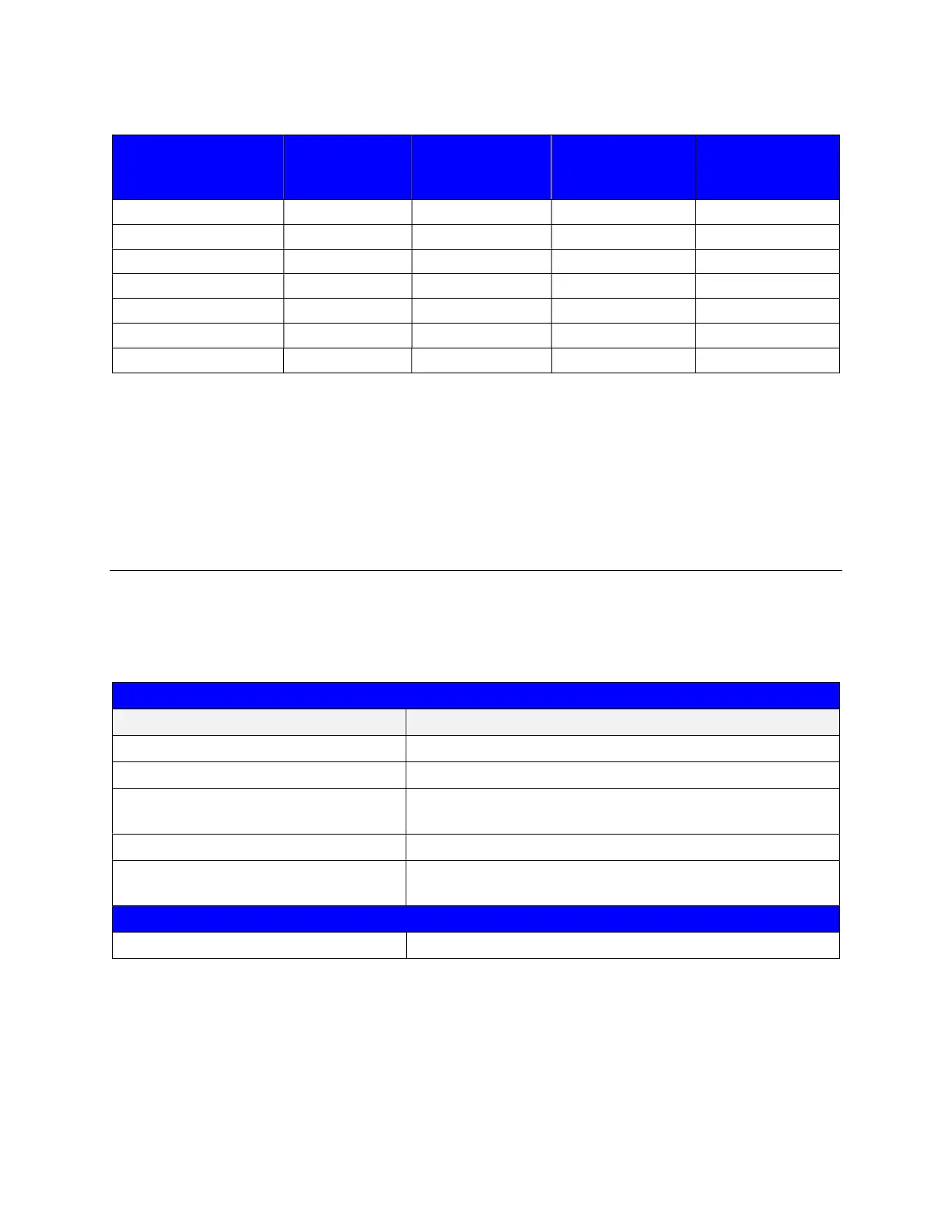
Method 2
Connection order Cable Colors
(2V system)
(12V system)
1st White Most Negative 0 volts 0 volts
2nd Blue Most Negative 0 volts 0 volts
3rd Brown Most Positive 8 volts 48 volts
4th Red Most Positive 8 volts 48 volts
5th Green 2 volts 12 volts
6th Yellow 4 volts 24 volts
7th Orange 6 volts 36 volts
Once the DCMs are installed, fiber optics run, current transducers, temperature probes, digital inputs,
and relays have been connected, the system can be configured using the Frontier web interface.
Instructions on connecting to the Frontier interface can be found in Section II – User Guide. Battery
configuration information can be found in the section titled Battery Design.
Installation: Frontier Electrolyte Level Detectors
This section will provide an overview of the installation and functionality of the Frontier Electrolyte Level
Detector (FED) devices.
Specifications
FED Specifications
Description Frontier Electrolyte Level Detector (FED)
Power Supply 12 VDC (through Interface Module)
Cable provided with each FED unit 1 ft. CAT5
Cable provided for inter-tier
connections
3 ft. CAT5
Dimensions 2.17" x 1.59" x 0.79" 55.02 mm. x 40.4 mm. x 20 mm.
Max. number of FED units per Frontier
system
250
Interface Module
Power Supply AC (100-240V) or DC (24V)
How it Works
The Frontier Electrolyte Level Detector (FED) contains a set of emitters and detectors that, when
calibrated, detect the internal fluid levels of a container. As the electrolyte level drops below the fill


 To Next Page