Cellwatch Frontier System Installation & User Manual
Section II – User Guide-89
Identifying failures
Ohmic value can change depending on the state of charge of the cell. Any time a high ohmic value is
detected, the cell torque and state of charge should be checked to determine if the cell simply needs to
be boost charged or if it should be replaced.
High ohmic value readings are often an indication of a failing cell. If a high ohmic value cell is identified
with a low charge voltage and a poor discharge performance, it should be considered for immediate
replacement.
Variability with other instruments
The DCM can and likely will vary slightly from hand-held battery testers as each device uses different
test methods. While nearly all devices will use the same equation from Ohms Law, the sampling
method, current draws, and depth of discharge will vary. These variances will cause inconsistencies
between devices.
Current Alarms
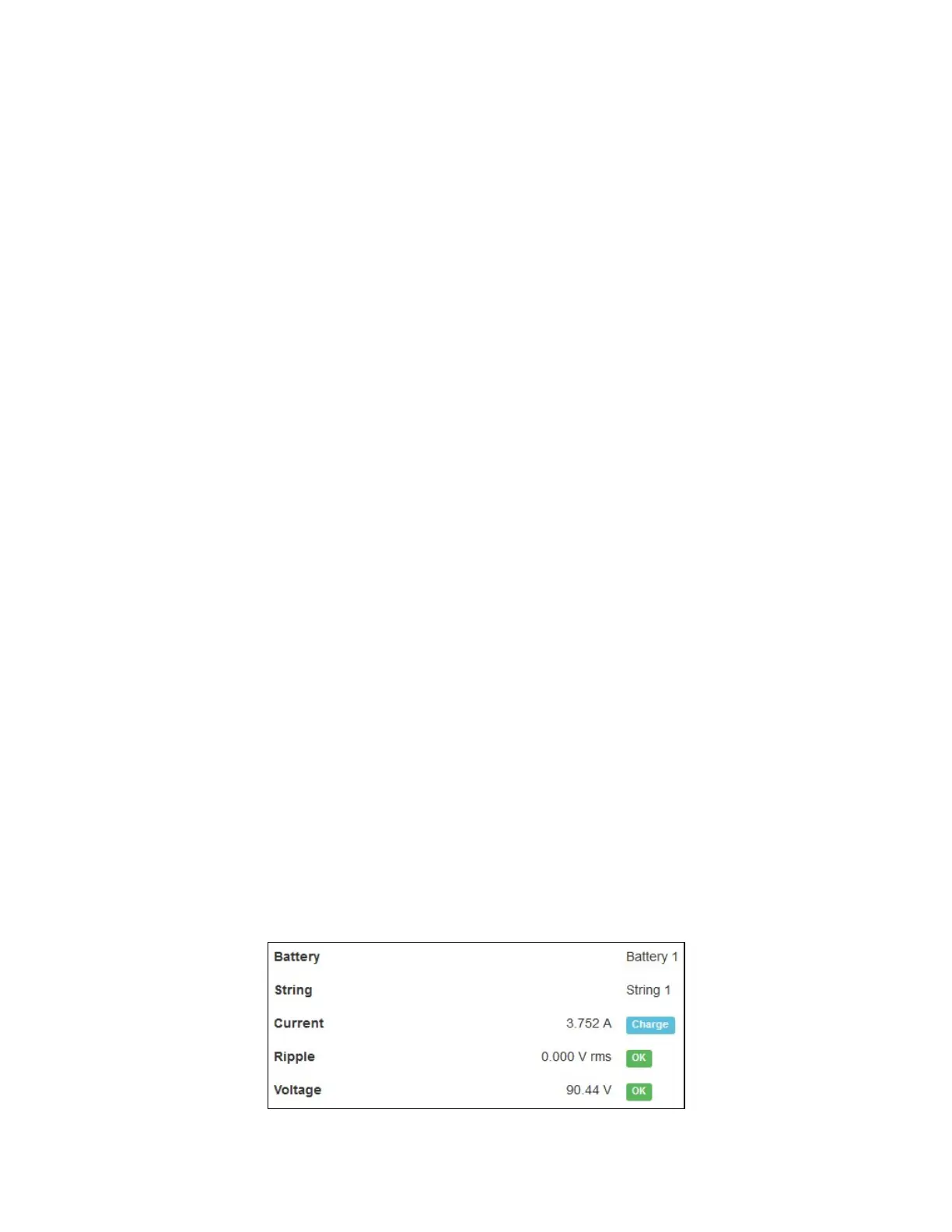
Current flow events are indicated by the direction of current either into or out of the battery. Current
flowing out of the battery as a load is placed on the system is considered a discharge event. Once the
load is removed and a charger provides current flow into the battery, this is considered a charge event.
Discharge events
A discharge event occurs when the DC charger is not capable of supporting the load and the battery is
utilized to supplement the power required by the system. Load amounts and discharge rates will vary
depending on the size of the system and the size of the load. It can be useful to capture discharge data
for analysis of the overall state of the battery. Frontier collects voltage, current, and temperature during
a discharge event, allowing the user to see how well the battery performs under expected loads over a
period of time.
Charge events
Charge events indicate current flowing into the battery. A higher precision probe is required to monitor
float current. Analysis of this data can be used to show the length of time required for the battery to
return to a fully charged state and will record voltages to show the overall performance of each
individual container.
Setting a charge limit does not place the Frontier system into alarm if triggered, but it can be used to
optionally monitor charge events for graphing and data analysis.


 To Next Page