FIMER_PVS-175-TL A.1 Version_Product manual_EN_RevC-
F
130
•
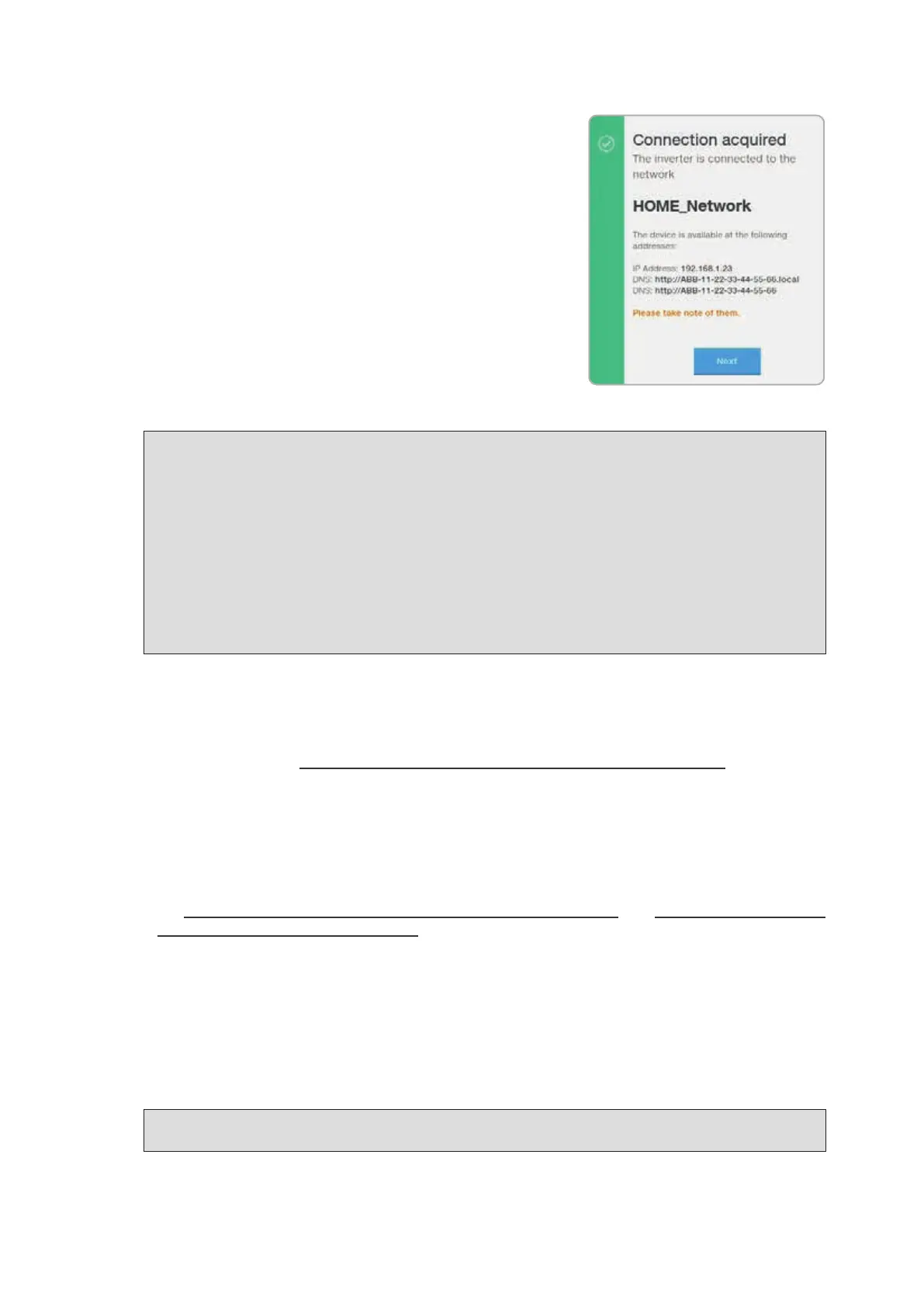
Once the tablet/smartphone/PC device is switched to the local
wireless network a new message will confirm that the
connection is acquired.
•
Click the “Next” button” to complete the setup of “Station
Mode”
NOTE – D In order to use the “Host Name” as an alternative to the dynamic IP address, the
Wi-Fi router to which the inverter is connected (when operating in “Station Mode”) must
provide the Domain Name System (DNS) service (contact the network administrator for
further information regarding the presence or absence of the DNS service in the Wi-Fi
router or how to enable it). In this way, even if the IP address assigned to the inverter should
change over time, (dynamic IP), it will always be possible to use the same “Host Name”
which will remain unchanged over time.
NOTE – D The IP address assigned may vary for reasons connected to the wireless router
setup (for example, a very brief DHCP lease time). If verification of the address is required,
it is usually possible to obtain the client list (and the corresponding IP addresses) from the
wireless router administration panel.
RS485
In the RS485 sub-menu it’s possible to adjust the settings relating to the RS485 main communication
port (43) (refer to the “Connection of the communication and control signals” paragraph for
further information about the port connection). In particular it is possible to set:
• RS485 Node address: It allows you to sets the address (any value from 2 to 63 is allowed).
• RS485 Baud Rate: It allows you to sets the Baud Rate (2400/4800/9600/19200/34800/57600/1152
00).
• RS485 Parity Mode: It allows you to set the Parity bit (No Parity, Even Parity, Odd Parity).
• RS485 Protocol Type: It allows you to sets the communication protocol to be used for the RS485
line when the port is set as SLAVE or to enable the port itself to work in MASTER mode (refer to
the “Serial communication connection (RS485 - Slave mode)” and “Serial communication
connection (RS485 - Master mode)” paragraphs for further information on SLAVE and MASTER
operating modes).
In particular it is possible to select among the following values:
- “Modbus SunSpec Server”: SunSpec complaint Modbus RTU communication protocol enabling
monitoring and controlling of the inverter by FIMER as well as third party systems (SLAVE
operating mode).
- “Device Acquisition”: Enables polling and logging of data from FIMER supported accessories
directly connected with the RS485 port like VSN800 Weather Station, digital environmental
sensors, meters (MASTER operating mode).
NOTE – D Please refer to official SunSpec Alliance documentation at www.sunspec.org, for
details on SunSpec communication protocol.
DEBUG SETTINGS
In the Debug Settings sub-menu it’s possible to enable or disable the Debugging access for FIMER
Service purposes.


 To Next Page