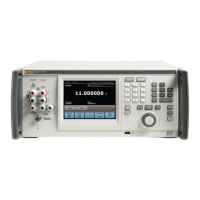
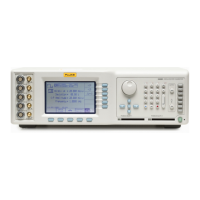
5322A
Operators Manual
50
Set the Compensation of Test Lead Resistance Value
The Product offers compensation for test lead resistance used for Line or Loop
impedance calibration. The resistance value of the leads in use or a cable
adapter can be entered and saved in the Setup menu independently for Loop
and Line mode.
To enter the value:
1. Push the Setup softkey.
2. With the cursor keys or rotary knob, move the cursor to Loop impedance or
Line impedance and either push the Select softkey or push in the rotary
knob.
3. With the cursor keys or rotary knob, move the cursor to the Series
resistance parameter and either push the Select softkey or push in the
rotary knob.
4. Enter the actual test lead series resistance and push the WRITE softkey to
confirm.
The Loop impedance and Line impedance function do not share the same series
resistance parameter. If the same test leads are applied for both functions, the
series resistance parameter has to be entered into both functions.
The Product cannot measure test lead resistance. The resistance value must be
measured with a suitable ohmmeter.
Use the Leakage Current Function
The Product employs these leakage current modes: passive leakage current,
active leakage current (5322A/VLC and 5322A/5/VLC only), differential leakage
current, substitute leakage current and Help. There are two special test modes
for substitute leakage:
• Substitute Short
• Substitute Open
To select a leakage current mode:
1. Push .
2. If the leakage current mode that you want is not shown, push the Mode
softkey.
3. Using the cursor keys or rotary knob, highlight a selection (Passive,
Substitute, Differential, or Active) and either push or push in the
rotary knob.
The primary difference between passive/differential leakage current and
substitute leakage current is the voltage used. Passive/differential leakage uses
the line voltage of the DUT. Substitute leakage current uses voltages in the range
of 50 V.


 To Next Page