OmniSTAR 8200HP User Manual
Issue 1.07, 10/2008
47
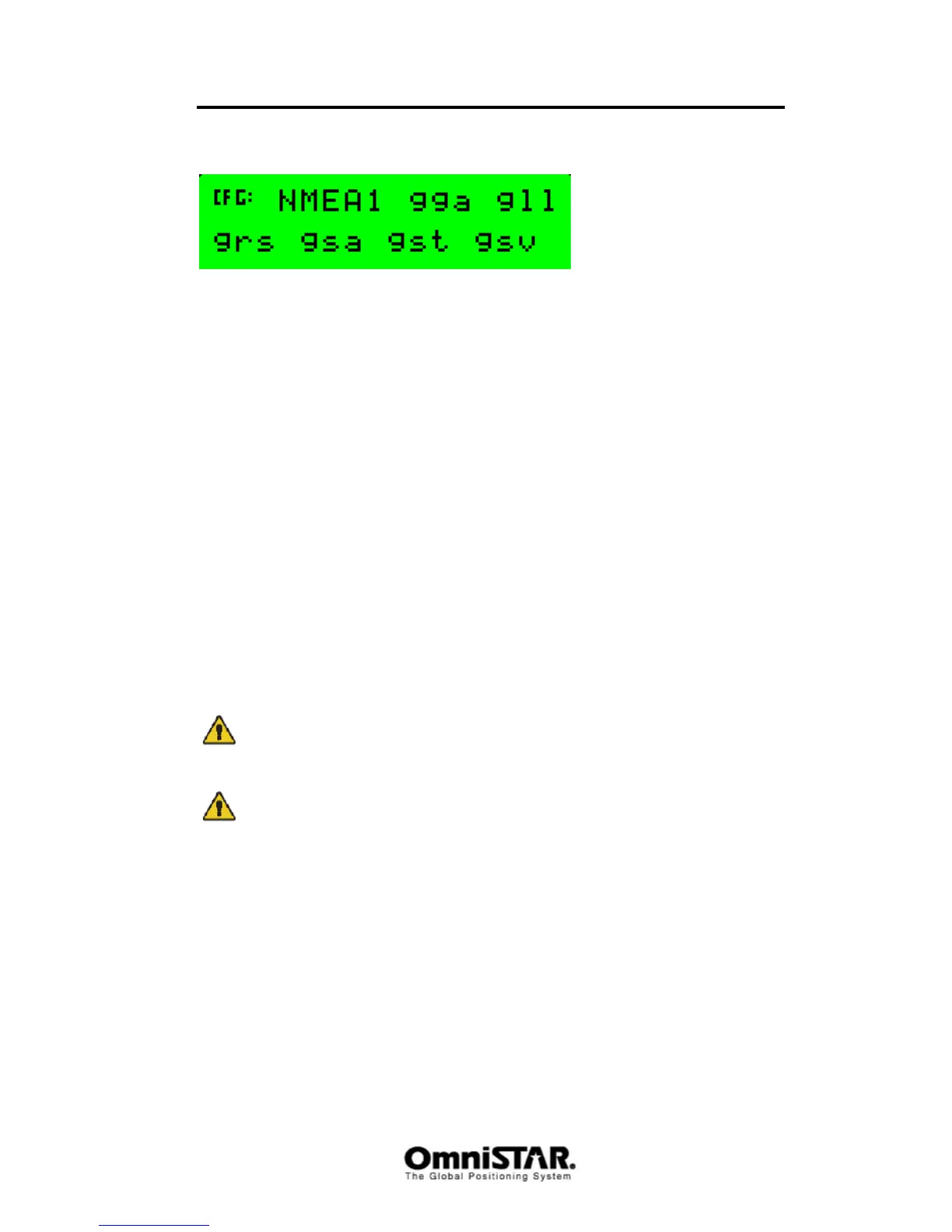
NMEA1 Messages
Figure 89: NMEA messages 1
The NMEA messages screens are used to control the NMEA output of the
8200HP. Messages set in lower case are not output, messages set in upper
case are output when the output protocol is set to NMEA. The 8200HP is
capable of outputting a number of NMEA messages, that may not all be
needed as inputs for the attached device. Furthermore, the number of NMEA
messages that can be sent by the 8200HP also depends on the baudrate of
the communication port and the set output rate of the NMEA messages.
For example: Selecting GGA, GSV and RMC to be output at a 5 Hz. output
rate, with an average of 8 satellites in view (so 2 GSV messages for every
GGA message), the baudrate (bits per second) can be calculated as follows:
1 GGA-message = 89 bytes * (8+1) bits/byte = 801 bits
2 GSV messages = 2*72 bytes * (8+1) bits/byte = 1296 bits
1 RMC message = 77 bytes * (8+1) bits/byte = 693 bits
Total 2790 bits
5 Hz. output = 5 * 2790 = 13950 bits/sec.
In the above example, the baudrate should be set to the next higher standard
baudrate, which is 19,200, to prevent a buffer overflow of the COM-port.
Warning: The above calculation is indicative, based on an average
message length count. Actual values may differ, yielding
different outcomes.
Warning: The initial NMEA standard called for a baud rate of only
4800. As a result, many external devices are still set to
communicate with a GPS receiver at 4800 baud. This is an
average of only 6 NMEA messages per second. Therefore,
be aware not to select too many NMEA messages or a
very high output rate for NMEA output, unless you have
set the baudrate on both the communication port of the
8200HP and the communication port of the external device
to a (much) higher value first.


 To Next Page