6. DATA REPORT AND POLLING
6-11
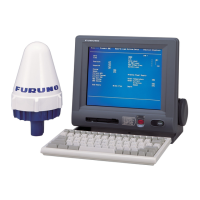
6.5.2 About the LRIT system
Power the equipment and keep it logged in at all times except for special occasions
such as when the ship is dry-docked for repairs. Position information is automati-
cally sent at fixed intervals, thus no operation is required. However, keep the equip-
ment in a ready state to received commands from the LRIT data center. Combined
use for routine messages, distress messages and SSAS (Ship Security Alert Sys-
tem) is possible.
The source of position data for this equipment can be its internal GPS receiver or
external GNSS (Global Navigation Satellite System) equipment. For GNSS equip-
ment, interface directly to the shipborne global navigation satellite system equip-
ment.
If external GPS equipment is used, set it to use WGS84 datum. Further, the output
sentences should minimally be as follows:
• Time data input: ZDA
• Position data input: RMC or GGA and VTG (pair)
This equipment and external GNSS equipment must be powered in the following
manner.
• If the above equipment is used as a GMDSS device also, connect them to an
auxiliary power source (radio communications battery).
• If the above equipment is not used as a GMDSS device, connect them to both
main and emergency power sources (via AC/DC Power Supply Unit PR-240/
241).
If an error message appears, take the necessary measures to restore normal op-
eration as soon as possible. Shown below are representative alarms.
• "WARNING: External NAV equipment failure." Position data is not input from
the external GNSS equipment. Check the GNSS equipment and the wiring be-
tween it and the FELCOM.
• "WARNING: Internal GPS UNIT failure." Position data is not input from the in-
ternal GPS receiver. If this alarm occurs frequently, have the set checked.
• "WARNING: Synchronization loss." Check the current Ocean Region.
• "WARNING: BBER over 80%. Scanning NCS start manually." Problem with
receiving the Inmarsat-C signal. Check if the current sea area is suitable for your
position. If it is not, change the sea area. If the area is suitable and the alarm con-
tinues, check the antenna and antenna cable. Request service if the problem
persists.


 To Next Page
 Loading...