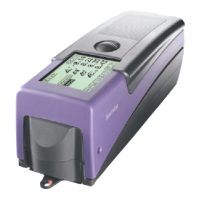
SpectroEye™ 63
2
2 • Use
In practice the densitometric
analyses are based on paper
(Pap setting) while the spectro-
photometric ones are based on
the integrated white reference
(Abs setting). It is advisable to
select the Auto setting and
change it only in special cases.
- White base
For a correct spectral or density measurement,
the corresponding white base must be defined.
The following settings are available
- Auto -> automatic selection
- Pap -> paper white
- Abs -> absolute white
If you select Pap, as white base, all subsequent
measurements will refer exclusively to the printed ink layer,
while the paper color effect will not be included. To obtain
the basic base reference you should always measure
the paper used.
If you select Abs, besides the printed ink layer, the
measurement will also include the paper effect.
Here the integrated white reference will be used as
the white base.
If you select Auto, SpectroEye will automatically use the
white base usually adopted for the selected function.
For densitometric functions, this is the white base of paper,
while for spectrophotometric functions it is the absolute
white base.
- Illuminant
To calculate the special color values, select the desired
normalised illuminant.
The most commonly used normalised illuminants are
already available:
A, C, D65, D50, F2, F7, F11
The normalised illuminants of D and F series must be
set-up using the Dxx and Fxx menu items. When you
perform this selection, an additional menu line appears,
where you can select the desired color temperature.
Here the following illuminants are available:
Fxx: F1 to F12
Dxx: D30 to D300
- Observer angle
When analysing the colorimetric values, the calculation
and consequently the result depend on the definition of
the observer angle.
In this menu line you must select the observer angle,
normally between 2° and 10°.
Usually the normalised illuminant
for the Graphic Arts industry used
in the USA is D50 while in Europe
it is D65.
You can freely select one of the two
settings. It is extremely important
that for chromatic comparison the
selected setting is always kept
constant.


 To Next Page