Measurement Quick Start
3-11
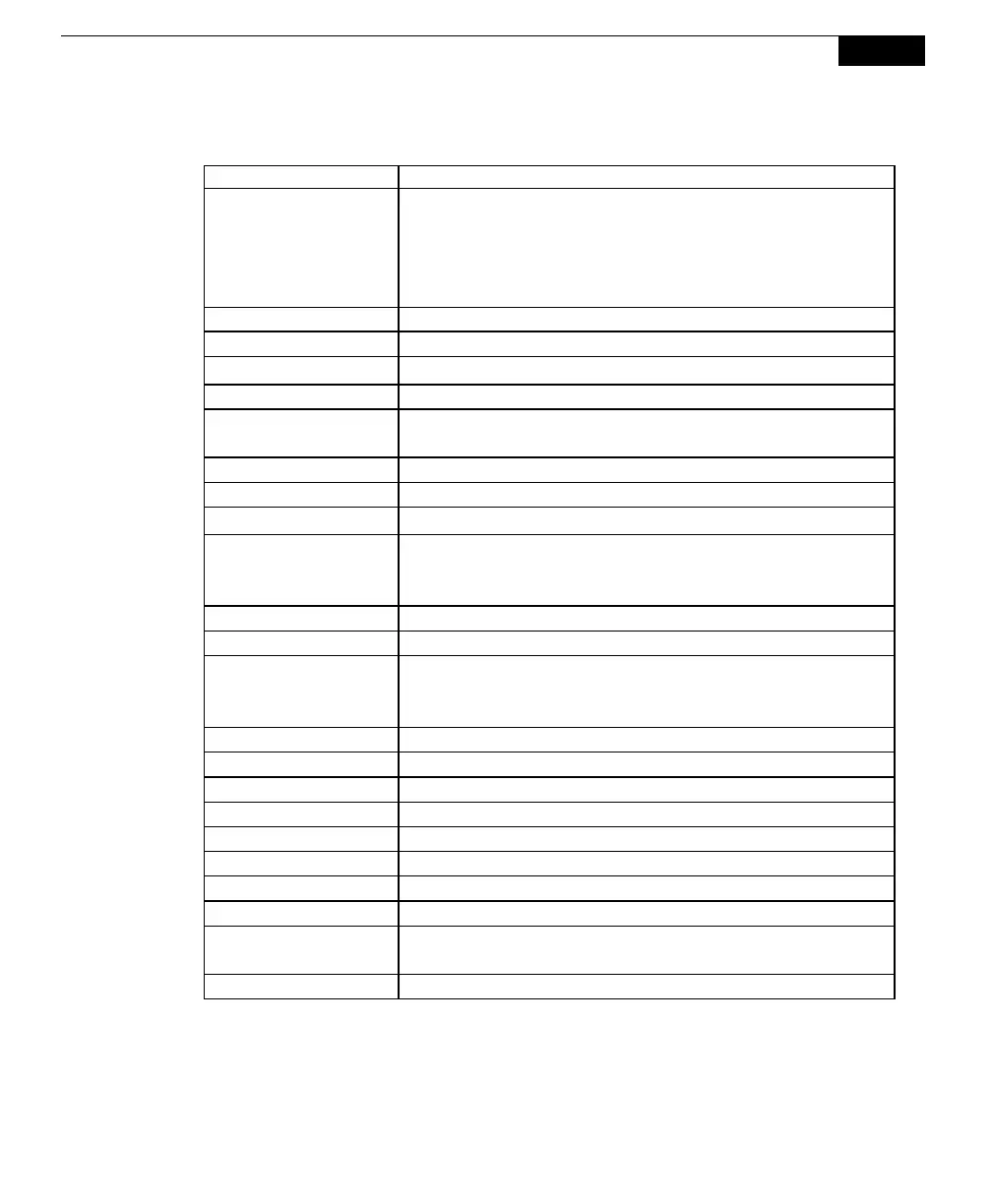
Label Description – Footer Variables
CrvFitStatus Curve fit solution. “Exp” means the exponential fit was
better than the linear fit (Exp_SSN<Lin_SSN). “Lin”
means the linear fit was still better after the maximum
number of iterations, and the non-linear coefficients
have therefore been derived from the linear fit
Exp Flux Flux computed from Exponential Fit
Exp_FluxCV Coefficient of variable (%) of Exp Flux
Exp_dCdry/dt Slope of the Exponential Fit at time t
0
(Eq. 4-15)
Exp_R2 Correlation coefficient for Exponential Fit
Exp_SSN Normalized sum of squares of residuals for Exponential
Fit
Exp_SE Standard error (%) of the Exponential Fit
Exp_a The a term in the Exponential Fit
Exp_Cx
The
C
term in the Exponential Fit
Exp_Co The C
o
term in the Exponential Fit. Usually the IV
value of Cdry, but if followed by *, indicates it has
been manually set.
Exp_t0 The t
o
term in the Exponential Fit
Exp_Iter Number of iterations used in the Exponential Fit
Exp_MaxIter Maximum number of iterations allowed for the
Exponential Fit. This is fixed to 10 in the LI-8100A (but
can be ajusted in the FV8100 program)
Lin Flux Flux computed from Linear Fit
Lin_FluxCV Coefficient of variable (%) of Lin Flux
Lin dCdry/dt Slope of the Linear Fit
Lin_R2 Correlation coefficient for the Linear Fit
Lin_SSN Normalized sum of squares of residuals for Linear Fit
Lin_SE Standard error (%) of the Linear Fit
Crv_Domain Time span (s) used in the curve fit
Crv_#Smp Number of data points used for curve fitting
Dead Band Time (s) after the chamber closes that are skipped by
the analysis, in the latest (re-)computation
TimeClosing Time, in seconds, it took the chamber to close



 To Next Page