6-18
Using the 10 and 20 cm Survey Chambers
This is important in certain cases where environmental factors may influence
the amount of CO
2
or moisture that is present in the gas sampling lines. For
example, in hot, moist conditions, you may want to increase the Post-purge to
ensure that the gas sampling lines are purged of moisture that may condense
in the lines, before the next measurement using that chamber is started. In
most cases, a Post-purge of about 45 seconds is adequate.
IMPORTANT NOTE: The Post-purge function was added to the Windows
Application Software V2.0 to accommodate the use of multiple chambers with
the LI-8150 Multiplexer, where it is important to purge the gas sampling lines
before making the next measurement with that chamber. Because the Post-
purge starts after the measurement is complete, it has slightly different
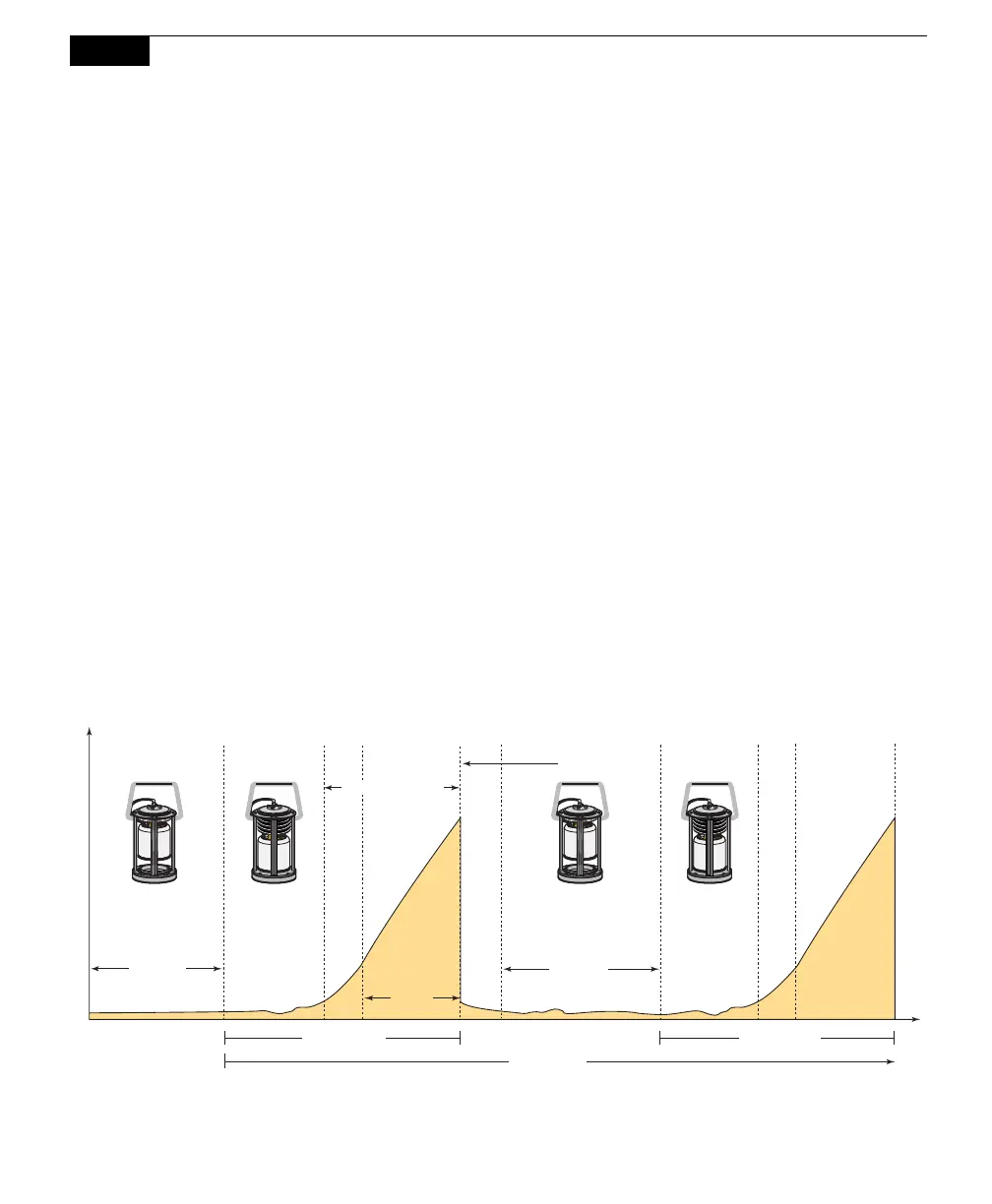
implications for use in single-chamber mode. As shown in the chart below,
after the first measurement is complete, the Post-purge starts, followed by the
Pre-purge; thus, the Post-purge and Pre-purge become additive. In most
single-chamber applications, the combination of the two delays is excessive.
Note, too, that before the first measurement starts, the chamber will not close
until the Pre-purge has finished; again, in most cases this delay is unwanted,
particularly when moving the chamber from collar to collar. For these
reasons, you may want to use the Post-purge value instead of the Pre-purge;
in other words, set the Pre-purge to zero, and set the Post-purge to 20-30
seconds, or more, depending on the conditions described above at “Pre-
purge”.
CO
2
Concentration (μmol/mol)
Observation #1
Measurement
(includes n observations)
Observation #2
Chamber
Closes
Chamber
Is Open
Chamber
Opens
Dead
Band
Post-
purge
Dead
Band
Summary
Records
Logged
Chamber
Closes
Data
Logged
Data
Logged
Pre-purge
(optional)
Pre-purge
(optional)
Observation Length
Range for
Summary
Records



 To Next Page