STARTING AND DRIVING
AXLES
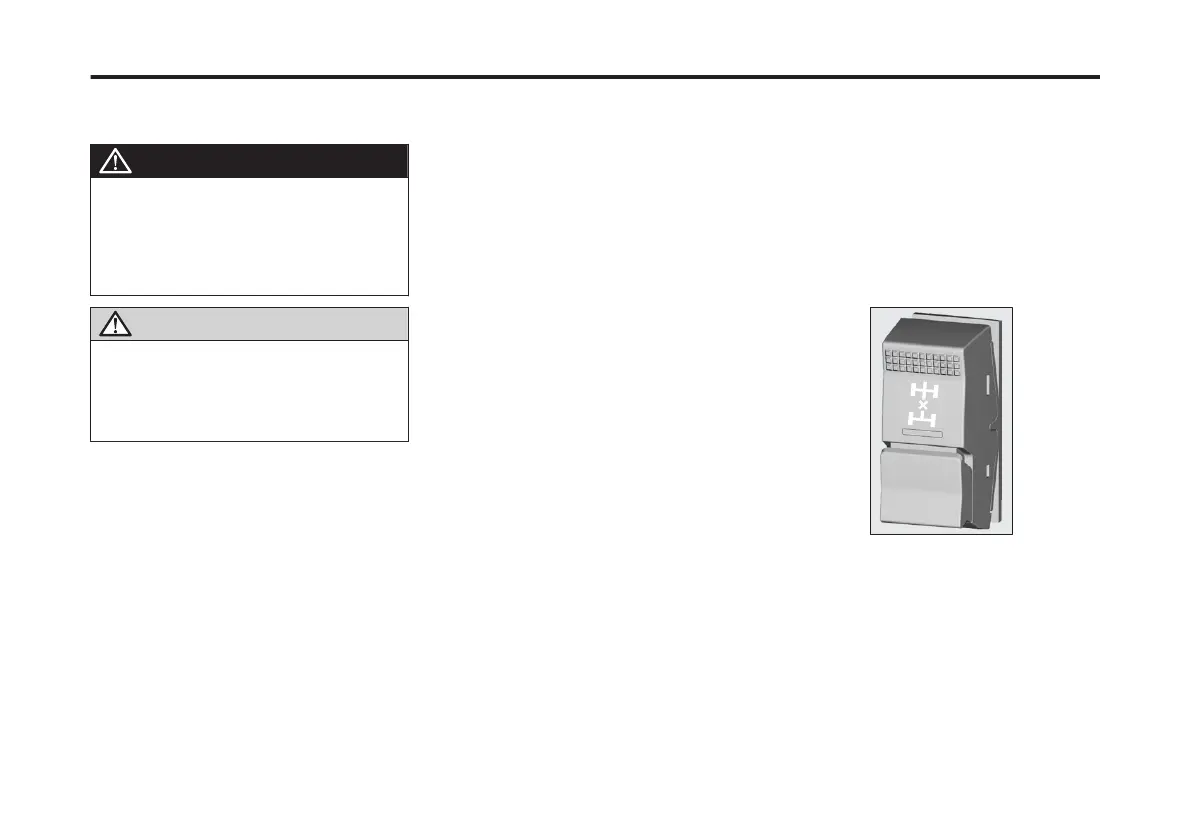
Differential Locks
DANGER
DO NOT drive on dry, paved surface with
the differential lock engaged. The vehicle
strives to maintain a straight line. Taking a
curve with the differential lock engaged
can cause an accident, leading to serious
personal injury or death.
CAUTION
Never operate the vehicle with the
differentials locked any longer than is
necessary. This state places a great strain
on the axles and can cause rapid tire
wear.
Under normal traction conditions, do not
engage the differential lock. If possible,
do not use the differential lock while
taking a curve. With good traction and
the differential lock engaged, the vehicle
is under steered and therefore tends to
drive straight in a curve. When using the
lock on good traction surface, drive
cautiously and do not exceed 40 Km/h
(25 mph). Disengage the lock as soon as
possible.
When the differential lock is disengaged,
the couplings can be under tension.
Disengage the lock by returning the
switch to the OFF position. Help with the
disengagement by briey letting up on
the accelerator to relieve the torque on
the couplings.
The drive axle can be equipped with the
differential lock. The single drive axle
only has a wheel differential lock. With
tandem drive axles; there could be both
interwheel differential lock and an
interaxle differential lock.
Use the differential lock on icy or
slippery surfaces. When the slippery
surface is passed, disengage the
differential lock. The differential lock
must not, under any circumstances, be
engaged when in a wheel-spin situation.
Engage the lock ahead of the slippery
area. If already slipping, stop the wheels,
engage the lock, and then continue.
Engaging the differential lock when the
wheels are spinning, damages the
differential and the rear axle drive unit
could possibly fail.
All efforts must be made to avoid
spinning the wheels at high speeds on
slippery surfaces. This fact is true
whether the differential lock is engaged
or not. Excessive wheel spin can result
in failure of the cluster gears, axle shafts
and other components found within the
rear axle housing. If unable to obtain
traction, engage the differential lock as
described. If still unable to move the
truck, seek assistance from a qualied
tow operator. Engaging the differential
locks must always be done as follows:
1 Press the service brakes. If
necessary, press the clutch pedal.
Wait for the drive wheels to stop
spinning.
2 Press the Differential Lock switch.
3 Select a suitable gear for the
transmission.
4 Release the service brakes. If
necessary, release the clutch pedal.
Interaxle Differential Lock Switch
173
X Publication_PC28


 To Next Page