MAINTENANCE, LUBRICATION AND SERVICE
COOLING SYSTEM
DANGER
Coolant is toxic; risk of poisoning. DO
NOT drink coolant. Use proper hand
protection when handling. Keep coolant
out of reach of children and animals.
Failure to follow these precautions can
cause serious illness or death.
WARNING
DO NOT raise the engine hood if you see
or hear steam or coolant escaping from
the engine compartment. Wait until steam
or coolant cannot be seen or heard before
raising the hood.
DO NOT remove the coolant ll cap if the
coolant in the surge tank is boiling. Also,
DO NOT remove the cap while the engine
and radiator are still hot. Scalding uid
and steam may be blown out under
pressure if the cap is taken off too soon
and can cause personal injury.
WARNING
Coolant may be combustible. Coolant
leaked or spilled onto hot surfaces or
electrical components can cause a re.
Clean up coolant spills immediately.
CAUTION
Mack Trucks does not recommend using
plain water in the cooling system. Water
alone is corrosive at engine operating
temperatures and does not provide
adequate boiling protection. The engine
may develop corrosion and cavitation
problems in the engine and radiator, and
the boiling point of the coolant is lowered
compared to a proper antifreeze and
water mixture. Failure to follow Mack
Trucks cooling system care/maintenance
recommendations can render the warranty
invalid.
The cooling system plays an important
role in overall engine performance by
keeping the engine within the normal
operating temperature range; hot
enough for efcient combustion, and
cool enough to prevent engine damage
caused by overheating. Good preventive
maintenance practices, along with
monitoring cooling system performance,
go a long way in preventing engine
damage that could result from cooling
system problems. The maintenance
items and tests outlined in this section
should be performed at the intervals
specied to ensure optimum
performance from the cooling system.
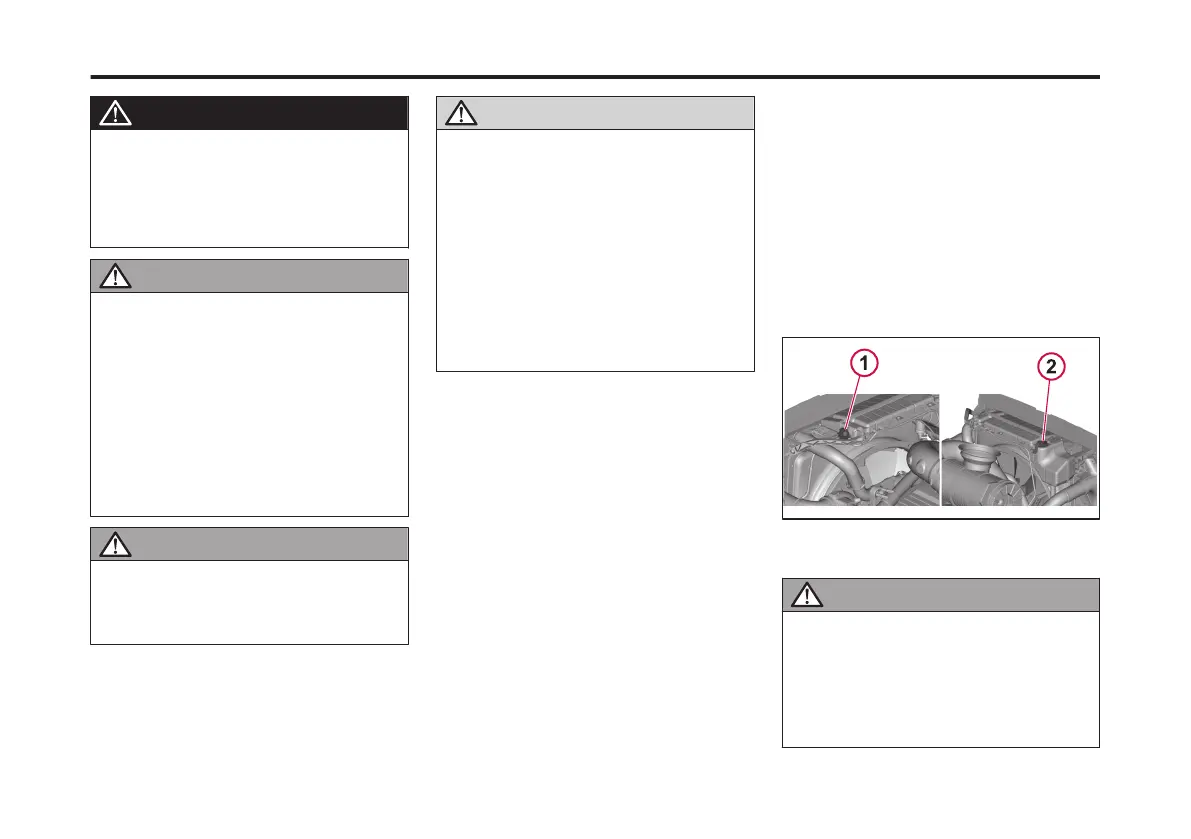
Surge Tank Cap (Conventional
Models)
The surge tank cap on your vehicle is
mounted on top of the radiator. The
surge tank has a ll cap located on the
top right-hand side of the tank, and a
pressure cap rated at 16 lb. which
incorporates an overow tube located
on the left-hand side of the tank. Check
the coolant level regularly, making sure
the coolant level is between the COLD
MIN and COLD MAX lines on the back
of the tank. Inspect the rubber gaskets
on each of the caps. Replace the cap(s)
if the gaskets show evidence of damage
which could affect sealing.
1 Pressure Cap
2 Fill Cap
WARNING
DO NOT remove the ll cap while the
cooling system is hot. Allow the system to
cool sufciently before removing. Turn the
ll cap slowly counterclockwise and wait
for the pressure in the system to dissipate.
After the pressure has dissipated,
completely remove the cap.
269
X Publication_PC28


 To Next Page