VS 2001
Technical Handbook
Technical Description
Page 38 Marconi Proprietary information
P/N: 779-0373/02
Revision 02
Note that in Trunking Mode, the SD3 oscillator will be at the frequency necessary
to generate the TX carrier (in Trunking Mode the operating transmitted frequency is
10 MHz down translated respect to the reception frequency). This enables a
common SD3 in the RX/TX paths.
After the first conversion, the received signal is passed to the first intermediate
frequency block (IF block) where it is firstly amplified, than filtered and finally
amplified again. Successively the received signal enters the AD607 component,
where a second frequency conversion from Fif1 to Fif2 takes place (see Tab. 2.4).
For this operation the local oscillator is the same VCO SD2 (set at Flo2) used for
TX carrier generation (see Fig. 2.9 and Tab. 2.4).
Finally the last conversion from Fif2 to I and Q base band components is carried
out in the I/Q Demodulator block with PLL frequency set at Flo3 (see Tab. 2.4).
The TX carrier (obtained by means of the mixer that combines SD2 and SD3
signals) is filtered by a group of four tuneable π LC cells (controlled by VT4 to VT7
signals) in order to filter out the undesired products of the mixer before being
amplified. The Tx carrier is then divided into two separate paths through the
Splitter. One part is sent to the Cartesian Loop passive I/Q Demodulator, which
serves to linearize the P.A. signal and the other to the phase shifter realised by
using a passive I/Q Modulator. The phase displacement introduced by this block is
a function of the VIB and VQB control voltages and determines the Loop stability.
The phase shifter output is sent to the I/Q Modulator. The low frequency
components at the input of this modulator are the results of a summing block
(closing of the Loop and the direct line feedback) dependent on the ITX and QTX
components. These are generated by the DAC TX AD1866, by the TX feedback
loop demodulated signals and by the IOB and QOB controls for residual carrier
rejection.
The AD1866 receives, through the J15 connector, I and Q components for serial
lines transmission and generates ITX and QTX low frequency components for the
modulator.
The modulator output is amplified and then passed to the P.A. card input through
the J11 coaxial connector. The blip from the P.A. directional coupler (feedback
loop input) enters the vehicle R/T card through the J12 coaxial connector.
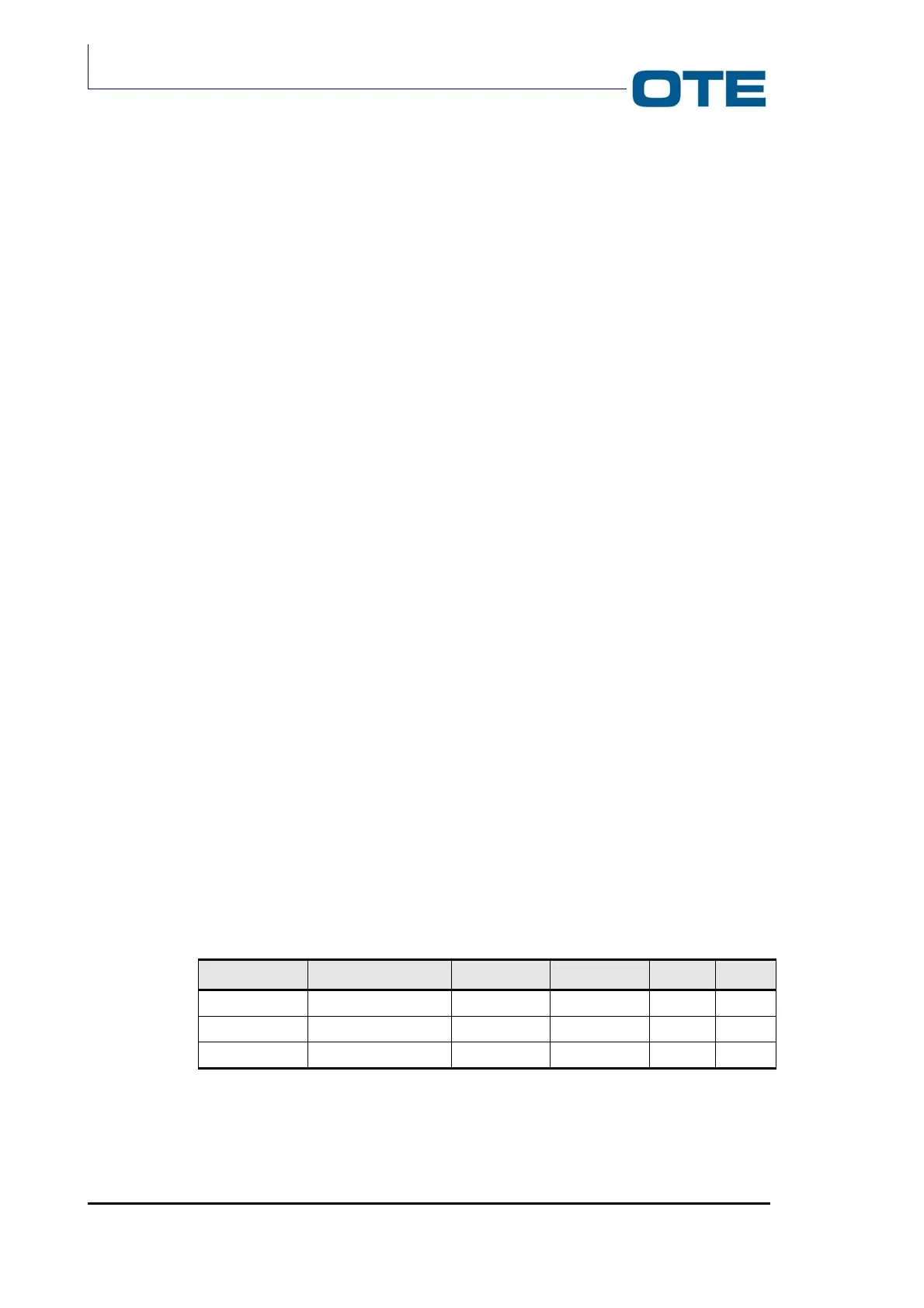
Tab. 2.4: R/T frequencies
Version Flo1 (SD3) Flo2 (SD2) Flo3 (PLL) Fif1 Fif2
VS 2001-400 (470 ÷ 500 ) MHz 100 MHz 10 MHz 90 MHz 10 MHz
VS 2001-430 (500 ÷ 530 ) MHz 100 MHz 10 MHz 90 MHz 10 MHz
VS 2001-470 (535.2 ÷ 570 ) MHz 100 MHz 10 MHz 90 MHz 10 MHz



 To Next Page