Previous Page Table of Contents Section Contents
Back
Index Next Page
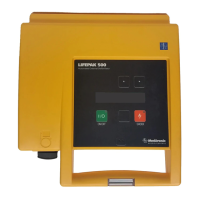
LIFEPAK 500 automated external defibrillator Troubleshooting
8-2
Fault Codes
The LIFEPAK 500 AED logs a fault code whenever an internal program or
process fails to execute properly. Fault codes are grouped into major (8000 and
above) and minor categories. The AED Fault Code Log stores the first 5 major
and first 30 minor faults. Any fault codes in excess of these limits are not
recorded. Fault codes rarely occur during routine AED use and should be
investigated thoroughly by qualified personnel before an AED is returned to
active service. Refer to the Fault Code Table for one or more recommended
Corrective Action Codes (CAC) to address each specific fault.
Note: Record the code(s), the date(s), and time(s) of occurrence for any fault
code(s), then Clear the Fault Code(s). Check for a recurrence of any fault
code(s). Always complete the Performance Inspection Procedure (PIP) after
encountering and clearing any fault code(s).
Fault codes stored in the Fault Code Log may not necessarily indicate a
permanent error. Fault codes can indicate transient electromagnetic interference
(EMI) or electrostatic discharge (ESD). If you suspect transient EMI or ESD as
the source of a fault, Clear Fault Codes(s), then shut down and restart the AED
(it may be necessary to do this twice for 91XX codes). If the fault code does not
recur, it may have been the result of EMI or ESD.



 To Next Page