3. Description of the QABrowser
Real-time Display and Waveforms
2012-10/4.3A
67
Barracuda & QABrowser Reference Manual
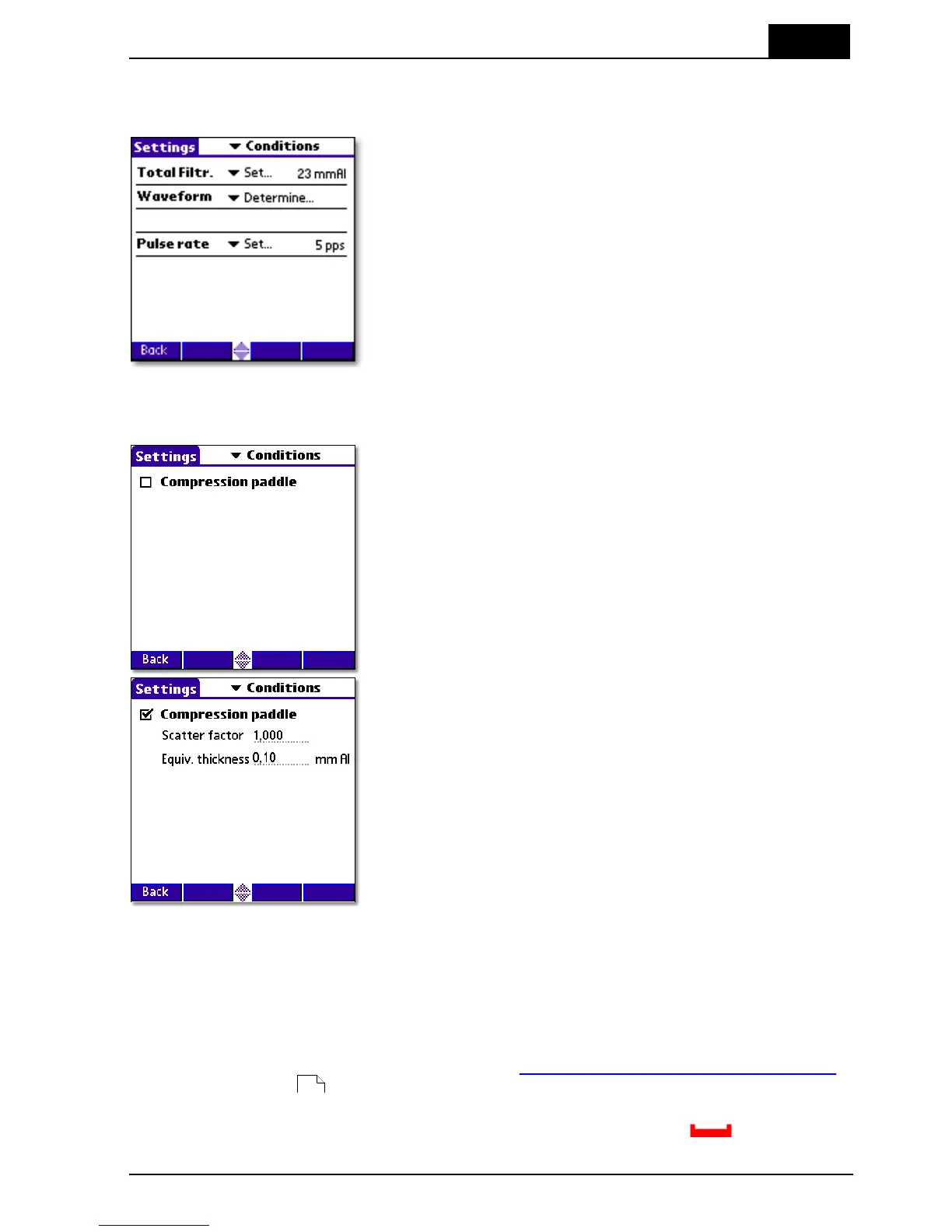
Conditions - Pulse rate
Conditions - Pulse rate
If a pulsed mode is used, like pulsed fluoroscopy or
pulsed radiography (cine) the pulse rate can be
specified in pulses per second (same as Hz). This
allows you to get a dose/pulse reading even if the
detector used (e.g. ion chamber) is too slow for the
Barracuda electrometer to detect the pulses. A
solid-state detector, like the R100, is however fast
enough to detect the frequency even for very low-level
signals.
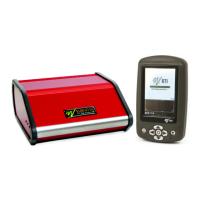
Conditions - Compression paddle
For mammography, it is sometimes easier to do
measurements with the compression paddle in the field.
The compression paddle will however normally affect
the Barracuda kV and dose reading. With this check
box, all the measured values (kV, dose and HVL) will be
corrected according to what the user has selected. The
default setting the first time you start the software is
without the compression paddle in the field.
When selected you will see the settings for Scatter
factor and Equivalent thickness. The thickness is given
in mm Al, if you do not know, ask the manufacturer or
make a comparison with Aluminium filters. When this
option is active, an indicator on the RTD screen
indicates that this feature is on.
If an ion chamber is positioned just below the compression
paddle, the measured dose will rise, because of side scattering
from the compression paddle material. The effect of this is
depending on the ion chambers angular dependence. Since the
MPD is almost insensitive to this, you can put a number here to
compare readings from the MPD with readings from an ion
chamber. See also section Average Glandular Dose, AGD (MGD)
.
When this is activated a red compression paddle indicator will
show in the top right corner of the RTD screen ( ).


 To Next Page