© 2008 Siemens Energy & Automation, Inc. All Rights Reserved.
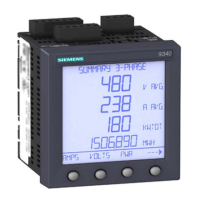
ACCESS 9340 and 9360 Meters PMCM-9340D-0208
Chapter 6—Basic Alarms 2/2008
EN–84
020 Under Value Alarm
If the test register value is below the setpoint long enough to satisfy the
pickup delay period, the alarm condition will be true. When the value in
the test register rises above the dropout setpoint long enough to satisfy
the dropout delay period, the alarm will dropout. Pickup and dropout
setpoints are positive, delays are in seconds.
021 Under Power Alarm
If the absolute value in the test register is below the setpoint long
enough to satisfy the pickup delay period, the alarm condition will be
true. When the absolute value in the test register rises above the
dropout setpoint long enough to satisfy the dropout delay period, the
alarm will dropout. Pickup and dropout setpoints are positive, delays
are in seconds.
051 Phase Reversal
The phase reversal alarm will occur whenever the phase voltage
waveform rotation differs from the default phase rotation. The ABC
phase rotation is assumed to be normal. If a CBA phase rotation is
normal, the user should reprogram the meter’s phase rotation ABC to
CBA phase rotation. The pickup and dropout setpoints and delays for
phase reversal do not apply.
052 Phase Loss, Voltage
The phase loss voltage alarm will occur when any one or two phase
voltages (but not all) fall to the pickup value and remain at or below the
pickup value long enough to satisfy the specified pickup delay. When all
of the phases remain at or above the dropout value for the dropout
delay period, or when all of the phases drop below the specified phase
loss pickup value, the alarm will dropout. Pickup and dropout setpoints
are positive, delays are in seconds.
053 Phase Loss, Current
The phase loss current alarm will occur when any one or two phase
currents (but not all) fall to the pickup value and remain at or below the
pickup value long enough to satisfy the specified pickup delay. When all
of the phases remain at or above the dropout value for the dropout
delay period, or when all of the phases drop below the specified phase
loss pickup value, the alarm will dropout. Pickup and dropout setpoints
are positive, delays are in seconds.
054 Leading Power Factor
The leading power factor alarm will occur when the test register value
becomes more leading than the pickup setpoint (such as closer to
0.010) and remains more leading long enough to satisfy the pickup
delay period. When the value becomes equal to or less leading than the
dropout setpoint, that is 1.000, and remains less leading for the dropout
delay period, the alarm will dropout. Both the pickup setpoint and the
dropout setpoint must be positive values representing leading power
factor. Enter setpoints as integer values representing power factor in
thousandths. For example, to define a dropout setpoint of 0.5, enter
500. Delays are in seconds.
055 Lagging Power Factor
The lagging power factor alarm will occur when the test register value
becomes more lagging than the pickup setpoint (such as closer to –
0.010) and remains more lagging long enough to satisfy the pickup
delay period. When the value becomes equal to or less lagging than the
dropout setpoint and remains less lagging for the dropout delay period,
the alarm will dropout. Both the pickup setpoint and the dropout
setpoint must be positive values representing lagging power factor.
Enter setpoints as integer values representing power factor in
thousandths. For example, to define a dropout setpoint of –0.5, enter
500. Delays are in seconds.
Table 6–5: Alarm Types
Type Description Operation


 To Next Page
 Loading...