SIMPRO-100
Settings Calculation
4
PRIM-2400C 61
The SIMPRO-100 Relay provides temperature
alarms and trips using the RTD temperature
measurements and the alarm and trip
temperature settings in Table 4.26 on page 60.
The temperature setting range is dependent on
the Temperature Preference setting so you can
enter your alarm and trip temperatures in degrees
Celsius or degrees Fahrenheit.
The relay issues a winding temperature alarm if
any of the healthy winding RTDs (RTD Location
setting equals WDG) indicate a temperature
greater than its RTD Alarm Temperature setting.
The relay issues a winding temperature trip if one
or two of the healthy winding RTDs indicate a
temperature greater than their RTD Trip
Temperature settings. Two winding RTDs must
indicate excessive temperature when the Enable
Winding Trip Voting setting equals Y. Only one
excessive temperature indication is required if
Winding Trip Voting is not enabled. Bearing Trip
Voting works similarly.
The alarm and trip temperature settings for
Bearing, Ambient, and Other RTD types function
similarly except that trip voting is not available for
Ambient and Other RTDs.
To disable any of the temperature alarm or trip
functions, set the appropriate temperature setting
to OFF.
Only healthy RTDs can contribute temperatures
to the alarm and trip functions. The relay includes
specific logic to indicate if RTD, leads are shorted
or open.
When you have connected an ambient
temperature sensing RTD and set trip
temperatures for one or more winding RTDs, the
relay gives you the option to enable RTD thermal
model biasing. When you enable RTD biasing,
the relay:
• Calculates RTD% Thermal Capacity and
adds the value to the Thermal Meter values.
• Automatically reduces the winding RTD trip
temperatures and thermal element trip
threshold if ambient temperature rises above
40°C.
• Provides an RTD Bias Alarm if the winding
temperature exceeds 60°C rise over ambient
and the RTD % Thermal Capacity exceeds
the thermal element % Thermal Capacity by
more than 10%.
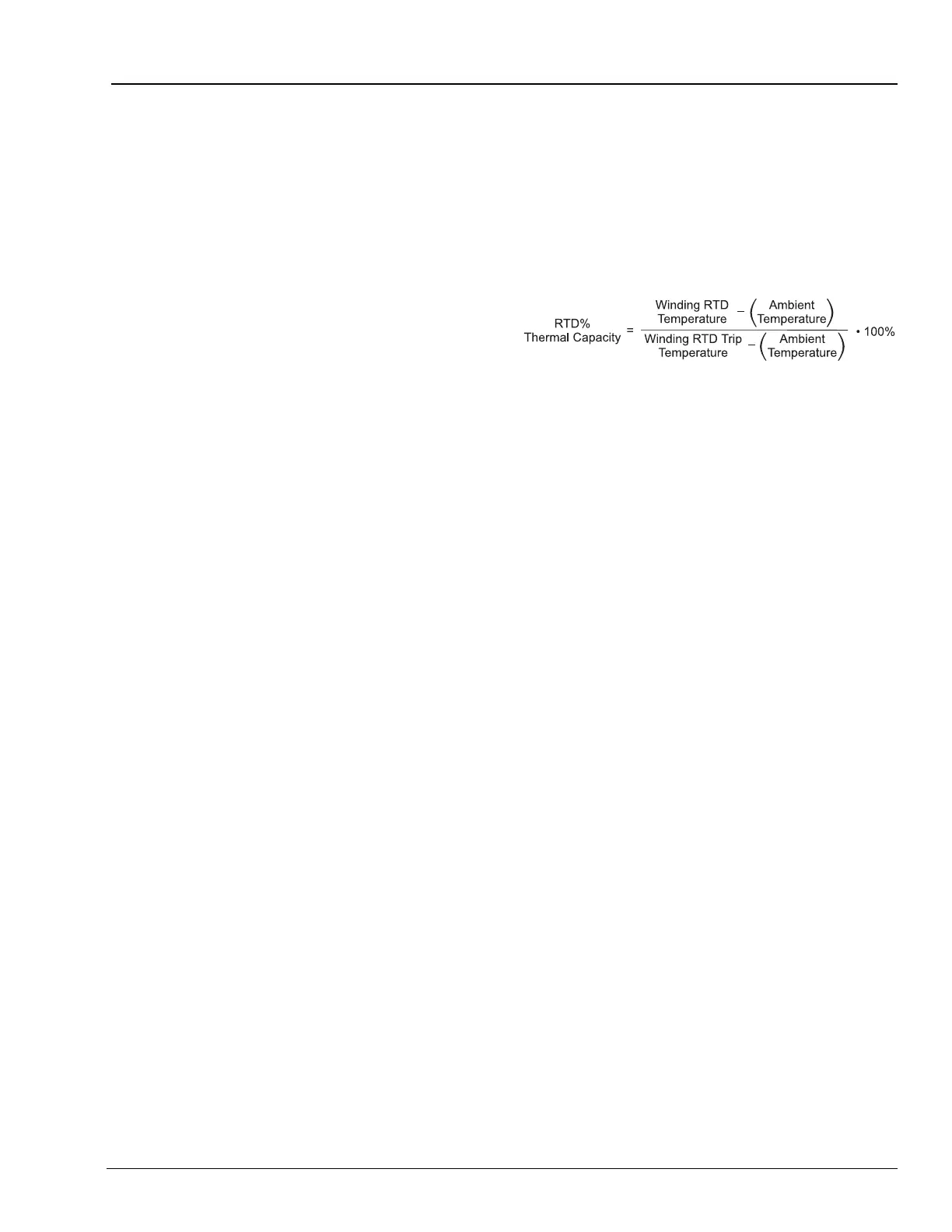
The relay calculates RTD % Thermal Capacity
using Equation 4.5:
Equation 4.5
As ambient temperature rises, the motor’s ability
to shed heat to the surroundings is reduced and
internal temperatures rise. To preserve insulation
life, NEMA standards suggest a 1°C reduction in
RTD trip temperature for each 1°C rise in ambient
temperature over 40°C. When you enable RTD
biasing, the SIMPRO-100 Relay automatically
reduces the RTD trip temperatures for all winding
RTDs when ambient temperature is above 40°C.
The relay reduces the trip temperatures by 1°C
for each degree rise in ambient temperature over
40°C.
Finally, when you enable RTD biasing, the relay
provides an RTD Bias Alarm when the RTD %
Thermal Capacity exceeds the thermal element
% Thermal capacity by more than 10 percentage
points while the winding temperature rise is
higher than 60°C over ambient. This alarm can be
a useful indicator that the motor has lost coolant
flow or that the winding RTD trip temperature is
conservatively low.
For all the RTD thermal capacity and bias
calculations described above, the relay uses the
winding RTD whose measured temperature is
closest to its trip value.
Table 4.27 on page 62 lists the RTD resistance
versus temperature for the four supported RTD
types.



 To Next Page