EasyManua.ls Logo

Solid State Logic Matrix2 Delta User Manual

Solid State Logic Matrix2 Delta
180 pages
To Next Page IconTo Next Page
To Previous Page IconTo Previous Page
Page #30 background image
STEP 5: Global Control of your DAW
In this step in the tutorial we are going to concentrate on global control of the DAW, leaving in-channel controls to Step 6.


control surface

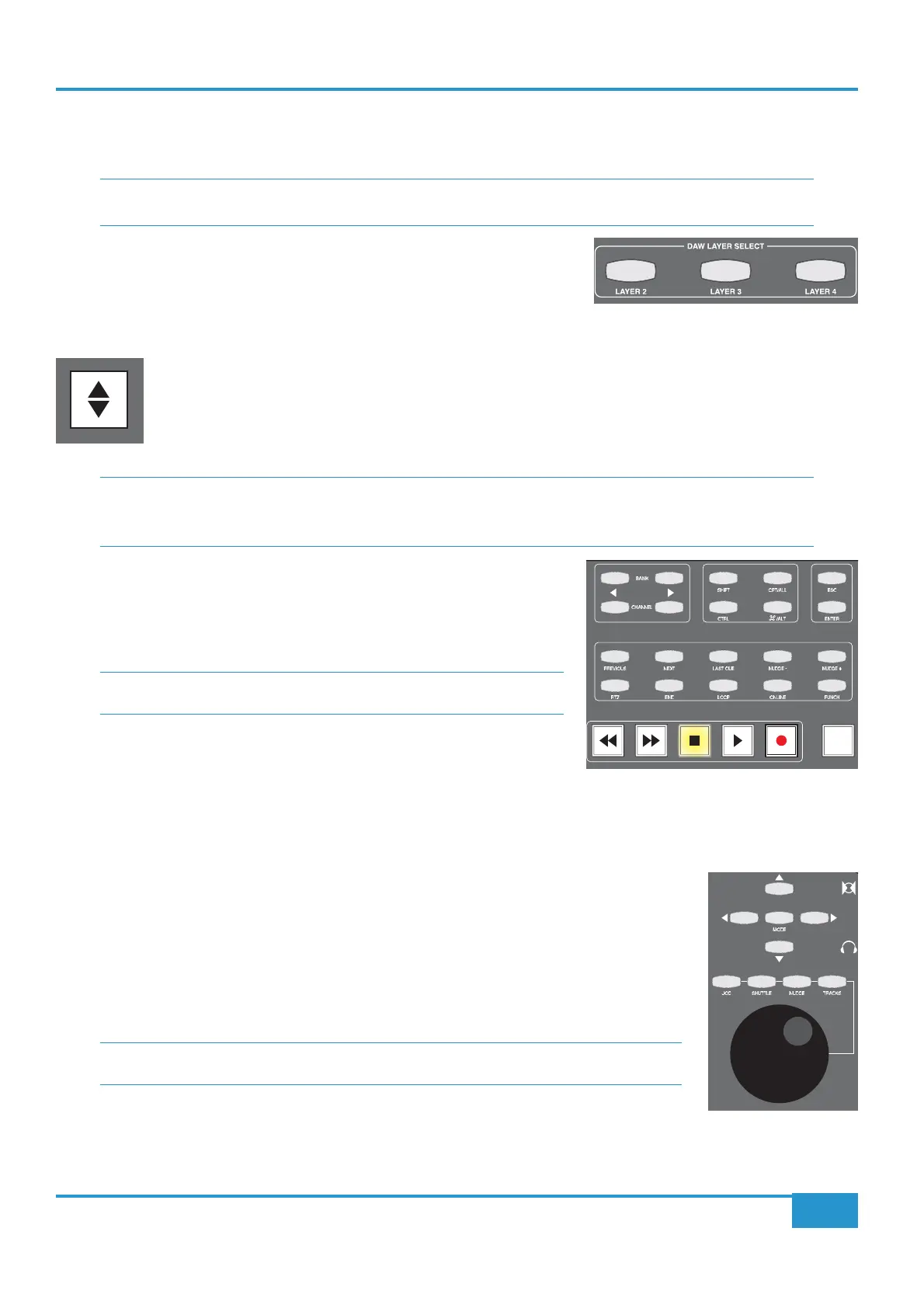
³ Find the
DAW LAYER SELECT buttons, located in the centre section, below

DAW. The selected button lights to indicate that it is active. Layer 1 is active
when none of the buttons are lit. If you wish to use Layer 1 and another layer
is selected, press the lit button to return to Layer 1.
³ Press the Focus button, located immediately below the Master Channel in the centre section. It should now
be unlit, indicating that you are now in DAW Focus mode. The console is now focussed on controlling the
signals inside the DAW rather than the analogue signals coming through the desk. You will notice that any
channel names you have created in the DAW now appear in the digital scribble strip that runs through the
middle of the desk, possibly in a shortened form.



³ Find the main Matrix transport controls, located at the bottom of the centre
ARTIST

buttons. These give you access to some of the more complex DAW controls.
If you operate any of the transport controls you will notice that they now
control the transport of your DAW.

ARTIST

³ 
BANK and
CHANNEL keys. These buttons scroll the DAW tracks through the Matrix
channels.
BANK scrolls the tracks 16 at a time, whereas CHANNEL scrolls
them one at a time. These buttons allow the 16 Matrix channels to control more than 16 DAW tracks. Make sure that you
leave the DAW track which is being fed from Channel Out 16 (which you named
Test) in one of the channel strips (not
necessarily channel 16).
³ To the right of the transport controls is a large black wheel with nine buttons above it. Ensure that
the cursor key
MODE button (towards the top, surrounded by arrow keys) is unlit. If it is lit or

the lit button to deselect it.
³
Refer to your DAW control surface documentation to determine the default function of the Scroll Wheel
and Cursor keys. Note that when controlling Pro Tools the Jog Wheel will scroll the timeline forwards and
backwards - this is not a normal Pro Tools function
.
 

Chapter 2 - Getting Started
22
Matrix
2
Owner’s Manual

Table of Contents

Question and Answer IconNeed help?

Do you have a question about the Solid State Logic Matrix2 Delta and is the answer not in the manual?

Solid State Logic Matrix2 Delta Specifications

General IconGeneral
Faders16
TalkbackYes
Computer ConnectivityEthernet
Channels40
EQ4-band parametric per channel
Aux Sends8
Busses/Groups4 stereo
Inserts16 channel inserts
SoftwareSSL Delta Control
PowerInternal PSU
Inputs - Line16 line inputs
Outputs - Main2 (stereo)
Control SurfaceYes
AutomationDAW Automation via Delta Control
ConnectivityEthernet
TypeAnalog/Digital Hybrid Mixer

Summary

Chapter 1 - Installation and Setup

Matrix Rear Panel Connections

Details the audio and digital connections on the Matrix rear panel, including XLR, DB25, and digital I/O.

Data Connections

Explains network and USB connections between the Matrix and a computer for control and data transfer.

Matrix Network Connection Examples

Illustrates direct connection and router/switch connection methods for network setup.

Software Installation and Configuration

Guides through installing Matrix Remote, ipMIDI, and SSL Delta Control plugins for Mac and PC.

Chapter 2 - Getting Started

Important Concepts

Introduces fundamental operating principles of the Matrix console, including Master Channel and Focus Modes.

Focus Modes

Explains Analogue Focus and DAW Focus modes and their effect on channel controls and metering.

STEP 1: Bringing Signal into the Channel

A step-by-step guide to bringing an audio signal into a Matrix channel via D-connectors.

STEP 5: Global Control of your DAW

Details how to use Matrix transport controls and DAW LAYER SELECT buttons for DAW operation.

STEP 11: Inserting Signal Processing into the Channel

Explains how to insert outboard signal processing using the Insert Matrix via the Matrix Remote.

Chapter 3 - Analogue Signal Flow

Introduction to Focus Modes

Explains the two operational modes, Analogue Focus and DAW Focus, and their effects on the console.

The Master Channel Strip

Describes the Master Channel strip and its role in accessing and controlling channel strip functions.

The Digital Scribble Strip

Details the function and display of the digital scribble strip in Analogue and DAW Focus modes.

Monitoring

Covers control room monitor controls, including volume, DIM, CUT, and source selection.

SSL Soft Keys

Explains the function and assignment of SSL soft keys for accessing various console settings.

Matrix Automation

Introduces the three methods of analogue automation: Delta Control, MIDI, and A-FADA.

Chapter 4 - The Matrix Remote

Introduction to the Matrix Remote

Overview of the Matrix Remote software and its six main tabs for console configuration.

The Projects Tab

Explains how to manage projects and titles, store session notes, and navigate project files.

Managing Projects

Details creating, backing up, restoring, renaming, and deleting projects within the Matrix Remote.

The Total Recall Tab

Covers storing and recalling console settings, taking, naming, and deleting TR snapshots.

The Channels Tab

Explains how to label analogue channels and manage channel name presets.

The Insert Matrix Tab

Guides on routing external signal processing, naming devices, and creating chains.

Chapter 5 - DAW Control

Introduction

Explains Matrix's DAW control capabilities using HUI, MCU, and CC protocols.

Layers

Describes how Matrix connects to DAWs via virtual layers and assigns profiles.

Focus Modes

Details Analogue Focus and DAW Focus modes and their impact on console operation.

DAW Track Control

Explains control of DAW track parameters using the Matrix channel strip sections.

SEL Key Modes

Details modes like Default, Rec Arm, Plug-in, Param, and Auto Set for DAW control.

Transport Controls

Covers the operation of Matrix's dedicated transport controls for DAW playback.

Standard Profile Soft Key Assignments

Lists the default assignments for Pro Tools soft keys on the Matrix console.

Chapter 6 - DAW and CC Configuration

Matrix Console Layer Selection

Explains how to select the active DAW layer on the Matrix console.

Assigning DAW Layers

Guides on selecting and assigning DAW Profiles for different layers and protocols.

Soft Keys

Details the soft key areas, DAW control protocols, and available soft key sets.

Programming Soft Keys

Explains how to program soft keys, save assignments, and manage soft key sets.

Assigning QWERTY Keystrokes

Details how to assign QWERTY keyboard shortcuts to Matrix soft keys.

Configuring CC Layers

Explains how to map CC (Continuous Controller) messages for MIDI devices.

Related product manuals