196 Chapter 11: Differential Equation Graphing
11DIFFEQ.DOC TI-89/TI-92 Plus: Differential Equation (English) Susan Gullord Revised: 02/23/01 11:04 AM Printed: 02/23/01 2:15 PM Page 196 of 26
For a general solution, use the following syntax. For a particular
solution, refer to Appendix A.
deSolve(
1stOr2ndOrderODE
,
independentVar
,
dependentVar
)
Using the logistic 1st-order differential equation from the example on
page 176, find the general solution for
y
with respect to
t
.
deSolve(y' = 1/1000 y
ù
(100
ì
y),t,y)
Before using
deSolve()
, clear any existing
t
and
y
variables.
Otherwise, an error occurs.
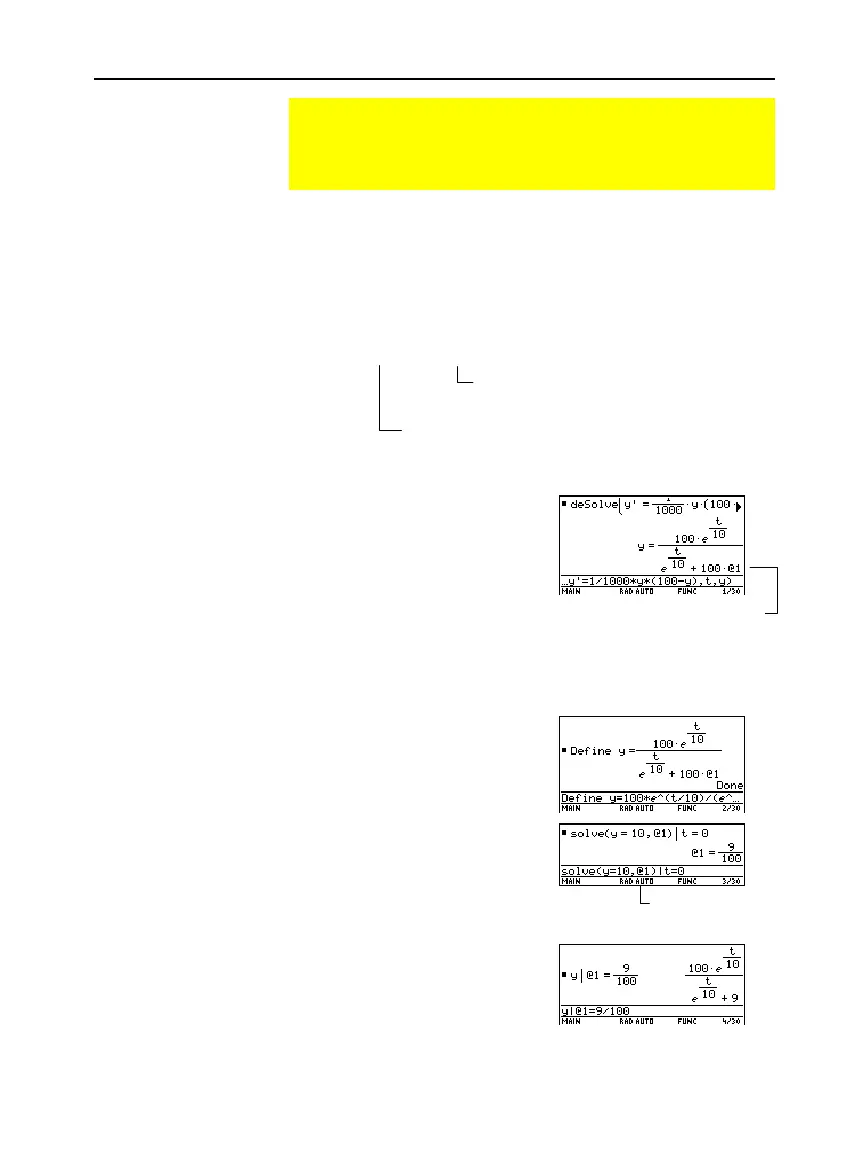
1. In the Home screen
TI
-
89
:
"
TI
-
92 Plus:
¥
"
use
deSolve()
to find the
general solution.
2. Use the solution to define a function.
a. Press
C
to highlight the solution in the history area. Then
press
¸
to autopaste it into the entry line.
b. Insert the
Define
instruction at the
beginning of the line.
Then press
¸
.
3. For an initial condition
y=10
with
t=0
, use
solve()
to find
the
@1
constant.
4. Evaluate the general solution
(
y
) with the constant
@1=9/100
to obtain the
particular solution shown.
You can also use
deSolve()
to solve this problem directly. Enter:
deSolve(y' = 1/1000 y
ù
(100
ì
y) and y(0)=10,t,y)
Example of the deSolve(
) Function
The
deSolve()
function lets you solve many 1st- and 2nd-
order ordinary differential equations exactly.
Example
Tip: For maximum
accuracy, use 1/1000
instead of .001. A floating-
point number can introduce
round-off errors.
Note: This example does
not involve graphing, so you
can use any
Graph
mode.
Tip: Press
2A
to move to
the beginning of the entry
line.
Note: If you got a different
constant (@2, etc.), solve
for that constant.
For @, type
TI-89:
¥
§
TI-92 Plus:
2
R
@1 represents a constant. You may
get a different constant (@2, etc.).
For ', type
2
È
.
Do not use implied multiplication between the
variable and parentheses. If you do, it will be
treated as a function call.


 To Next Page
 Loading...