78 Chapter 3: Symbolic Manipulation
03SYMBOL.DOC TI-89/TI-92 Plus: Symbolic Manipulation (English) Susan Gullord Revised: 02/23/01 10:52 AM Printed: 02/23/01 2:12 PM Page 78 of 24
Multi-statement user-defined functions should be used as an
argument for numeric functions (such as
nDeriv
and
nInt
) only.
In some cases, you may be able to create an equivalent single-
statement function. For example, consider a piecewise function with
two pieces.
When: Use expression:
x < 0
ë
x
x
‚
0 5 cos(x)
¦
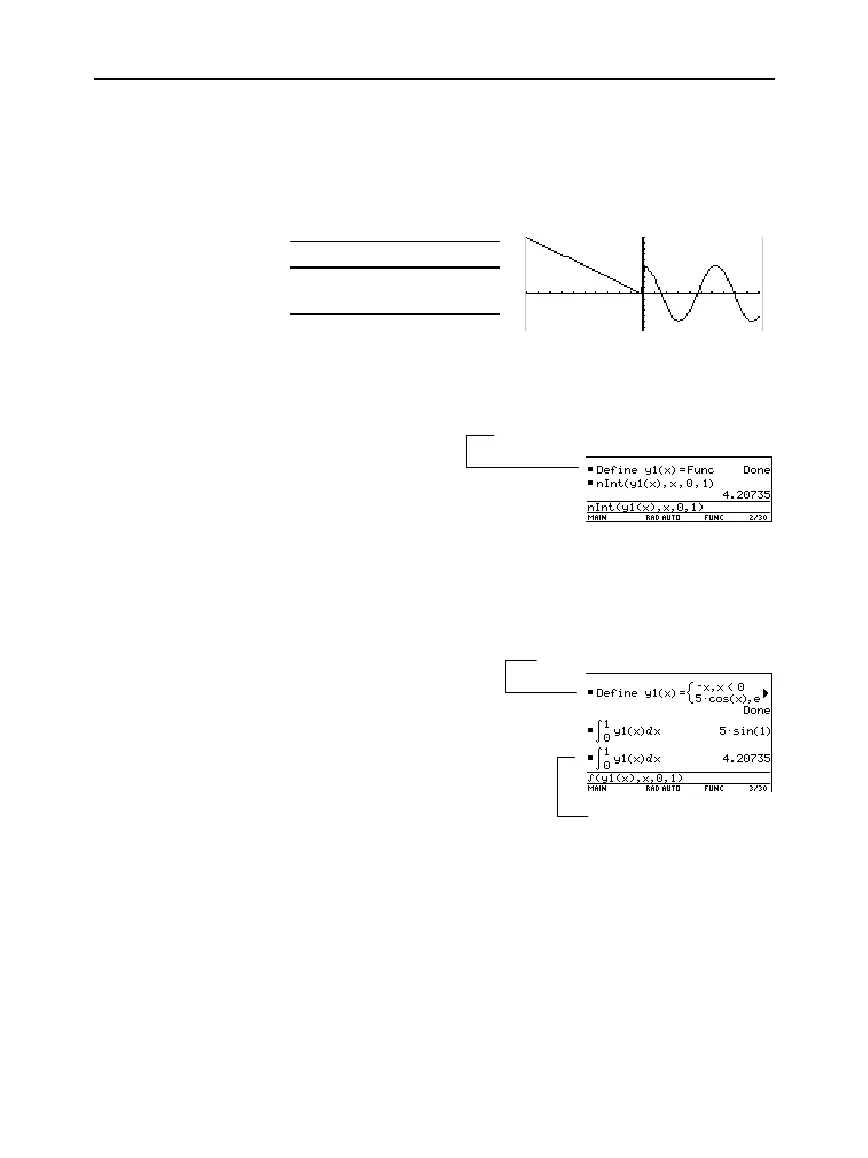
If you were to create a multi-statement user-defined function with
the form:
Func
If x<0 Then
Return
ë
x
Else
Return 5cos(x)
EndIf
EndFunc
Then numerically
integrate
y1(x)
with
respect to
x
.
¦
Create an equivalent single-statement user-defined function.
Use the
TI
-
89 / TI
-
92 Plus’s
built-in
when
function.
Then integrate
y1(x)
with respect to
x
.
Multi-Statement vs.
Single-Statement
Functions
Tip: You can use your
computer keyboard to type
lengthy text and then use
TI-GRAPH LINK to
send it to
the
TI
-
89 / TI 92
-
Plus.
See
Chapter 18 for more
information.
Tip: To select
nInt
from the
Calc
toolbar menu, press
…
B:nInt.
Tip: To select
‰
from the
Calc
toolbar menu, press
…
2
(or press
2
<
on the
keyboard).
Define y1(x)=Func:If x<0 Then: ... :EndFunc
Define y1(x)=when(x<0,
ë
x, 5cos(x))
Press
¥
¸
for a
floating-point result.


 To Next Page
 Loading...