6 THE BASICS OF SUBTRACTIVE
SYNTHESIS
Of all forms of sound synthesis, subtractive synthesis is one of the oldest and still
certainly one of the most employed today. It is this method that was developed toward
the end of the 60’s on analog synthesizers like the Bob Moog’s ones, ARP, Yamaha,
Buchla, Oberheim, Sequential Circuits (Prophet series), Roland, Korg (MS and PS series)
and many others. This concept of synthesis is still used on most current digital
synthesizers, complementing sample reading or wave tables, which progressively
replaced the analog oscillators of the first synthesizers in the 80’s. The 1971 Bob Moog’s
monosynth, or even your own Mini V, is among the best illustrations of the enormous
possibilities of subtractive synthesis.
6.1 THE THREE MAIN ELEMENTS
6.1.1 The oscillator, or VCO
The oscillator (Voltage Controlled Oscillator) is the starting module (with the noise
module which is often classed among the oscillators) for the creation of a sound on an
analog system.
It will generate the initial sound signal. We can think of the oscillator like a violin string
that once stroked or plucked, vibrates to create its sound.
The oscillator settings
The main oscillator settings are:
The pitch, determined by the oscillation frequency. You can set the frequency of
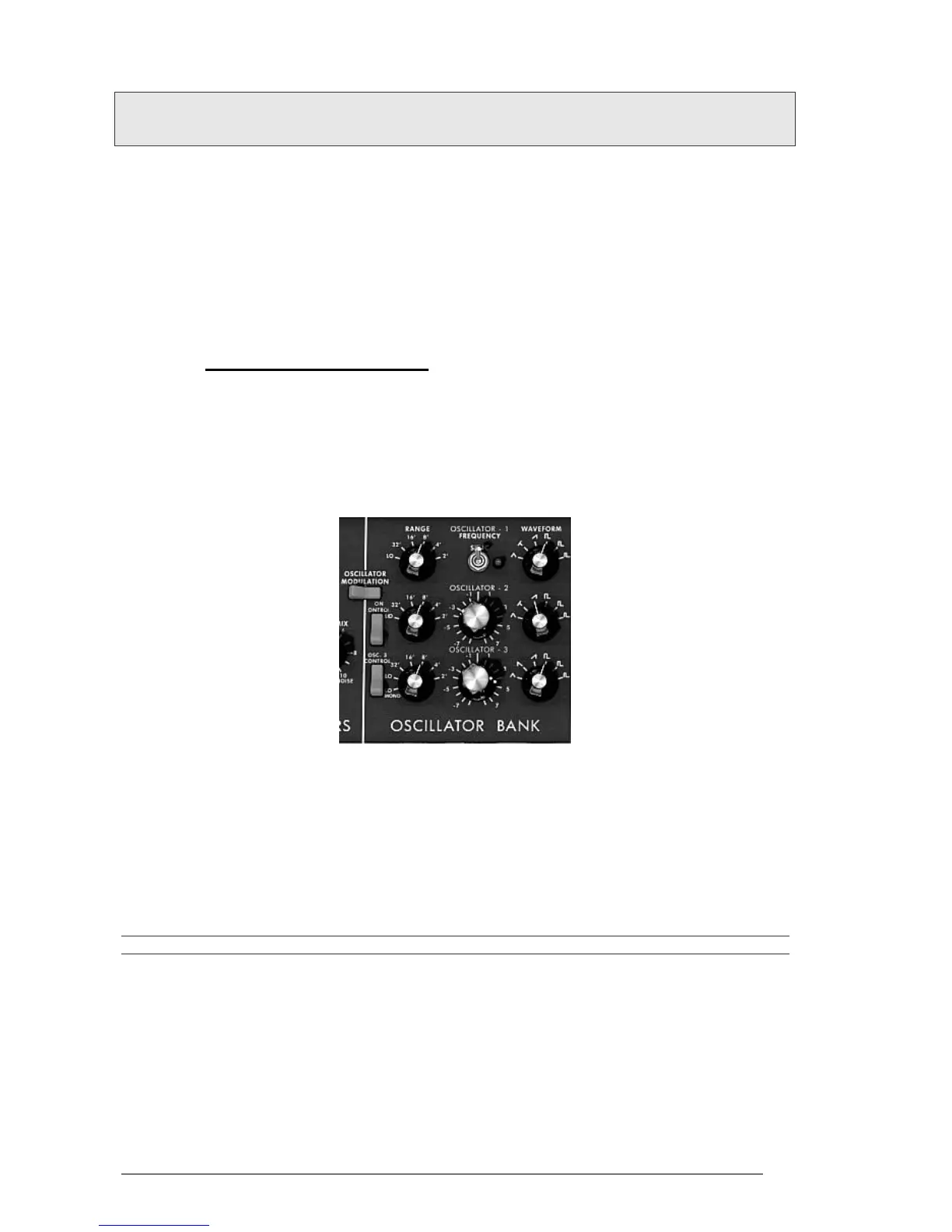
the oscillator with 2 controllers: first, the “RANGE” selector which determines the
fundamental frequency – it is expressed in feet: Low, 32, 16, 8, 4, 2; the highest
number (32) brings the deepest tone, inversely, the smallest number (2) brings
the highest tone. Secondly, the detune setting (“FREQUENCY”) lets you tune the
oscillator more precisely.
On the Mini V, the ”RANGE” and “FREQUENCY” buttons are placed in the “OSCILLATOR BANK” panel.
The waveform, which determines the harmonic richness of the audio signal. On
the Mini V, 6 waveforms are available:
o triangle
o saw-triangle
o sawtooth
o square (duty cycle: 48%)
o wide rectangular (duty cycle: 29%)
o narrow rectangular (duty cycle: 17%)



 To Next Page