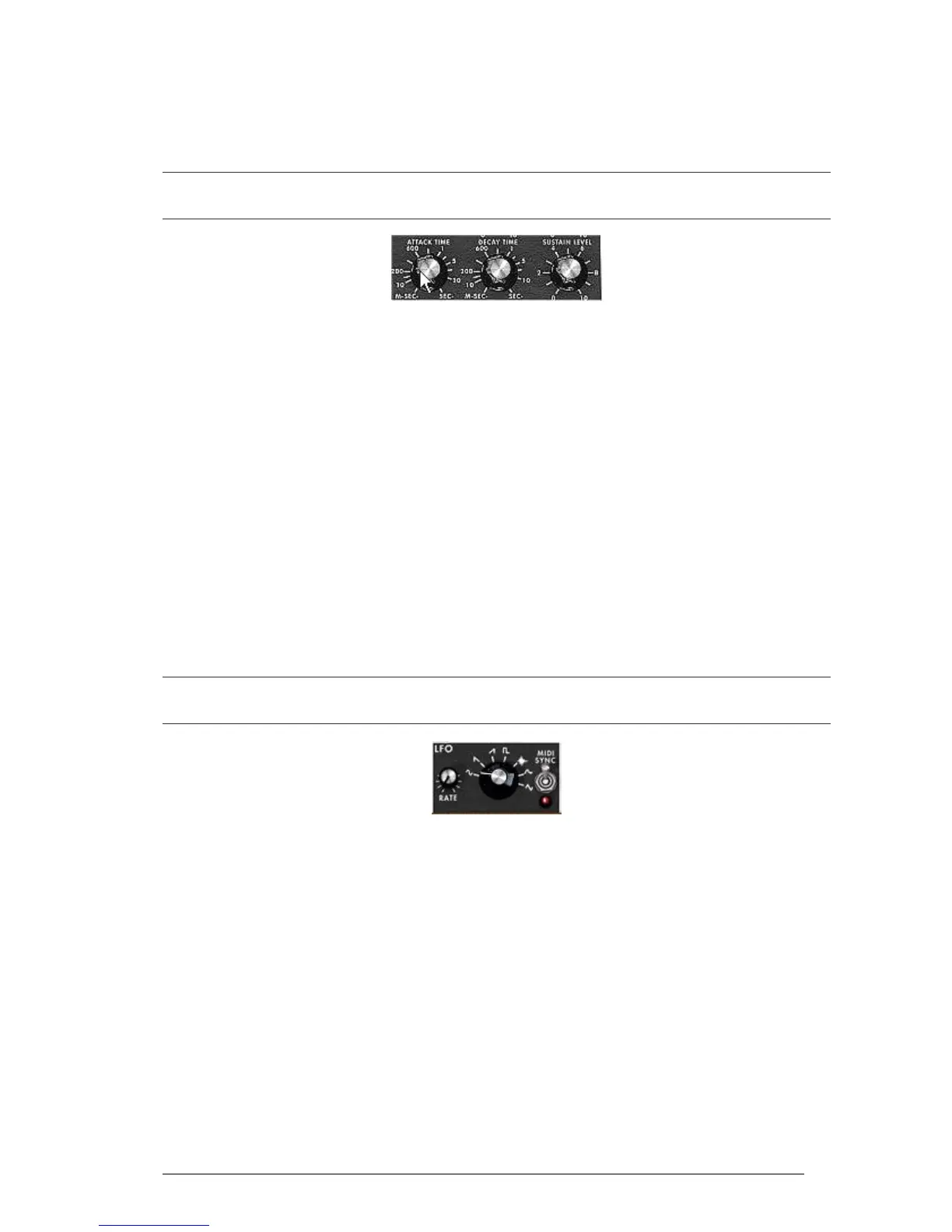
The Sustain (hold) is the maximum volume level that the sound will reach after the
decay is complete.
The Release is the time that the sound will take to fade once the key has been released.
The two envelopes of the Mini V (Contour) contain only 3 parameters: Attack, Decay and Sustain. You can get
the Release thanks to the “Decay” button located on top of the modulation wheels. The release time is thus
identical to the decay time of the envelope.
The Mini V ADS(R) envelope
6.2.3 The low frequency oscillator
The LFO (Low Frequency Oscillator – or LFO on the Mini V) possesses more or less the
same characteristics of the classic oscillator but it only produces frequencies lower than
20 Hz. In other words, you won’t hear the pitch of its sound.
It will create a cyclic modulation on the setting to which it is connected.
For example:
If the sine waveform of an LFO modulates the volume of an amplifier, the sound
will increase in volume then disappear in a varying manner following the speed
(the frequency) of this LFO. This will produce a tremolo effect.
A sine waveform on an LFO modulating the frequency of an oscillator would
produce a vibrato effect.
With an LFO sinusoid wave modulating the cut-off frequency of a slightly resonant
low-pass filter, you will obtain a “wah wah” effect.
The original model does not contain any dedicated LFO. You can use the third oscillator in low frequency (“Lo”
position of the “Range” selector) to modulate the filter and oscillators’ frequency.
The signal of the third oscillator can be mixed with the noise signal to create some random modulations.
The LFO module of the Mini V
Now to finish, here is the diagram of a complete synthesis voice on the Mini V containing:
3 oscillators (VCO)
1 noise module
1 mixer (mixing of the 3 VCO and the noise generator)
1 low-pass filter (VCF)
1 amplifier (VCA)
2 envelopes (one for the filter and the other for the VCA)
1 LFO


 To Next Page