w
C
::)
+
I-
::J
0
J--+-01--+--i---If---+--+--+
.....
a..
:iE
«
TIME
(Msec)
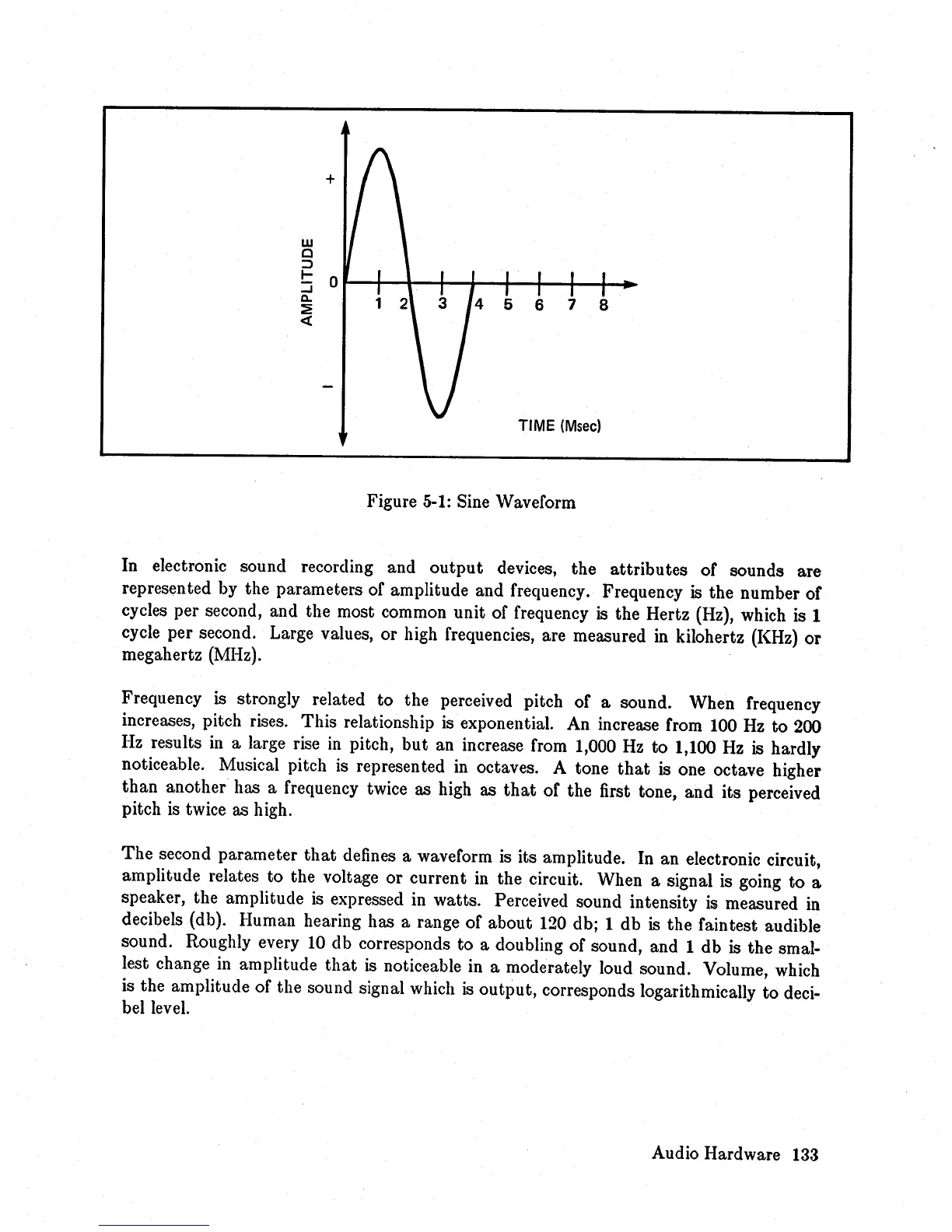
Figure
5-1:
Sine Waveform
In electronic sound recording and
output
devices, the attributes
of
sounds are
represented by the parameters of amplitude and frequency. Frequency
is
the number of
cycles per second, and the most common unit of frequency
is
the Hertz (Hz), which is 1
cycle per second. Large values, or high frequencies, are measured in kilohertz (KHz) or
megahertz (MHz).
Frequency is strongly related to the perceived pitch of a sound. When frequency
increases, pitch rises. This relationship is exponential. An increase from 100
Hz
to
200
Hz
results
in
a large rise
in
pitch,
but
an increase from 1,000
Hz
to 1,100
Hz
is hardly
noticeable. Musical pitch is represented
in
octaves. A tone
that
is one octave higher
than another has a frequency twice as high as
that
of the first tone, and its perceived
pitch is twice as high.
The
second parameter
that
defines a waveform is its amplitude. In an electronic circuit,
amplitude relates to the voltage or current
in
the circuit. When a signal is going
to
a
speaker, the amplitude
is
expressed
in
watts. Perceived sound intensity is measured
in
decibels (db). Human hearing has a range of about 120 db; 1 db is the faintest audible
sound. Roughly every
10
db corresponds to a doubling of sound, and 1
db
is the smal-
lest change
in
amplitude
that
is noticeable
in
a moderately loud sound. Volume, which
is the amplitude of the sound signal which
is
output, corresponds logarithmically to deci-
bel level.
Audio Hardware
133








 To Next Page