This same region of memory can be accessed by the bit-blitter. This means, for exam-
ple,
that
the user can store partial images
at
scattered areas of memory and
use
these
images for animation effects by rapidly replacing on-screen material while saving and res-
toring background images.
In
fact, the Amiga includes firmware support for display
definition and control as well as support for animated objects embedded within
playfields.
VCR
AND
DffiECT
CAMERA
INTERFACE
In addition
to
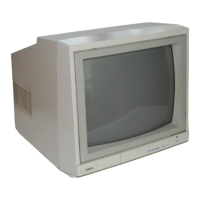
the connections for NTSC composite Amiga video and both digital and
analog RGB monitors, the system can be expanded
to
include a VCR or camera inter-
face. This system is capable of synchronizing with an external video source and replac-
ing the system background color with the external image. This allows for the develop-
ment of fully integrated video images with computer-generated graphics. Laser disk
input is accepted
in
the same manner.
PRIMARY
AND
SECONDARY
MEMORY
Primary memory
in
the Amiga consists of 256K bytes of ROM and 256K bytes of
RAM.
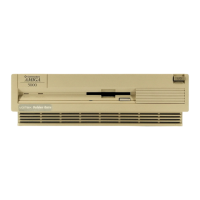
A RAM expansion cartridge is available as an option. Secondary memory
is
provided by
a built-in 3 1/2-inch floppy disk drive. Disks are SO-track, double-sided, and formatted
as
11
sectors per track,
512
bytes per sector (over 900,000 bytes per disk). A special util-
ity can read and write disk
files
compatible with the Apple II[tm]. In addition, the disk
controller can read and write 320/360K
IBM
PC[tm] formatted disks. External 3 1/2-
inch
or
5 1/4-inch disk drives can be added
to
the system through the expansion
connector.
PERIPHERALS
Circuitry for some of the peripherals resides on one of the custom chips; other chips han-
dle various signals not specifically assigned to any of the custom chips, including modem
controls, disk
status
sensing, disk motor and stepping controls, ROM enable, parallel
input/output
interface, and keyboard interface.
The
Amiga includes a standard RS-232-C serial port for external serial
input/output
devices.
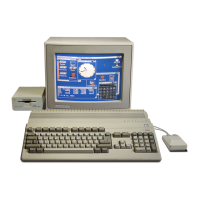
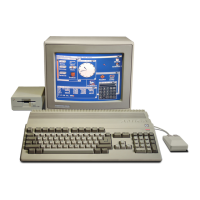
A detached, professional-quality keyboard
is
included
in
the base system. You can store
the keyboard beneath the system cabinet. For maximum flexibility, both key-down and
key-up signals are sent.
Introduction 5





 To Next Page